Neither one is simply better. Negative air is the foundation of a proper duct cleaning, because it keeps the system under suction so the dust leaves your home instead of drifting through it. A rotary brush (Rotobrush is the best-known brand) is one way to loosen debris while that suction runs. The real question is which agitation tool suits your duct material, and whether the crew keeps the system under negative pressure the whole time. This guide explains how the two relate, where each fits, and what to check before you book.
TL;DR
- Negative air describes how debris is captured: a powerful vacuum holds the system under negative pressure. A rotary brush describes how debris is loosened: a spinning brush scrubs the duct wall. They are not rivals so much as two parts of one job.
- Air whips and compressed air agitate gently. Brushes scrub harder. Both are normally paired with a vacuum.
- Flexible duct needs an assessment first. Industry guidance says it can be cleaned with negative air when its condition allows, and access openings go in nearby sheet metal, never in the flex itself.
- Evidence that duct cleaning improves health or air quality is thin, so book it for visible contamination, renovation dust, mould, pests or odours, not as a routine cure-all.
- Ask about NADCA certification, how the vacuum exhaust is handled, and whether you get before and after photos.
Table of Contents
- What each method actually is
- How they differ in practice
- Which method suits which duct system
- Can the two be combined?
- Does either method improve your air?
- What to check before you hire
- What this costs with Blue Brothers
- Our perspective
- Book a clean you can verify
- FAQ
- Sources
What each method actually is
The search term “rotobrush vs negative air” suggests two separate machines. In practice they describe different parts of the process.
Rotary brush cleaning. A motor-driven brush on a flexible shaft is fed into the duct. It spins and scrubs the metal walls while a vacuum pulls the loosened debris out. The manufacturer describes this as brushes scrubbing duct walls while a vacuum removes the debris.
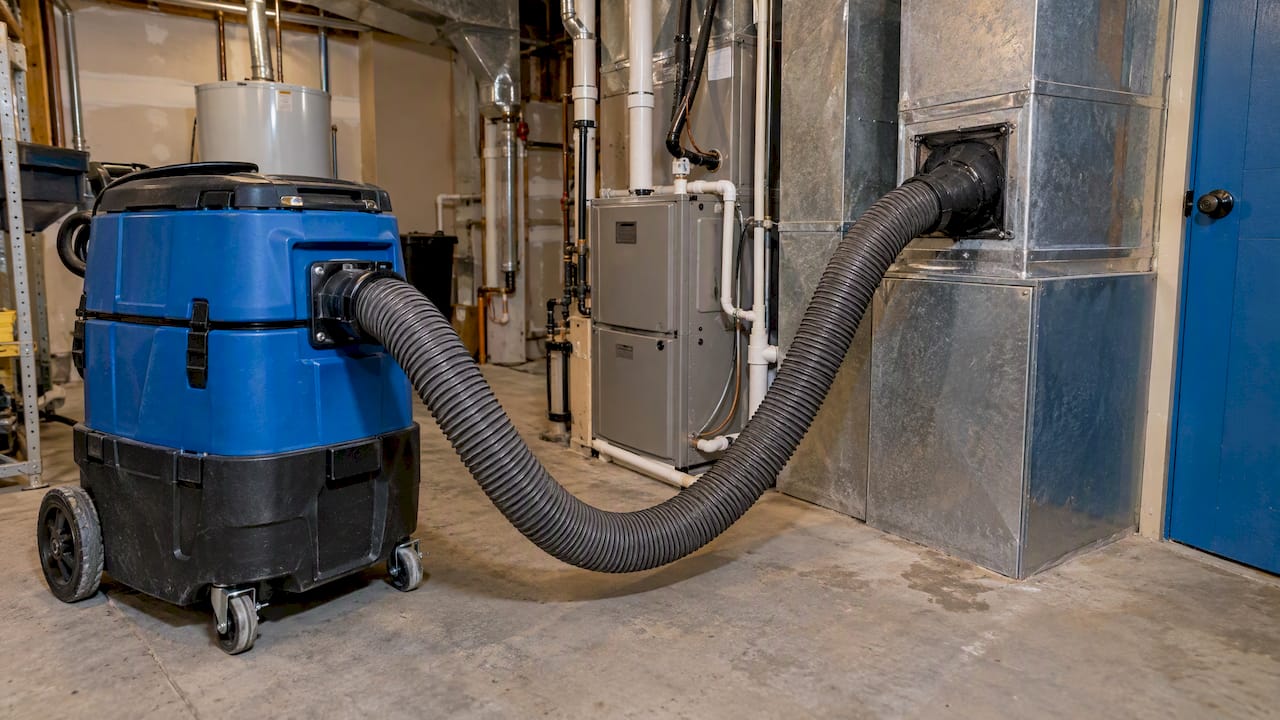
Negative air cleaning. The same source describes this approach as using compressed air and whips to agitate the debris, after which a vacuum creates negative pressure and pulls the debris toward it. A large truck-mounted or portable vacuum connects to the main trunk line. Every register and branch is sealed or worked in sequence so air always flows toward the vacuum.
So “negative air” is the pressure condition and the capture method. “Rotobrush” is a brand of rotary agitation tool. Crews who use brushes still run a vacuum; crews who use air whips also run a vacuum. What you are really choosing between is brush agitation and air-driven agitation, both under suction.

We cover the capture side in more detail in our guide on what to require for negative air duct cleaning.
How they differ in practice
| Factor | Rotary brush agitation | Air whip / compressed air agitation |
|---|---|---|
| How debris is loosened | Physical scrubbing by spinning bristles | Air energy and whipping action |
| Contact with duct wall | Direct, firm | Lighter, more intermittent |
| Best fit | Rigid sheet metal with caked-on dust or residue | Delicate surfaces, long runs, hard-to-reach branches |
| Capture | Vacuum required | Vacuum and negative pressure required |
| Main risk | Damage to liners, thin or damaged duct, if the wrong brush is used | Less effective on stubborn buildup |
| Result depends on | Brush type and operator skill | Airflow, whip placement, operator skill |
The table simplifies. Good crews carry several tools and switch between them as the duct changes. A main trunk of galvanized steel can take a firm brush. A branch that is crushed, lined or old may call for something gentler.
Why the vacuum matters more than the brush
The agitation tool gets the attention, but the vacuum decides whether dust ends up outside or in your living room. Research reviewed by the National Research Council Canada notes that duct cleaning, including vacuum collection devices, can become a source of indoor pollutants if exhaust air is not properly managed. That is why a truck-mounted unit venting outdoors, or a portable unit with true HEPA filtration, is worth asking about.
Which method suits which duct system
Rigid sheet metal ducts
Most Canadian homes with forced-air heating have galvanized steel trunks and branches. These handle either brushes or whips well. A brush is usually the more effective choice where dust has compacted or where kitchen or workshop residue has coated the walls. Negative pressure is non-negotiable in either case.
Our breakdown of rigid vs flexible duct explains how to tell what you have.
Flexible ducts
This is where the debate gets heated, and where the advice you read online often conflicts. Some marketing says negative air ruins flex duct. NADCA’s response is more measured. Its second vice president, Clint Orr, says technicians should assess flex duct before choosing a method and that it is misleading to claim flex ducts cannot be cleaned with negative air.
The same NADCA document gives practical rules:
- For stronger nylon flex duct, soft rotary brushes with negative air may be suitable.
- Other flex duct may be removed and contact-cleaned, or judged not suitable for cleaning at all.
- Service openings should not be cut into flexible ductwork. Access points are made in the adjacent sheet metal so negative air can be applied.
NADCA also states that a system with flex ductwork should be assessed and evaluated to set the cleaning protocol and scope of work. Age, durability and condition decide the method, not a blanket rule.
If a contractor refuses to look at your ducts first and quotes one method for everything, treat that as a warning sign.
Furnaces, coils, HRVs and dryer vents
A complete HVAC cleaning is more than ductwork. The return plenum, blower housing and coil area collect dirt too. These components are cleaned with different tools: hand brushes, specialized vacuums and coil-safe cleaners. Dryer vents are a separate job, handled with their own brushes and a vacuum, and they matter for fire safety because lint builds up fast.
Can the two be combined?
Yes, and that is how most professional jobs run. NADCA’s source removal approach, as described by contractors who follow it, places the system under negative pressure with a powerful vacuum while agitation devices (brushes, whips, or air tools) are inserted to dislodge debris so it travels to the vacuum. The tools differ, but the principle is the same.
A typical combined sequence looks like this:
- Inspect the system, including the furnace, return and any flex runs.
- Protect floors and seal or cover registers.
- Connect the vacuum and establish negative pressure.
- Work through the branches and trunk with the right agitation tool for each section.
- Clean the furnace blower and accessible components.
- Photograph the result and reseal any access points properly.
If someone tells you they only do “brush” or only “negative air”, ask what they mean. Brush-only without strong suction just moves dust around. Suction without agitation leaves caked debris behind.
Does either method improve your air?
Honest answer: the evidence is limited. The 2010 review by Z.M. Sultan for NRC Canada found insufficient evidence that duct cleaning improves indoor air quality, health, energy savings or HVAC performance, and in some studies pollutant levels after cleaning were higher than before. It also noted that the toxicity of sealants and biocidal products is unclear.
That does not mean cleaning is pointless. It means the reasons should be concrete:
- Visible mould growth in ducts or on system components.
- Rodent or insect infestation.
- Heavy dust or debris that is clogging the system or blowing out of registers.
- Construction or renovation dust that got into open returns. See our guides on post-renovation duct cleaning and the 30 to 60 minute rule for renovation dust.
- Smoke or persistent odour, where a purifier alone will not solve it. Our comparison of duct cleaning vs air purifiers helps you decide.
If you are not sure your ducts are dirty, start with our five DIY checks for dirty air ducts. On timing, a 3 to 5 year interval is a guide, not a deadline.
Also be careful with add-ons. Sanitizer or sealant applied to dirty ducts is a poor idea; our note on sanitizing air ducts explains why cleaning comes first.
What to check before you hire
The method debate is a distraction if the contractor is careless. These are the checks that matter.
Certification and assessment
Look for technicians certified by NADCA as an Air Systems Cleaning Specialist (ASCS). NADCA’s guidance points to certification and a pre-cleaning assessment of flex duct age, durability and condition as the basics. Ask who will actually be in your home and whether they hold the credential.
Scope
A proper job covers the supply and return ducts, the return plenum, the blower housing and the evaporator coil area where accessible. A quote that only mentions “vents” may mean wiping the registers.
Containment and exhaust
Ask where the vacuum exhausts and whether it is HEPA-filtered. Ask how registers and the furnace are protected. This directly addresses the pollutant risk the NRC review raised.
Documentation
Before and after photos are the industry’s standard way to show what was done. A guide on inspecting HVAC, attic and ducts first makes the same point for smoke odours: a contractor should be able to show you what they found and what they did, not just tell you. Keep the photos and the written scope.
Price transparency
Be wary of very low advertised prices and add-on pressure at the door. A written quote that lists what is included protects you.
What this costs with Blue Brothers
Our published ranges, as listed on our site, are:
| Service | Published price (CAD, one-off) |
|---|---|
| Air duct cleaning | $400 to $800 |
| Dryer vent cleaning | $99 to $225 |
| Furnace cleaning | $50 to $300 |
| Air conditioning coil cleaning | $100 to $400 |
| HRV cleaning | $100 to $400 |
| Grease exhaust and hood systems | $400 to $800 |
Where you land in a range depends on the size of the home or system, the number of runs and the access. Check the service pages for current details: air duct cleaning, dryer vent cleaning, furnace cleaning, AC coil cleaning and HRV cleaning.
Our perspective
We get asked “brush or negative air?” more than almost any other question, and the honest answer is that it is slightly the wrong question. The system should always be under negative pressure. What changes from house to house is the agitation: a firm brush on solid steel trunks, something lighter on a tired branch, and an assessment first when flex duct is involved.
We would rather explain that than sell a brand name. A homeowner who understands the difference can judge any quote, ours included. We also say plainly that duct cleaning is not a cure for every air complaint. If your filter is clogged or your dust comes from a particular source, fix that first. If you have renovation dust, mould, pests or heavy buildup, cleaning is the right call, and it should be done carefully with proper containment and photos you can keep.
For commercial kitchens, the standard is different and stricter: grease exhaust work follows NFPA 96, and that is a separate service from residential ductwork.
— Jayce
Book a clean you can verify
We clean residential and commercial systems across British Columbia, Alberta and Saskatchewan, with certified technicians, written pricing and round-the-clock support including emergencies. If you want a recommendation on method for your home, request a quote and tell us whether you have flex duct, recent renovation dust, or a specific smell.
Start with our residential duct cleaning page, or see commercial duct cleaning if you manage a building. For restaurants, our grease exhaust and hood cleaning service is built around NFPA 96.
FAQ
Is Rotobrush better than negative air?
They do different jobs, so the comparison is partly a false choice. Rotobrush is a brand of rotary brush that scrubs duct walls, while negative air is the suction that captures what is loosened. A good cleaning uses suction every time and picks the brush or air whip to suit the duct.
Can negative air damage flex duct?
Not automatically. NADCA says it is misleading to claim flex duct cannot be cleaned with negative air, but the duct must be assessed first for age and condition. Access openings should go in the neighbouring sheet metal, not the flex.
Are rotary brushes safe for my ducts?
On sturdy sheet metal, yes, when the technician chooses the right brush and has experience. On fragile, lined or damaged duct, a brush can cause harm, which is why the assessment comes first. Ask the crew how they decide.
Will duct cleaning make my air healthier?
The research does not firmly show it. A 2010 NRC Canada review found insufficient evidence of improved air quality or health, so clean for visible contamination, mould, pests or renovation dust. If someone in your home has asthma or a respiratory condition, talk to your doctor about what is likely to help.
What should I ask a duct cleaner before booking?
Ask if technicians are NADCA-certified, whether the system will be under negative pressure throughout, where the vacuum exhausts, and whether you will get before and after photos. Get the scope and price in writing.
Sources
- Common Air Duct Cleaning Methods, Rotobrush
- Is ventilation duct cleaning useful? A review, NRC Canada
- According to ACR, The NADCA Standard, section 1.10 (Orr response)
- Effects of Negative Air Duct Cleaning on Flex Ducts, NADCA
- Inspect HVAC, attic and ducts first