A commercial kitchen hood inspection covers five things: the hood and filters, the ductwork, the exhaust fan, the fire suppression system and the paperwork that proves all of it was done. In Canada, the National Fire Code points to NFPA 96, and your provincial rules and local fire department decide how that plays out in your building. The checklist below is built for operators and managers who want to walk the line themselves, know what a fire inspector will look for and know when to call a qualified contractor.
TL;DR
- Look over the readily accessible parts of your hood system at least weekly. Deeper inspections run monthly, quarterly, semi-annually or annually depending on how much and what you cook (Government of Saskatchewan).
- Fire suppression systems need inspection, testing and maintenance at least every six months, and that work is for certified people, not for staff.
- If you find grease buildup, the whole system must be cleaned, not just the part you can see.
- Keep the cleaning certificate and service tags. In Alberta the certificate has to carry specific details, listed below.
- Rules differ by province and by municipality, so confirm the details with your local fire authority.
Table of Contents
- What a hood inspection checklist has to cover
- The walk-through checklist
- How often to inspect and clean
- Which rules apply where you operate
- Who may do what
- Records that should be on file
- What to do when a check fails
- Common mistakes
- A note on residential hoods
- Our perspective
- Get your hood system cleaned to NFPA 96
- FAQ
- Sources
What a hood inspection checklist has to cover
A kitchen ventilation system is more than the stainless canopy over the line. The Government of Saskatchewan describes a complete assembly as an exhaust hood, filters, ductwork, an exhaust fan and a source of make-up air (Commercial Cooking Operations, Government of Saskatchewan). A checklist that stops at the hood misses most of the places grease actually collects.
A thorough template covers the facility details, the hood and plenum interior, the grease filters, the full duct run, the mechanical operation of the exhaust fan, the fire suppression status (nozzles, pull station, cylinder), grease containment and whether access panels are accessible and sealed (MapTrack). The sections below follow that order, so you can print them and walk the system from the cooktop to the roof.
The walk-through checklist
1. Hood and plenum
- Look at the inside surfaces of the hood canopy. Is there a film or drip of grease, or is the metal bright?
- Check the plenum behind the filters. Grease here is hard to see and easy to miss.
- Confirm the hood is intact: no dents, gaps or open seams where grease could escape. Saskatchewan’s guidance says hoods and ducts must be steel with seamless welds so grease cannot leak (Government of Saskatchewan).
- Check the grease cup or trough and empty it if it is filling.
- Make sure lights and electrical connections at the hood are not showing heat damage or loose fittings.
2. Grease filters
- Pull filters out and inspect them. They should be present in every slot, with no gaps.
- Look for heavy grease saturation, bent frames or holes.
- Confirm they sit correctly and are the type your system was designed for.
- Note how often they need washing. If you are cleaning them more often than planned, your cooking volume may have grown past your schedule.
3. Ductwork and access panels
- Open any access doors you can reach and look for grease streaks in the visible duct.
- Check that access panels exist at the places the system needs them, and that they are closed and sealed.
- Look for grease stains on the outside of the duct, on the ceiling or on the roof around the fan. Staining outside the duct points to a leak or overflow.
- Note anything you cannot reach. Inaccessible sections are exactly where a qualified contractor’s cleaning matters most.
4. Exhaust fan
- Listen for unusual noise or vibration when the fan runs.
- On the roof, check for grease on the fan housing, drip pans or roof surface, and make sure the containment is not overflowing.
- Check that the fan switch and fan whip (the flexible electrical connection) show no heat damage.
- Confirm the fan actually starts and runs every time the cooking equipment is on.
5. Make-up air
A hood that exhausts air needs air coming back in. Saskatchewan’s guidance lists confirming an adequate supply of make-up air among the checks (Government of Saskatchewan). Signs of trouble are doors that pull hard against you, weak capture at the hood or smoke rolling out of the canopy. If you see them, have your mechanical contractor look at it.
6. Fire suppression system (visual check only)
Staff can look at the system. They should not service it.
- Check that the service tag is present, legible and recent.
- Check that nozzles are in place, with their caps on, and are not coated in grease.
- Make sure the manual pull station is visible, unobstructed and has no broken seal.
- Look at the cylinder and the pressure gauge, if one is fitted, and note anything out of the normal range.
- Confirm a K-class extinguisher is nearby and accessible.
Alberta’s standata requires that fire suppression maintenance be done by individuals holding specific manufacturer certifications or approved public post-secondary training (Alberta Municipal Affairs). Fire protection systems need inspection, testing and maintenance at least every six months (Government of Saskatchewan).
7. Records
- Is the latest cleaning certificate on site and easy to find?
- Does it name the next due date?
- Are earlier certificates and suppression reports filed in order?
How often to inspect and clean
The Saskatchewan guidance sets a rhythm that works as a baseline for most Canadian kitchens. Operators should visually inspect readily accessible parts at least weekly. Thorough inspections follow the type of cooking (Government of Saskatchewan):
| Cooking type | Thorough inspection |
|---|---|
| Solid-fuel cooking | Monthly |
| High-volume operations | Quarterly |
| Moderate-volume operations | Semi-annually |
| Low-volume operations | Annually |
The schedule is a floor, not a promise. Cleaning is triggered by what you find, and when grease or residue buildup shows up, the complete system has to be cleaned (Government of Saskatchewan). Alberta adds that the authority having jurisdiction (usually your fire department or safety codes officer) may require more frequent cleaning based on the grease, dust or residue they find (Alberta Municipal Affairs).
In practice, a kitchen running a deep fryer and a charbroiler all day will fall in the high-volume bracket, while a sandwich shop with a griddle may sit lower. Ask your inspector which bracket they place you in rather than guessing.
Which rules apply where you operate
The three provinces we work in each reach the same standard by a slightly different route.
- Saskatchewan: the National Fire Code adopts NFPA 96, which sets minimum requirements for commercial cooking ventilation and fire protection (Government of Saskatchewan).
- British Columbia: commercial cooking exhaust and fire protection systems must be designed and installed to the BC Building Code, and their use, inspection and maintenance must conform to NFPA 96, subject to specified requirements (BC Fire Code 2018, Division B, Section 2.6).
- Alberta: contractors cleaning commercial kitchen exhaust systems need training based on the National Fire Code (Alberta Edition) and NFPA 96, and they must give the owner a maintenance certificate (Alberta Municipal Affairs).
Municipalities can add their own inspection forms and expectations. If your local fire department sends a checklist, treat it as the final word for your building. For a plain-language breakdown of the standard itself, see our guide to NFPA 96 compliance for commercial kitchens.
Who may do what
A useful way to divide the checklist is by who is allowed to do each task.
| Task | Who |
|---|---|
| Weekly look at hood, filters, grease cups | Your kitchen staff |
| Filter washing and daily wipe-downs | Your kitchen staff |
| Cleaning the full duct and fan system | Trained duct-cleaning contractor |
| Fire suppression inspection and testing | Certified suppression technician |
| Make-up air and fan repairs | Mechanical or HVAC contractor |
Alberta requires that cleaning be done by persons with recognized training in duct-cleaning procedures (Alberta Municipal Affairs). Whatever your province, ask a cleaning company to show its training and to put it on the certificate. Cleaning and suppression are separate trades, and one visit rarely covers both.
Records that should be on file
An inspector often starts with paperwork, then looks at the hood. In Alberta, a maintenance certificate has to include:
- the cleaning company’s contact information
- the supervising person’s printed name and signature
- the date of the cleaning or inspection
- the next due date and recommended frequency
- the areas cleaned, and the reasons any areas were left out
- the recognized training organization
Those details come from the Alberta Municipal Affairs standata, and they are a good model for kitchens in any province. If a certificate you receive lacks one of them, ask for a corrected copy. Before and after photos of each section (hood, vertical risers, rooftop, fan) make the record stronger still.
What to do when a check fails
No checklist is useful unless the “no” answers lead somewhere. Rules differ by province, so treat this as a practical order of response, not a legal ruling.
Visible grease in the duct, plenum or fan. Stop relying on the schedule. The Saskatchewan guidance says that when buildup is found, the complete system has to be cleaned (Government of Saskatchewan). Book a qualified exhaust cleaner and move your next scheduled interval forward.

Grease outside the duct or on the roof. Take it as a sign of a leak, a full containment tray or a failing seal. Get a cleaner to clear it and a mechanical contractor to repair the leak.
Missing filters, nozzle caps or a broken pull-station seal. These are suppression and hood problems. Call your certified suppression company the same day, and fix missing filters before cooking resumes. If the system cannot be relied on, ask your fire authority or your insurer what is expected of you in the meantime.
Out-of-date or missing service tag. Book the six-month service now rather than waiting for the inspector to find it.
Sealed access panel that will not close, or no access where it is needed. Have the contractor note it on the certificate so there is a record of why an area was not cleaned. Alberta’s certificate rules explicitly ask for reasons areas were omitted (Alberta Municipal Affairs).
If your fire authority issues a written order, follow its deadline and keep the response in your records.
Common mistakes
- Treating filter washing as a system cleaning. Clean filters protect the hood, but the duct and fan behind them keep collecting grease.
- Cleaning only what is visible. Buildup anywhere in the system calls for cleaning the complete system.
- Using one interval for every kitchen. A wok line and a bakery are not the same risk.
- Filing the invoice but not the certificate. An invoice proves you paid. A certificate proves what was done and when it is next due.
- Letting staff service suppression equipment. Certified technicians do that.
A note on residential hoods
Home kitchens work differently from commercial ones. They have no grease duct codes of the same kind, and choosing between overhead and downdraft systems is mostly about how well smoke and grease are captured at the source. If you are comparing home options, this look at overhead versus downdraft hoods explains the capture trade-offs. The checklist on this page is for commercial cooking.
Our perspective
We clean a lot of hood systems, and the pattern is consistent: fires rarely start from one dramatic failure. They start from months of ordinary grease nobody looked at. The best-run kitchens we see do two things. They assign one named person to the weekly walk-through, and they treat the cleaning certificate like a food-safety record, filed and dated.
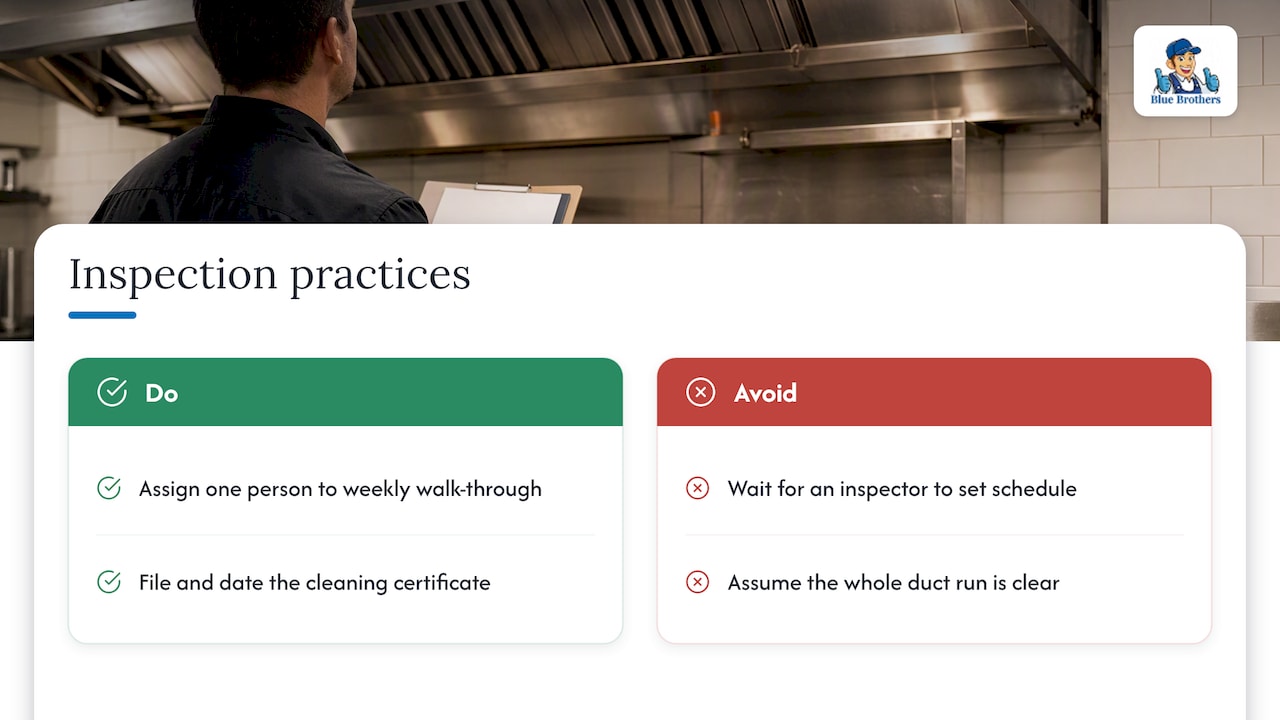
Our advice is to match your cleaning interval to your real cooking, not to the calendar. If your weekly check keeps finding grease, move up a bracket. It costs less than an emergency visit, and it keeps the inspection conversation short. Cleaning to NFPA 96 is what we do, and we would rather you ask us what we cleaned and what we could not reach than assume the whole run is clear.
One more thing: do not wait for an inspector to be your schedule. A fire authority sets a minimum, and the grease in your ducts does not read it.
— Jayce
Get your hood system cleaned to NFPA 96
Blue Brothers cleans commercial kitchen exhaust and hood systems across British Columbia, Alberta and Saskatchewan. Our grease exhaust and hood cleaning service is listed from $400 to $800 per one-off job, with clear pricing and no hidden fees, and we offer unlimited hood cleaning packages for kitchens that need a regular schedule. Our technicians are certified, and we offer round-the-clock support, including emergencies.
We work in many communities, including Vancouver, Burnaby, Kamloops and White City. Final pricing depends on the size and condition of your system, so ask for a quote before booking.
FAQ
How often should a commercial kitchen hood be inspected?
At least weekly for the parts you can readily see. Thorough inspections are monthly for solid-fuel cooking, quarterly for high-volume kitchens, semi-annual for moderate volume and annual for low volume (Government of Saskatchewan). Your fire authority can require more.
Can my staff inspect the hood themselves?
Yes, for the visual weekly check of the hood, filters and grease cups, and for washing filters. Cleaning the duct and fan needs trained people, and suppression servicing needs certified technicians, as Alberta’s rules spell out.
What does a fire inspector look at first?
Typically the service tag on the suppression system, the cleaning certificate and the general state of the hood, filters and visible duct. Having recent, complete records on site shortens the visit.
Does the checklist change between provinces?
The core items do not, since Saskatchewan, BC and Alberta all work from NFPA 96 through their fire or building codes. The paperwork details and who can perform the work vary, so check with your local fire authority.
Sources
- Commercial Cooking Operations, Government of Saskatchewan
- Fixed Fire Suppression and Exhaust Systems standata, Alberta Municipal Affairs
- BC Fire Code 2018, Division B, Section 2.6 Service Equipment
- NFPA 96 Kitchen Hood Inspection Checklist, MapTrack