When one room is warm and the next is cold, the cause is almost always how heat travels through your house, not how much heat your furnace makes. Airflow through the ducts, thermostat placement, air leaks and insulation gaps explain most cases, and you can rule out several of them in an afternoon with a few free checks. This guide walks through the causes in the order worth testing, shows what you can fix yourself, and tells you when the problem belongs to a technician.
TL;DR
- Uneven heat usually comes from airflow: distant rooms get less warm air than rooms near the furnace, especially in multi-level homes.
- Start with the free checks: filter, blocked or closed registers, furniture over vents, thermostat batteries and settings.
- A thermostat on one floor can’t see the temperature on another, so one level can overheat while another stays cold.
- Drafts, stack effect and thin insulation pull heat out of the rooms that are already hardest to warm.
- If the basics don’t fix it, the ducts need a proper look: sizing, balancing, buildup inside the system, or a zoning option.
Table of Contents
- What uneven heating actually means
- How heat moves through your house
- The most common causes, in the order to check them
- A simple one-weekend diagnosis
- Perspective: what we see inside the ducts
- When to call a professional
- How we can help
- FAQ
- Sources
What uneven heating actually means
Uneven heating means some rooms sit comfortably warm while others stay cool, even though the furnace runs and every vent is open. HRAI, the Heating, Refrigeration and Air Conditioning Institute of Canada, points to duct design, thermostat location and poor upper-floor airflow as possible causes. It says inadequate warm-air delivery from floor to floor or room to room can leave a home’s temperature non-uniform, and that this is common in multi-level homes, especially with a basement furnace.
That last point matters in Canada. Many houses here are two or three storeys with the furnace in the basement, long duct runs and a thermostat in the hallway. The system was balanced, if at all, on the day it was installed. Since then you may have finished the basement, added a room, swapped windows or let dust build up in the ducts. Each change shifts where the air goes.
Two patterns are worth separating before you start:
- One room is always cold or hot. Usually a local cause: a long or restricted duct branch, a leaky wall, a big window, a closed register.
- A whole floor is off. Usually a system-level cause: thermostat placement, duct sizing, stack effect, or a furnace that can’t keep up.
How heat moves through your house
It helps to know the rules the house follows. Natural Resources Canada explains that heat moves in any direction, from warmer areas to colder ones, rather than only upward, and that conduction, convection and radiation carry it through the building. The same page says conduction and convection are the main causes of heat loss in homes, with convection the main culprit when a house is leaky. Insulation works by trapping pockets of still air, which slows heat flow.
In practice: a room with two exterior walls and a big window loses heat faster than an interior bedroom, so it needs more warm air to hold the same temperature, yet it often gets the same amount or less. The gap shows up as “this room is always cold.”
The most common causes, in the order to check them
1. Airflow restrictions you can see
This is the cheapest cause to fix. Walk the house and look at every supply register and return grille.
- Is the register open, and is anything sitting on it: a couch, curtains, a rug edge, a storage bin?
- Is the return grille clear? Warm air has to have a path back to the furnace.
- Are interior doors closed? A closed bedroom door with no return in that room traps air pressure and starves the room.
The Government of Canada’s guidance on home mechanical systems tells occupants to make sure heating equipment is on and set appropriately, thermostat batteries work and the furnace filter is clean. The same page says furnace exhaust and intake vents must be unobstructed. A clogged filter chokes airflow across the entire system, so replace it before you chase anything more complicated.
2. Ductwork that favours the near rooms
Forced air takes the easiest route. HRAI notes that improperly designed ductwork can distribute heat unevenly because air follows the path of least resistance. It tends to discharge through the registers closest to the furnace, while distant rooms receive less.
Signs this is your problem:
- The rooms nearest the furnace are warm or even stuffy; the farthest ones are cool.
- Airflow from the weak registers is noticeably feeble when you hold a hand over them.
- The problem is worst on the coldest days, when the system is running flat out.
The duct fix depends on the cause: resizing a run, rebalancing the system with dampers, or adding a supply duct to a room that never had a proper one. HRAI says a qualified HVAC contractor can evaluate the ductwork and advise on these changes. Zoning, which controls heat by area, is another option it mentions.
3. Dirt and debris inside the ducts
Duct design is one thing. What has collected inside the duct is another. Years of dust, drywall powder from renovations, pet hair and the odd lost toy narrow the passage and add resistance, which hurts the longest, weakest runs first. If you’ve renovated, the dust issue is worth a look: see our post-renovation cleaning checklist for what settles into a system after construction.
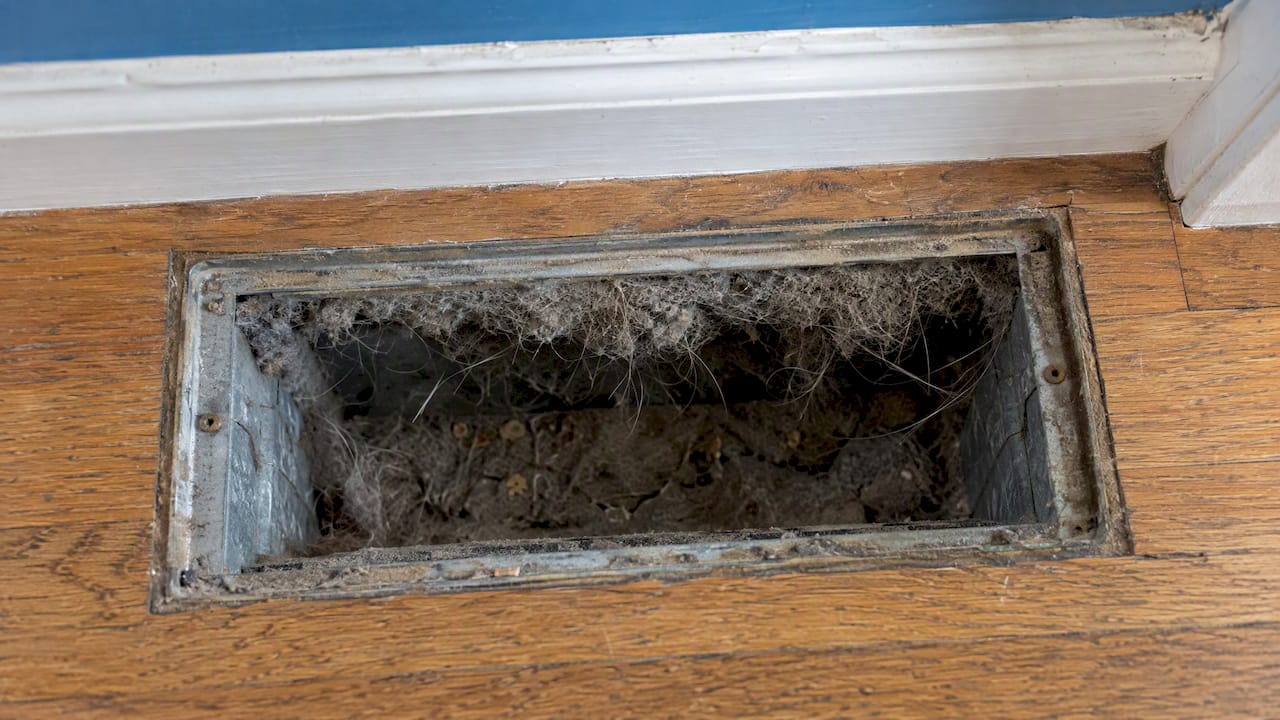
We cover the link between clean ducts and furnace performance in more depth in how clean air ducts improve furnace efficiency in winter. Cleaning won’t redesign a badly laid-out duct system, but it removes one source of restriction so you can see what the layout is really doing.
4. A thermostat that only sees one room
Your furnace runs until the thermostat is satisfied. If the thermostat sits on the main floor, HRAI says it may run the furnace without accounting for the temperature upstairs. It adds that poor upper-floor register airflow can point to duct-sizing or air-balancing problems. The result is a classic split: the main floor feels right while the bedrooms are too warm or too cool, depending on the season and the layout.
Check these before you blame the device:
- Is the thermostat near a sunny window, a kitchen, a fireplace or an exterior door? Those spots give false readings.
- Does it have fresh batteries, if it takes them?
- Is the fan set to “on” or “auto”? Running the fan continuously mixes air between rooms and can smooth out differences, though it may raise your electricity use.
Signs the thermostat itself may be faulty include a displayed temperature that doesn’t match a separate thermometer in the same spot, a furnace that cycles on and off too quickly or never shuts off, and controls that don’t respond. Put a cheap thermometer next to it for a day. If the readings differ by several degrees, or the furnace behaves oddly, ask a licensed technician to test it and the wiring. Don’t open the furnace cabinet yourself.
On settings: Natural Resources Canada says that, apart from some hydronic systems and heat pumps with slow response times, a programmable setback thermostat is the best way to turn the temperature down to save energy. If you have a heat pump or in-floor heat, deep overnight setbacks can leave rooms behind in the morning, so check what your system type recommends.
5. Air leaks and the stack effect
Some rooms are cold because the house is pulling cold air into them. Health Canada explains that in winter the stack effect draws cold outdoor air in near the bottom of a house while warm indoor air escapes through leaks, cracks and openings near the top. The bigger the indoor-outdoor temperature difference, the stronger the effect.
That’s why basements feel drafty and top floors can be oddly hot or oddly cold, depending on where the leaks are. Look for:
- Cold air around outlets and baseboards on exterior walls.
- Gaps around window and door frames, attic hatches and rim joists.
- Cold floors above unheated garages or crawl spaces.
Sealing is cheap compared with most HVAC changes, but don’t seal and forget. Natural Resources Canada warns in its home ventilation guide that airtightness, while energy-efficient, needs careful attention to ventilation to avoid moisture problems and backdrafting of combustion appliances. If you’re planning insulation or ventilation work together, look at specialists in ventilation and insulation upgrades who consider moisture and combustion appliance safety as part of the job.
6. Insulation gaps
A thinly insulated attic or an uninsulated wall section makes a room hard to heat, however good the airflow. A room under a poorly insulated roof or over a cold garage can lose heat faster than the ducts can deliver it. Insulation slows heat flow, so uneven insulation produces uneven rooms.
A quick clue: in winter, look at snow on the roof. Bare patches over particular rooms suggest heat escaping there. A technician or energy advisor can confirm with a blower-door test or thermal camera.
7. A furnace that is the wrong size or getting old
If the whole house struggles on the coldest days, or the furnace runs constantly, the equipment may be undersized for the home as it is today, especially after an addition. A very old furnace may also lose output. Furnace type affects comfort too: a two-stage unit runs longer at lower output, which tends to even out room temperatures. Our guide to single versus two-stage furnaces for Canadian homes explains the differences, and gas versus electric furnaces covers the fuel question if you’re weighing a replacement.
A simple one-weekend diagnosis
Budget Heating, a U.S. heating company, compares a room to a leaky bucket and advises measuring, fixing the biggest leaks, and measuring again before deciding a system is inadequate. That’s good discipline. Here’s a practical version.
- Measure. Put an inexpensive thermometer in each problem room and one in a comfortable room. Record morning, afternoon and night readings for two or three days.
- Check the filter and registers. Replace a dirty filter. Open every supply register fully and clear every return.
- Feel the airflow. Compare the output at registers in the cold room and a warm room. A big difference points to the ducts.
- Look for leaks. On a windy day, hold a stick of incense or a lit tissue near suspect windows and outlets. Watch for movement. Use caution with open flame near curtains, and prefer the incense.
- Check the thermostat. Compare with your thermometer; replace batteries.
- Adjust, then re-measure. If your registers have damper tabs, open the cold room’s fully and partly close the hot room’s. Never close a register completely: it can add pressure and strain on the system.
- Compare readings. If the gap is still more than a few degrees, the cause is probably in the duct design, the equipment or the building envelope.
Perspective: what we see inside the ducts
We clean ducts, furnaces and ventilation equipment in homes and buildings across Saskatchewan, British Columbia and Alberta, so we spend a lot of time looking at what’s actually inside the systems behind a “cold room” call. Our view is that people reach for the thermostat first, and the real answer is often further down the line.
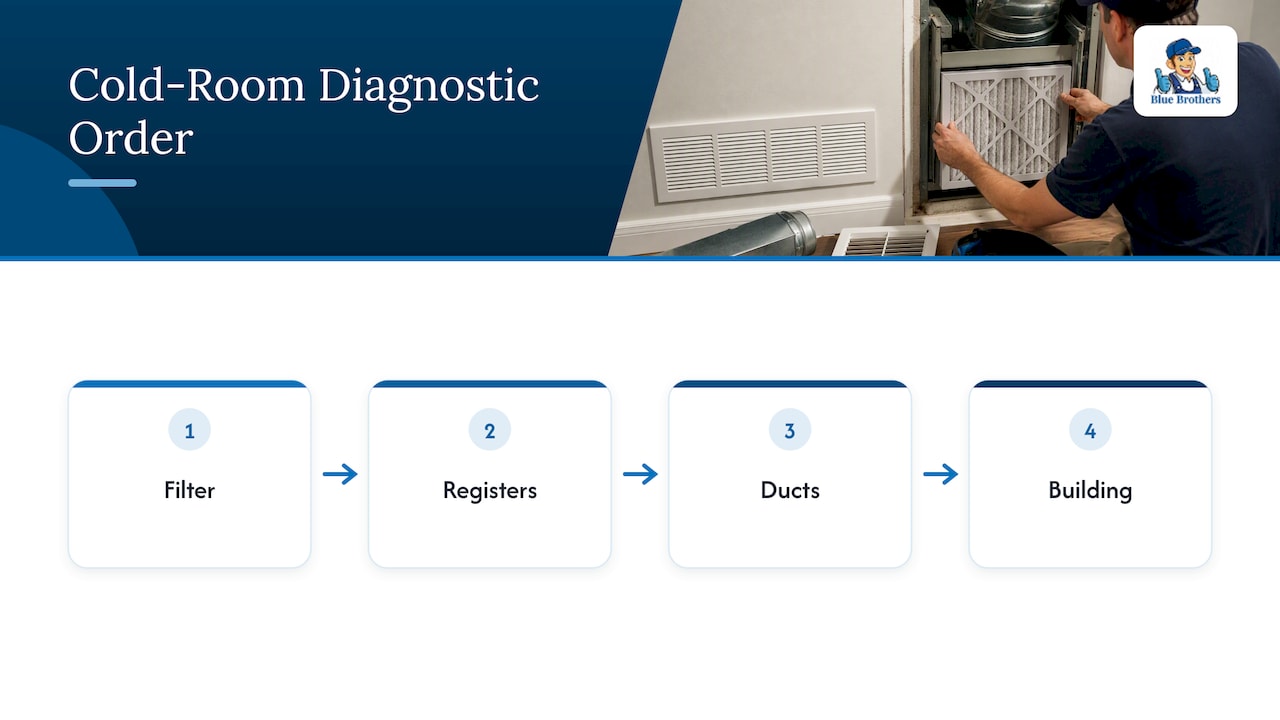
When a customer tells us one room never warms up, the sensible order is: filter, registers, then the ducts, then the building. Buildup inside a long branch run can cut flow to the last room on the line. We don’t claim that cleaning fixes a duct that’s too small or was never connected properly, and we’d rather tell you so than sell you a cleaning that won’t help. What it does is remove dust and debris as a variable, and it tells you whether you have a layout problem. If we see signs of a design issue, such as a disconnected run or a crushed flex duct, we say so and suggest a heating contractor to correct it.
The other thing we see is equipment that was never serviced. A furnace with a dirty blower or a clogged coil moves less air, and the weakest rooms go first. Cleaning the furnace, and the heat recovery ventilator if you have one, often restores airflow you didn’t know you’d lost.
— Jayce
When to call a professional
Call a qualified technician when:
- The problem remains after the free checks above.
- Airflow at certain registers is weak and the filter is clean.
- The furnace short cycles, runs constantly or the thermostat appears faulty.
- You smell something unusual from vents, or see dust blowing out of them. Our guides on dust from vents and musty smells from vents help you decide what you can handle.
- You have any sign of combustion trouble, such as soot, a pilot that won’t stay lit or a carbon monoxide alarm. Leave the house and call the gas utility or emergency services first.
What the technician should assess: duct sizing and layout, register balancing, the furnace’s temperature rise and blower performance, thermostat placement, and whether zoning makes sense. Ask them to explain the readings and show you the problem spots. A clear answer on cause should come before any quote for equipment.
If you rent or live in housing with a managed maintenance service, report persistent problems to the property manager or maintenance desk rather than adjusting equipment yourself. For strata and multi-unit buildings, we offer strata furnace cleaning.
How we can help
If your checks point to restricted airflow or dirty equipment, we can clean the system and show you what’s inside it. Our published price ranges are $400–$800 CAD for air duct cleaning, $50–$300 CAD for furnace cleaning, and $100–$400 CAD for HRV cleaning. The final amount depends on the size and layout of your home and the system. Our residential teams serve BC, Alberta and Saskatchewan, and you can see the details on our residential duct cleaning page.

We also offer emergency and round-the-clock support. If you aren’t sure where to start, contact us through our site and tell us which rooms are the problem. We’ll tell you honestly whether cleaning is likely to help.
For a deeper read on the seasonal angle, see how duct cleaning keeps your home comfortable all winter.
FAQ
Why is one room hotter or colder than the others?
Heat is probably being distributed unevenly. HRAI says distant rooms may receive less airflow, and a first-floor thermostat may not account for upstairs temperatures. Exterior walls, large windows and air leaks add to the difference.
Can a bad thermostat cause uneven heating?
Yes, though it more often causes the whole house to be too warm or too cold. A thermostat in the wrong spot can leave rooms on other floors out of step. A reading that doesn’t match a separate thermometer, or a furnace that never shuts off, are signs to have it tested.
Should I close vents in rooms that are too warm?
Partly closing a register with its damper tab can redirect air to cold rooms, but don’t close one fully. Blocking registers changes the pressure in the duct system and can strain the furnace. Adjust a little, re-measure, and call a technician if the gap persists.
Will duct cleaning fix uneven heat?
It can when dust and debris are restricting airflow, particularly on long runs. It won’t fix undersized ducts, disconnected runs or poor insulation. A technician can tell you which problem you have.
Why does the upstairs get so much hotter or colder than the basement?
Warm air and cold air move through the house in predictable ways. Health Canada describes the winter stack effect, where cold air enters low and warm air leaves through the upper leaks. Combined with a basement furnace and long duct runs, this commonly produces floor-to-floor differences.
Sources
- HRAI Consumer Tips: some rooms noticeably cooler in winter
- Your home’s mechanical systems, Canada.ca
- Natural Resources Canada, Keeping the Heat In, Section 2
- Natural Resources Canada, Keeping the Heat In, Section 9
- Health Canada, Ventilation and the indoor environment
- Natural Resources Canada, How to get the ventilation you need in your house
- Budget Heating, The Heat Transfer Mystery
- Energy efficiency upgrades, ventilation and insulation