Use rigid metal duct for main runs, dryer vents and anywhere you can reach. Use flexible duct only for short, straight, fully stretched connections where metal will not fit. That hybrid approach gives you most of the airflow of an all-metal system, and it is easier to keep clean over the life of the house.
The longer answer depends on what the duct carries (heated air, return air or hot, lint-laden dryer exhaust), how much room you have, and how well the work is done. Below we compare the two on airflow, cost, durability, cleaning and fire safety, with Canadian context.
TL;DR
- Rigid galvanized steel has a smooth interior, lasts longer and is easier to clean. Flex is cheaper and easier to fit into awkward spaces.
- A flex duct that is pulled taut and properly supported can perform close to metal. A sagging or kinked one can choke your furnace blower.
- For dryer vents, rigid metal is the safer choice. Lint snags on corrugated surfaces and crushed flex is a fire risk.
- Flex needs a closer look over time because a torn outer jacket lets insulation absorb moisture.
- Whatever you have, a professional cleaning on a sensible schedule keeps airflow and air quality where they should be.
Table of Contents
- What the two types are
- Airflow: the smooth wall matters, but installation matters more
- Cost: cheaper to buy, not always cheaper to own
- Comparison at a glance
- Durability, moisture and mold
- How long a flex run can be, and how it must be supported
- Dryer vents: this is where rigid really matters
- The hybrid approach most experts recommend
- Which one should you choose?
- Perspective: what we see in the field
- Cleaning rigid and flexible ducts
- How we can help
- FAQ
- Sources
What the two types are
Rigid duct is made from galvanized steel or aluminum. In residential work, sheet-metal ducting is typically 26 to 24 gauge, fabricated into straight sections, elbows and transitions that are sealed at the joints. It holds its shape, so the airway stays the size the designer intended.
Flexible duct is a coil of wire wrapped in a plastic or foil liner, usually with a layer of fibreglass insulation and an outer jacket. According to the Angi comparison, flexible ductwork can be made from silicone, rubber, plastic or plastic-coated fabric, and it bends to fit a space. The same ribbed construction that makes it easy to route is what causes most of its problems.
You will also hear the term semi-rigid. This is usually a corrugated aluminum product used for dryer exhaust. It holds a shape better than foil or vinyl accordion duct but still has a ridged interior, so it sits in between on most of the points below.
Airflow: the smooth wall matters, but installation matters more
Duct systems work best when air moves with as little friction as possible. The Canadian Centre for Occupational Health and Safety states this as a basic design principle for ducts. Metal’s smooth interior suits that principle. Flex has a corrugated inner surface that creates more resistance per foot.
The real-world gap is smaller than the debate suggests, if the install is good. A building-science writer at GreenBuildingAdvisor argues that flex duct performs close to rigid when the liner is pulled tight. The problem is the common habit of leaving it slack. Sags, tight bends and compressed sections add pressure drop, and your furnace or air conditioner blower works harder to push the same air.
Two practical consequences follow:
- Size flex up. The Air Duct Council notes that flexible duct often needs a larger diameter than the equivalent metal pipe, typically about an inch, to offset the pressure drop from the internal wire coil. Designers should size with ACCA Manual D or an equivalent method rather than swapping flex in at the same diameter.
- Use metal for turns. Practitioners recommend rigid elbows for direction changes and flex only for straight, taut runs.
If you have rooms that never seem to get warm, a long, saggy flex run is one of the first things a technician should check.
Cost: cheaper to buy, not always cheaper to own
Flex wins on up-front price. Angi, a US publication, puts rigid duct at roughly $7 to $13 per linear foot and flex at $1 to $4. Those are US figures and Canadian quotes will differ, but the ratio is the useful part. Rigid also needs more skilled labour for cutting, fitting and sealing, while flex goes in quickly on shorter, simpler runs.
That is why flex shows up in so many new builds and renovations. Over time, though, the numbers shift:
- Flex runs that sag, tear or collect moisture may need replacing sooner than metal, which has a longer service life.
- Poor airflow can raise your heating and cooling load, since the blower strains against restriction.
- Metal is easier to clean thoroughly, which keeps maintenance predictable.
When you collect bids for a new system, ask each contractor how much flex is in the design, how long each run is and how it will be supported. A low bid that relies on long flex runs may not be a bargain.
Comparison at a glance
| Factor | Rigid metal | Flexible |
|---|---|---|
| Interior surface | Smooth, low friction | Corrugated, higher friction |
| Up-front cost | Higher (more material and labour) | Lower |
| Fit in tight spaces | Needs planning and fittings | Easy to route around obstacles |
| Durability | Long-lasting, resists tears | Jacket and liner can be punctured or crushed |
| Moisture and mold risk | Low, does not hold moisture | Higher if the jacket tears and insulation gets wet |
| Cleaning | Straightforward with brush and vacuum equipment | Possible, but the liner can be damaged by rough tools |
| Best use | Trunk lines, main branches, dryer vents | Short connections to registers, tight retrofit spots |
Durability, moisture and mold
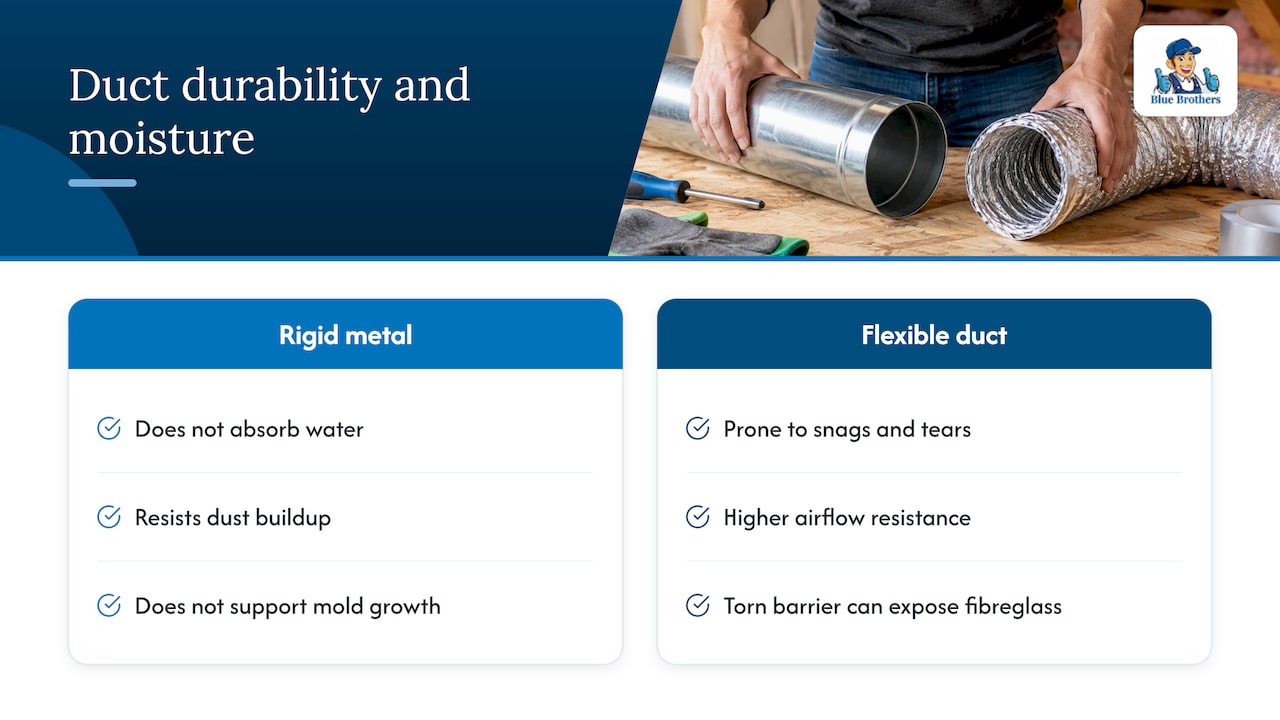
Metal’s advantage here is simple: it does not absorb water. Angi’s comparison says rigid duct resists dust buildup and does not support mold growth, while flex is prone to snags, tears and airflow resistance.
Insulated flex has one particular weak point. According to the same Ontario HVAC contractor write-up cited above, the outer vapour barrier is easily punctured by tools or accidental contact. Once the jacket tears, the fibreglass can take on moisture, lose R-value and become a place for mold to grow. In a basement, crawl space or attic, a single nick from a stored box or a trade working nearby can start the problem.
Cold-climate homes face a second issue: condensation. The same source says R-8 insulation has effectively become the standard over R-6 in Ontario’s climate, because it keeps the duct surface warmer and reduces sweating in the shoulder seasons. That is an Ontario contractor’s view, but the logic applies to uninsulated or thinly insulated ducts in cold attics and crawl spaces across Saskatchewan, Alberta and BC’s interior. If you are unsure what insulation your ducts have, ask a technician to look.
How long a flex run can be, and how it must be supported
Codes vary by province and municipality, so check with your local authority before any install. As a reference point, a city building bulletin from Fresno, California describes common practice: flexible ducts are limited to short connections of about 5 feet in length, should never replace rigid fittings such as elbows, must be listed to UL 181 Class 1, and need at least 2 inches of collar length for a secure, leak-resistant attachment. It also gives a support interval for flex of no more than 4 feet to prevent sags. That is a US municipal document, not a Canadian rule, but it matches how competent installers work everywhere.
In plain terms, a good flex installation is short, straight, fully extended and hung with proper straps, not draped across joists.
Dryer vents: this is where rigid really matters
For the supply and return ducts in a house, the choice between rigid and flex is mostly about performance and longevity. For a dryer vent it is also about fire.
A dryer pushes hot, moist air full of lint through its exhaust. Lint catches on ridges, folds and screws. A corrugated or foil accordion duct gives it more places to build up, and flex that is crushed behind the dryer or sagging in a wall cavity can restrict flow badly. When airflow drops, the dryer runs hotter and longer, and the lint is the fuel.

We would put it plainly: where you have a choice, use smooth rigid metal for the dryer exhaust, keep it as short and straight as possible, and vent it directly outside. Canada’s building code direction supports venting clothes dryers outdoors. The National Research Council’s explanation of the 2010 National Building Code changes notes that direct-to-outdoors venting for laundry drying appliances is aimed at humidity, mold and lint fire hazards. For multi-unit buildings, it describes a common exhaust duct with a central fan and an accessible central lint trap, so that lint does not accumulate in inactive branches.
If you live in a strata or manage rental units, shared vent stacks make regular cleaning even more important. Our strata dryer vent cleaning service is built for that. If your vent exits on a roof, read about rooftop dryer vent cleaning safety.
Signs your dryer vent needs attention include clothes taking more than one cycle to dry, a hot dryer or laundry room, a burning smell, or lint around the exterior hood. Our 10-minute dryer checks walk through what you can inspect yourself before you book a pro.
A note on commercial kitchens
Grease exhaust is a different category again. Kitchen exhaust ducts carry grease, not lint, and the fire standard is NFPA 96. The ductwork is typically rigid for exactly the reasons above. If you run a restaurant, this guide to how professional kitchen exhaust cleaning protects a business from fires is a useful companion read on the fire risk.
The hybrid approach most experts recommend
The either/or framing is less useful than it sounds. Building-performance writers advocate a hybrid: rigid trunk lines for the main runs, with flex only for short, straight connections to terminal devices. The Ontario contractor article reaches the same conclusion for container builds, pairing a rigid sheet-metal trunk with short insulated flex branches.
Here is how that looks in a typical house:
- Main trunk and long branches: rigid, sealed at the joints.
- Final connection to a register boot: a short length of flex, stretched taut, supported and not kinked.
- Tight retrofit spots: flex is acceptable where metal cannot be fitted, but keep it as short as possible.
- Dryer exhaust: rigid metal, direct to the outdoors.
- Furnace and air handler connections: follow the manufacturer and local code.
Which one should you choose?
You are building or replacing the whole system. Ask for rigid trunks and a short flex-to-register design. Get the designer to show the duct sizing. If a bid uses long flex runs, ask why.
You are renovating a finished house. You may have to use some flex to get through joist bays and soffits. That is fine, provided it is short, supported and sized up.
You already have flex ducts. You do not necessarily need to rip them out. Look for sags, crushed sections, torn jackets, loose collars and damp insulation. Fix what is wrong. Replace sections that are damaged.
You are venting a dryer. Use rigid metal where possible, and make sure it vents directly outside and not into the attic, crawl space or garage.
Perspective: what we see in the field
Day to day we clean the systems people actually have, not the ones in the brochure. A few patterns come up again and again in homes across Saskatchewan, Alberta and BC.
First, lint-clogged dryer vents are the most preventable fire hazard we see. A neglected vent can look fine from outside and be nearly blocked a few feet in. That is why we steer people toward smooth metal duct and short runs, and why we treat dryer vent cleaning as routine maintenance, not an emergency.
Second, flex is not the villain, but it is unforgiving of shortcuts. We would sooner see a short, taut, well-supported flex connection than a long, crushed run. The trouble starts when it is stretched across a ceiling and left to sag.
Third, cleaning is easier and more thorough in metal. With flexible duct we use more care, because aggressive tools can tear the liner. Technicians who know the difference matter. We use certified technicians and equipment suited to each material, and we tell you honestly if a damaged section should be replaced instead of cleaned.
Finally, when you ask us for a price, we give a clear number with no hidden fees. Duct type affects the job, so a quick description or photos of your system help us quote accurately.
— Jayce
Cleaning rigid and flexible ducts
Cleaning keeps either type working as designed. Dust, pet hair and construction debris collect in both, and in flex the ridges hold it more stubbornly. A professional job normally includes agitating debris loose from the duct walls and pulling it out with powerful negative-pressure vacuum equipment, then checking registers, the furnace and the blower.
What to ask a cleaner:
- What tools will you use on flex duct, and how do you avoid tearing it?
- Will you inspect and tell me about damaged or disconnected sections?
- Do you quote a clear price before starting?
- Can you also service the furnace, coil and HRV, since they share the airflow?
If you are only chasing dust at the registers, try the checks in our guide on fixing dust from vents first, and call a pro if the problem persists.
How we can help
We clean both rigid and flexible systems for homes and businesses in BC, Alberta and Saskatchewan. Our published ranges are:
- Air duct cleaning: 400-800 $CAD
- Dryer vent cleaning: 99-225 $CAD
- Furnace cleaning: 50-300 $CAD
- HRV cleaning: 100-400 $CAD
For homes, see our residential duct cleaning page. For offices and shops, see commercial duct cleaning. Support is available round the clock, including emergencies.
FAQ
Is metal duct better than flex duct?
For most uses, yes. Metal has a smoother interior, lasts longer, resists moisture and is easier to clean. Flex is still a sensible choice for short connections and tight retrofit spaces, as long as it is stretched, supported and sized up.
Should I use R6 or R8 flex duct?
In cold climates, R-8 is the better pick. An Ontario HVAC contractor says the extra insulation keeps the duct surface warmer and limits condensation. Check your local code and ask your installer what applies to unconditioned spaces like attics and crawl spaces.
Can I use flexible duct for a dryer vent?
Smooth rigid metal is the better choice because lint collects on ridged surfaces and flex can be crushed. Foil or vinyl accordion duct is the worst option. If you must use some flexible metal in a tight spot, keep it short, fully stretched and accessible, and follow the dryer manufacturer’s instructions and your local code.
How far can flex duct run?
There is no single Canadian figure that fits every situation, so check your local building authority. As a reference, a Fresno building bulletin describes flex connections limited to about 5 feet, supported at no more than 4-foot intervals. Shorter and straighter is always better.
Does flex duct need cleaning more than rigid?
It needs inspecting more often, since a torn jacket can let insulation get wet. Cleaning intervals depend on your household, pets, renovations and whether anyone has allergies. A technician can advise after seeing your system.
Sources
- The Joy of Flex, GreenBuildingAdvisor
- HVAC Ducting Flex vs Rigid, Van Blanc
- Flex Duct vs. Rigid: Pros, Cons, and Costs, Angi
- Flexible Ductwork bulletin, City of Fresno
- Frequently Asked Technical Questions, Air Duct Council
- CCOHS: Industrial Ventilation, Ducts
- National Research Council Canada, building code publication
Recommended
- Fix Odour, Dust, or Smoke: Duct Cleaning vs Air Purifiers in Canada
- ❄️ Cold Outside, Clean Inside: How Duct Cleaning Keeps Your Home Comfortable All Winter – Blue Brothers
- Air Duct Cleaning: 3–5 Years Isn’t a Deadline for Canadian Homes
- Stop Wasting Heat: How Clean Air Ducts Improve Furnace Efficiency in Winter – Blue Brothers