In British Columbia, gas furnace venting is governed by the CSA B149.1 gas installation code, adopted through the province’s Gas Safety Regulation, and by your furnace manufacturer’s installation manual. Venting is regulated gas work. It must be done by a certified person under a Technical Safety BC (TSBC) permit, and your job as the owner is to know what a compliant system looks like and keep it clear, clean and working. We clean furnaces, ducts and dryer vents in BC, so this guide covers the rules in plain language and what keeps the system safe afterwards.
TL;DR
- BC’s Gas Safety Regulation adopts CSA B149.1-20 as the governing code, and the installer must also follow the manufacturer’s manual.
- An 80% furnace is a Category I appliance that vents vertically through a chimney or B-vent. A high-efficiency furnace uses plastic pipe that the manufacturer specifies.
- Furnace venting is gas work that needs a certified installer and a permit, with an inspection before the system is placed into service.
- Your furnace needs combustion air from outdoors, and blocked vents, soot, odours or a carbon monoxide alarm mean you stop and act at once.
- Clean, clear furnace and vent systems are easier to keep safe, and a furnace cleaning in BC is listed at $50 to $300 CAD.
Table of Contents
- Who sets the venting rules in BC
- Which venting type does your furnace use?
- Termination clearances: the figures that come up most
- Combustion air: the furnace has to breathe
- Who is allowed to do venting work, and what the permit covers
- Warning signs that the venting is not working
- Keeping a compliant system clean and clear
- Our view on venting and cleaning
- Book the cleaning that keeps your system clear
- FAQ
- Sources
Who sets the venting rules in BC
Three layers apply to a gas furnace.
- The Gas Safety Regulation. This provincial regulation, last amended May 1, 2025, adopts CSA B149.1-20, B149.2-20, B149.3-20 and B149.5-20 as the governing gas codes in the province. B149.1 is the natural gas and propane installation code, and it contains the venting and clearance rules.
- Technical Safety BC. TSBC is the provincial safety regulator. It issues permits, carries out inspections and publishes directives that clarify how the code applies in BC.
- The manufacturer’s installation manual. Every certified furnace comes with instructions that set the vent material, size, length and termination details. Where the code and the manual differ, the stricter requirement is the one to follow.
The code is revised on a cycle. TSBC has consulted on adopting the 2025 gas codes, including a proposed change to the clearance between a gas vent discharge and an ignition source in Table 5.3, from 10 ft to 5 ft. The edition in force is whatever the regulation currently lists, so a permit holder works from the current text rather than from older articles or forum posts.
Which venting type does your furnace use?
The first question is how efficient your furnace is, because that decides everything about the vent.
| 80% furnace (mid-efficiency) | High-efficiency furnace (90%+) | |
|---|---|---|
| Category | Category I, fan-assisted | Condensing, plastic vent |
| Vent material | Factory-built B-vent or a properly lined chimney | Plastic pipe specified by the manufacturer |
| Direction | Vertical or nearly vertical | Slopes back toward the furnace; can run through a wall |
| Typical outlet | Roof | Side wall or roof |
| Common trouble | Blocked or oversized flue, spillage | Condensate lockouts, blocked terminations in snow and ice |
80% furnaces: vertical venting
An 80% furnace is classed as a Category I appliance. Manufacturer instructions, such as this Whirlpool 80% furnace manual, say it must be vented vertically or nearly vertically, and that a fan-assisted Category I furnace must not be vented into single-wall metal pipe.
In Canada the venting must conform to CAN/CGA B149.1 or B149.2. A Category I furnace must connect to a factory-built chimney or vent, or to a masonry or concrete chimney lined with material acceptable to the authority having jurisdiction. According to a manufacturer’s installation manual, venting into an unlined masonry or concrete chimney is prohibited, and the furnace must not vent into a solid-fuel flue unless the fireplace is permanently sealed.
This matters most when a furnace is replaced. A manufacturer’s installation instructions point out that an undersized or oversized Category I vent after a furnace replacement can cause condensation, leaking combustion products and spillage into the living space, so the vent may need resizing. Another manufacturer’s instructions add that extreme cold, long vent connectors or an exterior chimney can make a clay-tile liner unsuitable. In those cases the chimney is relined, a vertical B-vent is used, or in some conditions a 90%+ furnace vented through PVC takes its place.
Can an 80% furnace vent through a wall?
Not directly. An 80% furnace is not approved for plain horizontal sidewall venting. According to one manufacturer’s installation instructions, a sidewall termination is possible only with a listed mechanical power venter or draft inducer added, approval from the authority having jurisdiction, and compliance with B149.1 and the manual. Horizontal runs must slope upward at least 1/4 inch per foot, and the vent can’t be single-wall metal.
BC Housing’s 2013 guidance on sidewall venting of gas appliances describes a 4 ft (1.2 m) side yard to the property line with a certified plume-redirecting fitting, and no placement restrictions if an adjoining building is 8 ft (2.4 m) or more away. It also recommends roof venting where possible, because frost, ice and re-entrainment of exhaust gases are real risks on a side wall.
High-efficiency furnaces: plastic vent pipe
High-efficiency condensing furnaces cool the exhaust so much that it can leave through plastic pipe, and the manual names the material. The exhaust pipe has to slope back toward the furnace so condensate drains, stay within the manual’s maximum equivalent length and elbow count, and meet the code and manual clearances at the outdoor termination.
That last point catches people out. A termination that is code-compliant on the day it is installed can still end up blocked by a snowdrift, a new fence, shrubs or a stacked woodpile. That is a maintenance question, and it is yours.

Termination clearances: the figures that come up most
Where the manufacturer’s instructions don’t give a clearance, TSBC’s directive on special venting and Type BH venting, dated January 20, 2022, sets these defaults:
- 36 in (91 cm) vertical clearance to a ventilated soffit above the terminal, within 2 ft (61 cm) horizontally
- 36 in (91 cm) to an unventilated soffit
- 12 in (30 cm) to a permanently closed window
- 12 in (30 cm) to an outside corner
- 36 in (91 cm) to an inside corner
TSBC also has a rule about gas regulators and meters. Under its appliance air intake clearance directive, fan-assisted air intakes, including direct-vent two-pipe Category III and IV installations, must end at least 10 ft (3 m) in any direction from a gas regulator relief or overpressure relief outlet. Passive air intakes need 1 ft (0.3 m) per CSA B149.1 Table 5.3. TSBC’s information bulletin confirms that the 10 ft figure applies to a two-pipe direct-vent furnace in BC.
These are the numbers an installer checks against the manual. If your furnace pipes sit close to the gas meter or a window, ask the installer to show you the clearances on the permit paperwork.
Combustion air: the furnace has to breathe
A furnace burns gas using air from the room or from a dedicated intake. The BC rules on this are specific.
- BC’s Gas Safety Regulation requires an outdoor air supply inlet with at least 24 in (600 mm) between the bottom of the intake grill and the finished floor. It must be protected from snow blockage and can’t draw from a carport.
- For passive air supply to low-volume installations (400,000 Btu/h or less) with draft control, the code asks for 1 in² of free area per 7,000 Btu/h, with the opening 6 to 18 in above the floor, as set out in SkilledTradesBC’s gas systems course material.
- The same material explains that appliances with draft control need both combustion and dilution air, while power burners without draft control need less because they do not require dilution air.
- BC’s Building Code, Section 9.33.6.12, prohibits return-air inlets in an enclosed room or crawl space that provides combustion air to a furnace.
In a house this means a few practical things. Don’t block or cover the outdoor air inlet. Don’t stack storage against the furnace room openings. And if you are tightening up the home with renovations, tell your gas fitter, because a sealed house can starve a furnace of air.
Who is allowed to do venting work, and what the permit covers
BC’s Gas Safety Regulation, section 4(1), prohibits regulated gas work unless the person holds a certificate of qualification or falls into a specific permitted category. A gas venting certificate entitles the holder to install, alter and repair venting under the right permit. A Class B gas fitter certificate covers appliances of 120 kW or less that carry a certification mark, plus piping and vents.
TSBC states that a permit is required for installing or replacing a furnace and for installing or replacing gas piping or vent systems. The inspection step matters as much as the permit. Under section 34, the permit holder or gas fitter must notify TSBC at completion of each phase and at final completion. TSBC’s Ask a Gas Safety Officer explains that without the required inspection request, the system is not authorized to be placed into service.
For a homeowner, that gives you a simple checklist after any furnace or venting job:
- A permit exists for the work.
- The vent route and termination location are documented.
- The inspection has been requested, so the system is authorized for use.
- You have the manufacturer’s manual and the clearances in writing.
For reference, TSBC’s homeowner fee schedule effective January 1, 2026 lists a gas installation permit at $164 for one or two appliances including vent and gas piping in a detached dwelling. Fees are revised, so check TSBC’s current schedule.
If you are choosing a new furnace, our guides to getting the right BTU size for a house and to when gas beats electric cover the decision before venting even comes up.
Warning signs that the venting is not working
Code compliance on installation day is only the start. Vents get blocked, corroded, iced over or disturbed. Environment and Climate Change Canada lists these warning signs of combustion gas problems:
- Repeated headaches, throat irritation or shortness of breath
- Combustion odours
- Soot stains
- Hot, muggy air near heating equipment
- Melted plastic fittings on a water heater
It says to call an experienced heating contractor immediately if a smoke-indicator test shows smoke moving into the home.
A blocked Category I vent normally trips the draft safeguard switch and shuts the furnace off, according to manufacturer instructions. If the furnace keeps shutting down, do not reset it repeatedly or bypass the switch. Call a licensed gas fitter.
If a carbon monoxide alarm sounds, follow Health Canada’s guidance: leave the home immediately, don’t try to find the source, call 9-1-1 from outside, and go back in only after a professional has fixed the problem. Health Canada also recommends a yearly professional inspection of fuel-burning appliances and checking vents for blockages, ice, snow and debris during and after snowstorms.
Keeping a compliant system clean and clear
A vent that met code when installed still depends on what is around and inside the furnace. Dust and lint in the furnace cabinet, blower and ducts add load to the system. A dryer vent clogged with lint is a separate fire hazard. For the rest of the house’s airflow, that is where cleaning comes in.
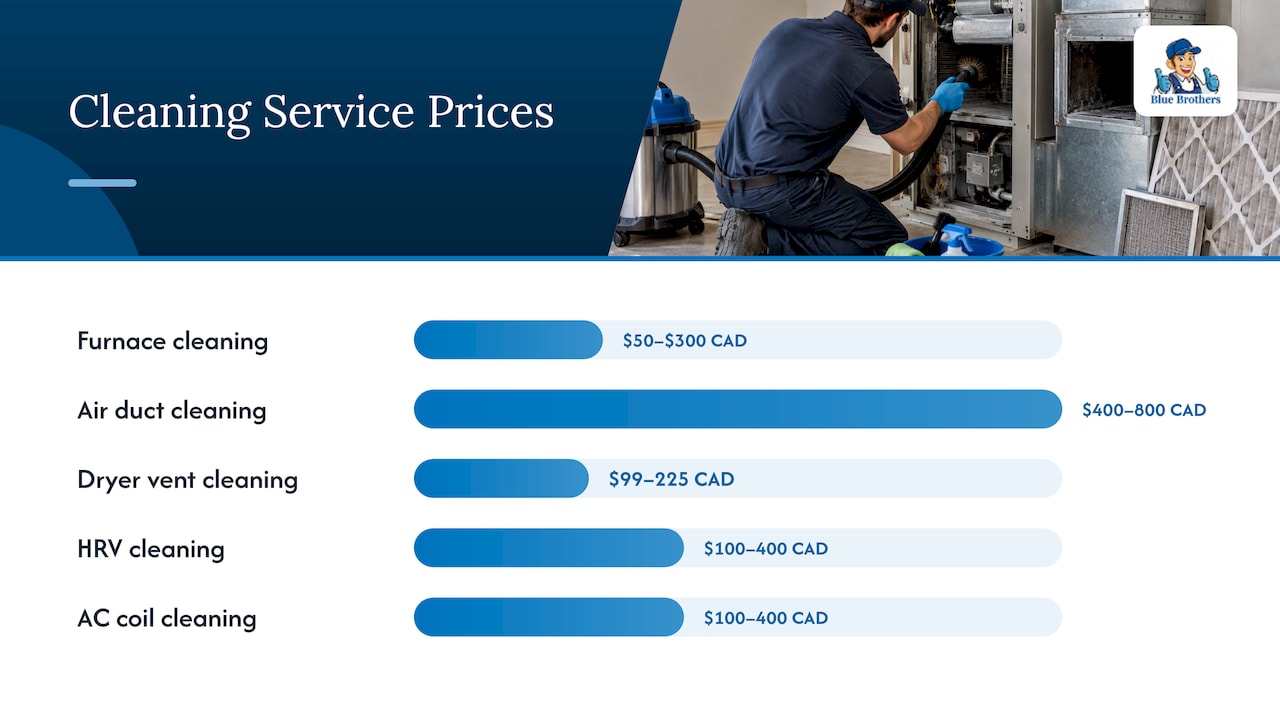
Here are the services that fit around a code-compliant gas furnace, with our published price ranges:
| Service | Published range |
|---|---|
| Furnace cleaning | $50 to $300 CAD |
| Air duct cleaning | $400 to $800 CAD |
| Dryer vent cleaning | $99 to $225 CAD |
| HRV cleaning | $100 to $400 CAD |
| Air conditioning coil cleaning | $100 to $400 CAD |
The vent pipe itself, its slope, length and termination, stays with the certified gas fitter who holds the permit. Our work is the cleaning side: the furnace, the ducts that carry the heat, the HRV and the dryer exhaust.
For property managers and stratas, the same logic holds across many suites. There are dedicated pages for strata furnace cleaning and commercial furnace cleaning. Restaurants and commercial kitchens have their own exhaust rules, and our hood cleaning in British Columbia is carried out to NFPA 96 standards.
Our view on venting and cleaning
We are asked about venting code a lot, usually after a homeowner has been told something at the door or read a conflicting forum post. Our answer is the same each time: the vent is regulated gas work, and the code and the manual decide what is right, not guesswork.
What we do see as cleaning specialists is that a heating system is more than the vent pipe. The furnace, the ducts, the HRV and the dryer exhaust all move air or exhaust through your house, and all of them collect dust, lint and debris. We built our service around doing that work carefully, for homes and for businesses, with certified technicians and advanced equipment.
We publish our price ranges, with no hidden fees, so you know the scale before you book: furnace cleaning from $50 to $300 CAD, dryer vent cleaning $99 to $225 CAD and air duct cleaning $400 to $800 CAD. We also offer round-the-clock support and emergency service, because a heating or exhaust problem rarely picks a convenient hour.
Our advice: get your venting right through a certified gas fitter and a permit, then keep everything around it clean and clear.
Jayce
Book the cleaning that keeps your system clear
Once your venting has been checked and your permit is in order, the furnace and ductwork are the next thing to look after. Blue Brothers cleans furnaces, air ducts, HRV units, AC coils and dryer vents for homes, stratas and businesses across BC, with certified technicians and published pricing.
Start with the furnace cleaning service or ask for a quote on dryer vent cleaning. We serve many BC communities, including Vancouver, Burnaby, North Vancouver, Victoria and the Comox Valley.
FAQ
What is the code for a furnace exhaust pipe in BC?
BC follows CSA B149.1, adopted in the Gas Safety Regulation, plus the furnace manufacturer’s manual. High-efficiency furnaces use the plastic pipe the manual names, sloped back toward the furnace and within the maximum length and elbow count. Termination clearances come from the code and the manual, and the stricter one applies.
Can I vent an 80% furnace through a wall?
Not as a plain horizontal vent. An 80% furnace is a Category I appliance meant for vertical venting. A sidewall outlet is possible only with a listed power venter, approval from the authority having jurisdiction and the clearances the code requires. A certified gas fitter confirms what is allowed for your house.
Do I need a permit to replace a furnace or its vent in BC?
Yes. TSBC states that a permit is required to install or replace a gas furnace and to install or replace a vent system. The work must then be inspected, and the system is not authorized for use until the required inspection request has been made.
How much ventilation does a gas furnace need?
The amount depends on the furnace’s input and whether it has draft control. For low-volume installations with draft control, the code asks for 1 in² of free area per 7,000 Btu/h, with the opening 6 to 18 in above the floor. Your gas fitter sizes this for your furnace, and you keep the openings clear.
What should I do if my carbon monoxide alarm goes off?
Leave the home immediately, don’t try to find the source, and call 9-1-1 from outside. Go back in only after a professional has fixed the problem. Fuel-burning appliances should also be inspected professionally at least once a year.
Sources
- Gas Safety Regulation, BC Laws (last amended May 1, 2025)
- Gas Safety Regulation, section 4(1)
- Gas Safety Regulation, point in time 2023
- BC Building Code 2018, Section 9.33
- TSBC: 2025 gas codes proposal
- TSBC directive: special venting and Type BH termination clearances
- TSBC directive: appliance air intake clearance
- TSBC information bulletin: clearances to regulator vents
- TSBC homeowner gas permits
- TSBC homeowner fee schedule
- TSBC: Ask a Gas Safety Officer on inspections
- SkilledTradesBC: code requirements for gas appliances
- BC Housing: sidewall venting of gas appliances
- Whirlpool 80% gas furnace installation instructions
- Furnace installation manual (Category I venting)
- Direct Comfort installation instructions
- Furnace installation instructions (sidewall venter, draft safeguard)
- Environment Canada: combustion gases in your home
- Health Canada: carbon monoxide, preventing exposure