A wall is the better place for a dryer vent to end. Appliance guidance says venting straight up through the roof is acceptable, but venting out through an outside wall is better. A wall route is shorter, easier to see, easier to reach and less exposed to frost. A roof route can be done safely when the house layout leaves no other option, but it needs the right cap, insulation and regular cleaning. Either way, a vent that is clean is what keeps lint from becoming a fire hazard. At Blue Brothers we clean dryer vents for homes in British Columbia, Alberta and Saskatchewan, and the questions below are the ones we hear from homeowners, strata owners and property managers.
TL;DR
- Wall termination is the first choice: shorter run, easier cleaning, no attic or shingles involved, and less ice build-up at the cap.
- A roof vent is acceptable when there is no wall route, but it must be insulated through the attic, use a dryer-rated cap with a damper and no screen, and be accessible for cleaning.
- Canadian codes require the duct to discharge directly outdoors, stay independent of other exhausts, be smooth and corrosion-resistant, and be cleanable. They never allow it to end in the attic.
- Lint buildup is a leading cause of house fires in Canada, and a roof run gives lint more places to settle.
- Professional dryer vent cleaning on our published price list runs from $99 to $225 CAD, depending on the home and the vent.
Table of Contents
- Wall vs roof at a glance
- Why the wall route usually wins
- When a roof vent is the right call
- What goes wrong with roof routes
- Warning signs for either route
- What the Canadian rules say about placement
- Can a dryer vent fit inside a 2×4 wall?
- Wall hoods and unwanted visitors
- Cleaning a wall vent and a roof vent
- Which route should you choose?
- Our view
- Book a dryer vent cleaning
- FAQ
- Sources
Wall vs roof at a glance
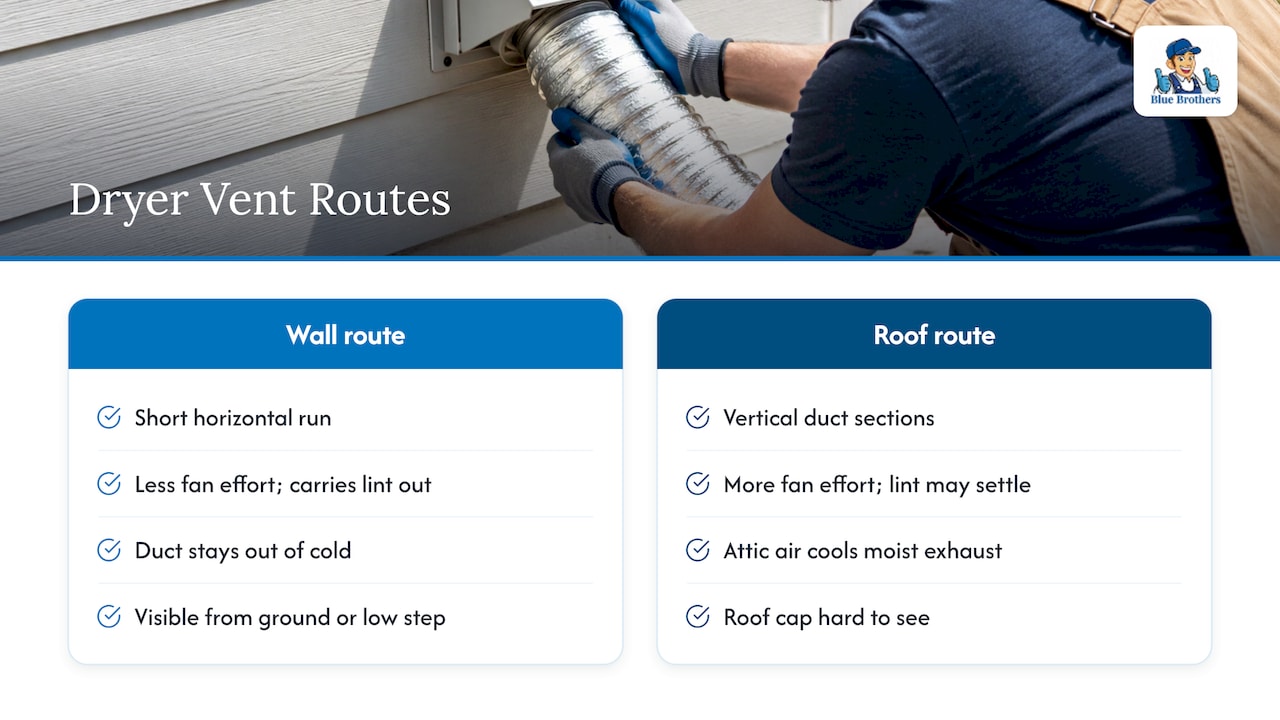
Both routes carry the same hot, damp, lint-laden air out of the house. What differs is how far the air has to travel, what it passes through, and how easily anyone can see or reach the end of the duct.
| Factor | Exterior wall | Roof |
|---|---|---|
| Typical run | Short and fairly straight | Long, with vertical sections and elbows |
| Airflow | Fan works mostly horizontally | Fan works against gravity and distance |
| Attic exposure | None, or very little | Duct passes through cold attic space |
| Condensation risk | Lower | Higher, especially in winter |
| Ice and frost | Possible at the hood, but easy to see | Frost inside the cap, plus melt that can refreeze on the roof |
| Checking the cap | Often possible from the ground | Out of sight, needs a ladder or roof access |
| Cleaning access | Usually simple | Harder, and a fall risk |
| Best fit | Most detached homes, basements, main-floor laundry rooms | Townhomes, interior laundry rooms, upper floors with no outside wall |
The rest of this article explains why each row matters and what to do about it.
Why the wall route usually wins
The dryer’s fan has a limited amount of push. Every extra metre of duct, every elbow and every vertical section takes some of it. A short horizontal run to an exterior wall asks the least of the fan, so lint is carried out instead of settling on the duct walls.
A wall run also keeps the duct out of the cold. Warm, moist air that travels through an unheated attic cools on the way, and cooling air drops its moisture. That moisture wets lint, and wet lint sticks.
The third advantage is visibility. A wall hood can be checked from the ground or a low step. Ontario’s fire-safety guidance tells homeowners to check the outdoor exhaust vent regularly to confirm the flap opens when the dryer runs and that airflow is not blocked. That simple check is easy with a wall hood and awkward with a roof cap you cannot see.
Some home inspectors go further and say the roof is a poor spot for a dryer vent, pointing to cleaning difficulty and contributions to ice dams. That is a strong position, and it explains why a builder with a choice will nearly always pick the wall.
When a roof vent is the right call
Not every laundry room has an outside wall. Townhomes, condos, interior laundry closets, and second-floor laundry rooms in the middle of a house often leave a roof run as the only practical path. In those cases a roof vent is a normal solution, and it can work well if it is built and maintained properly.
The Canadian code does not forbid it. What the code requires is that the exhaust discharge directly outdoors. BC Housing’s summary of the 2018 BC Building Code changes says Article 9.32.1.3 requires dryer exhaust ducts to discharge directly outdoors, be independent of other exhaust ducts, be accessible for cleaning and be made of smooth, corrosion-resistant material. That requirement applies to the permanently installed duct, not the short flexible connector between the dryer and the duct.
A roof route that meets those requirements has these parts:
- A dryer-rated cap with a hinged or gravity damper and no screen. A screen collects lint and can block the cap.
- The correct duct diameter all the way to the cap, normally 4 inches for a household dryer.
- Proper flashing woven into the roofing so the penetration does not leak.
- Sealed joints between the duct and the cap, so warm air does not escape into the attic.
- Insulation around the attic section of the duct, covered below.
- An accessible location for cleaning, not one buried behind a chimney chase or at the top of a steep slope.
The same guidance says a roof cap must never connect to a ridge vent, a soffit or a plumbing stack, and the duct must never end inside the attic.
What goes wrong with roof routes
Slower airflow and more lint
In a roof run, lint has to travel upward. When airflow slows, lint settles on the duct walls and elbows, and some falls back to the lowest bend. Over a season the duct narrows, the dryer takes longer to finish a load, and the dryer runs hotter. ATCO Energy states that dryer vent buildup is one of the leading causes of house fires in Canada. Its explanation is simple: even with a clean lint trap, some lint escapes into the duct, restricts airflow, causes overheating and can ignite.
Condensation in the attic
Warm moist air moving through a cold attic condenses on the duct. Condensation can wet lint, drip back toward the dryer, soak insulation or leave stains on the ceiling. The Canadian building code addresses this directly for the attic run. Exhaust ducts must not discharge into enclosed spaces, and a duct passing through an unheated space must be insulated to at least RSI 0.5 where it is not separated from that space by an insulated assembly. Check the wording of the code edition your province uses, because the numbers can differ.
Frost and ice at the cap
In a Canadian winter the roof cap is the coldest point in the system. A roof dryer vent can build frost inside the hood and form ice on the damper flaps, reducing or blocking exhaust. The same source notes that a dryer moves far more air than a typical roof vent, which can disturb the pressure balance in the attic and pull air from nearby soffit or roof vents.
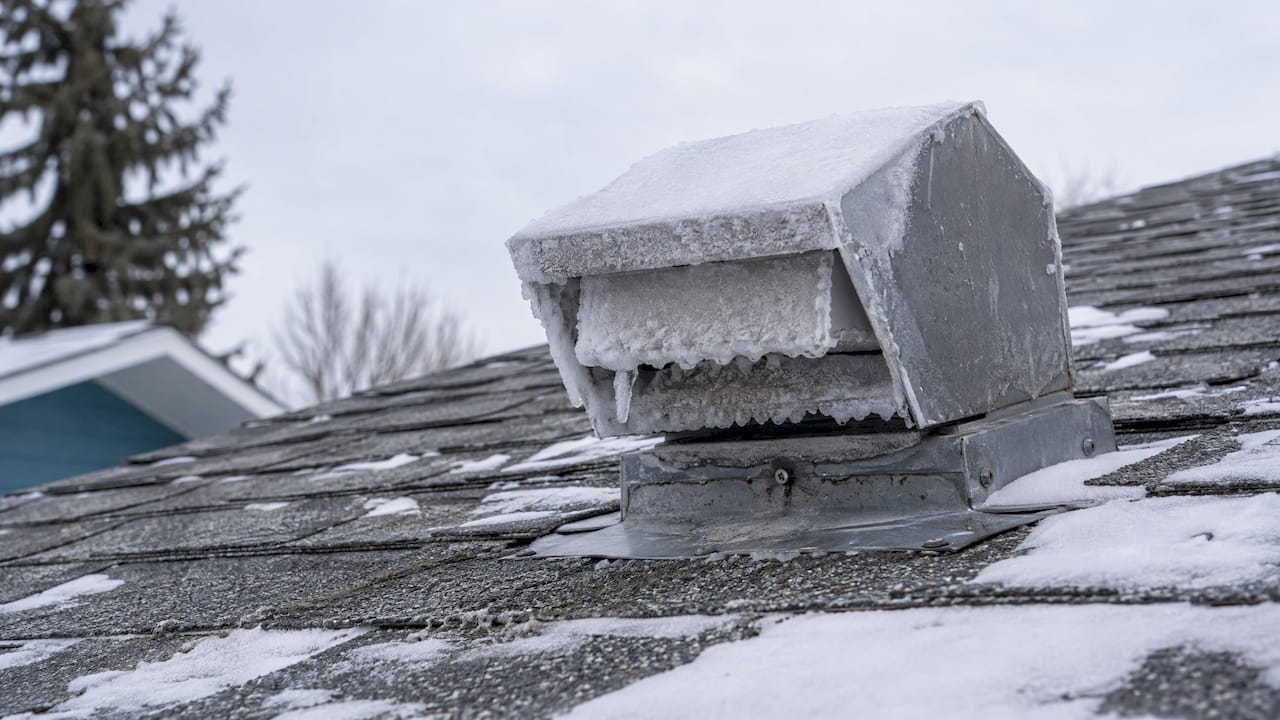
There is also the roof itself. Roof-terminated dryer vents can melt snow that refreezes farther down the slope, contributing to ice dams large enough to cause leaks.
Hard to inspect
Most owners never see their roof cap. A damper that is jammed open by lint or frozen shut can go unnoticed for a whole winter. The signs show up indoors instead.
Warning signs for either route
ATCO Energy lists the red flags: damp clothes after a full cycle, unusually hot laundry, a hot or humid laundry room, a burnt smell, and an outside flap that barely opens. If you see any of them, stop using the dryer for the day and have the vent looked at. We have a short guide to 10-minute checks for a dryer that is not drying that walks through the usual causes before you book anyone.
If your dryer runs on gas or propane, Ontario’s guidebook adds one more safety point: a carbon monoxide alarm on every storey and outside all sleeping areas. Most Canadian provinces have similar expectations for fuel-burning appliances, so confirm the rule for your province.
What the Canadian rules say about placement
The national model code is adopted province by province, so the exact wording depends on where you live. A few points apply widely.
Direct discharge outdoors. The duct must not end in an attic, crawl space, garage or soffit cavity. Ontario’s guidebook says to vent directly outdoors by the shortest, straightest path, never into the house or attic.
Metal duct, not plastic or foil. The same guidance calls for metal ducting, because plastic or foil can sag, crush or melt. Our guide to rigid versus flexible duct explains where each type fits.
Clearance from air intakes. The 2020 National Building Code introduced a 1,800 mm clearance between moist-air exhaust outlets, including clothes dryers, and air intakes or vented soffits. Alberta’s variance guidance explains that Sentences 9.32.3.13(4) to (6) set that distance, and an approved variance can reduce it to 900 mm where the outlet is horizontal to or above the intake. Alberta’s code summary confirms that the change directly affects dryer vent placement. In Ontario, the City of Kingston notes a 1.8 m requirement below vented soffits under the 2024 code.
This clearance matters most when you are choosing where a new wall hood goes. A hood tucked under a vented soffit can push damp air straight back into the attic. A local building department can confirm the figure that applies to a particular address.
Length and elbows. Run length and the number of turns are limited by the code and by the dryer manufacturer. Our page on dryer vent length code in Canada covers limits, elbows and the rules in more detail. A roof route often uses up much of the allowed length before it leaves the house, which is another reason to prefer a wall.
Can a dryer vent fit inside a 2×4 wall?
Usually not with a standard 4-inch round duct. Fine Homebuilding explains that a 2×4 stud is actually 3-1/2 inches deep, and the 2018 US International Residential Code added a rule that wall cavities must allow duct installation without deformation. Squashing a 4-inch duct into a 3-1/2-inch cavity restricts airflow and catches lint. That rule is American, but the physics is the same in Canada: a crushed duct is a lint trap.
If a vent must cross a wall, the clean answer is a straight run through the wall, a deeper cavity, or a different route. Do not flatten the pipe.
Wall hoods and unwanted visitors
A wall termination has its own small issue: the opening is at a height animals can reach. A hood needs a working damper that closes when the dryer is off, to keep out wind, rain and animals. If you notice rodents or birds around a wall vent, the choice of cover matters. This overview of air brick covers for mice explains what actually stops rodents at an exterior opening. A dryer vent cap needs to keep a free-moving damper and must not use a fine screen, so choose a dryer-rated hood rather than a general-purpose cover.
Cleaning a wall vent and a roof vent
Ontario’s guidance is to remove lint from vent ducts once a year, or more often if clothes take longer than normal to dry. ATCO Energy recommends professional deep cleaning at least twice a year, more often for households with kids or pets. Think of those as the outer bounds, and let your dryer’s performance tell you where in that range you sit.
Between cleanings, a few habits help:
- Empty the lint trap after every load.
- Watch the outside hood while the dryer runs. The flap should open fully.
- Note drying times. If a normal load needs a second cycle, the duct is restricting.
- Check the duct behind the dryer for kinks or crushing when you pull the machine out.
On a wall route, much of this can be done from the ground. On a roof route, the cap and the vertical section are out of reach, and stepping on shingles or tiles is a fall risk and can damage the roof. That is where a professional visit pays for itself. We explain how rooftop vent cleaning is handled in rooftop dryer vent cleaning safety in Canada.
For a townhouse complex or apartment building, the same applies on a larger scale. Our strata dryer vent cleaning service is set up for buildings where many units share a roof or a wall of vents.
Which route should you choose?
Use these questions in order.
- Is there an exterior wall within a short, straight run of the dryer? If yes, use it. This is the first choice for new installs and renovations.
- If not, can the dryer be moved? Relocating the machine a metre or two can turn a roof route into a short wall route.
- If neither works, is a roof vent built to the standard above? Insulated duct, dryer-rated cap, sealed joints, proper flashing and an accessible location.
- Is an existing roof vent giving trouble? Repeated clogging, a run longer than the allowed maximum, or ceiling stains are good reasons to move the exhaust to an exterior wall.
- Is the duct the right material? Rigid metal is the standard, and short flexible metal connectors are used only at the dryer.
If you are buying a home, look at where the dryer vent ends. A roof cap with a ceiling stain nearby, or a wall hood that has no flap movement, tells you something about how the vent has been looked after.
Our view
Most of the dryer vents we see have the same problem, whether they leave through the wall or the roof: lint has been building for years and nobody could see it. A wall hood makes that easier to catch. A roof cap makes it easier to forget.
If you have a roof vent, you do not need to panic. You need a duct that is the right material, a cap that opens freely and a schedule for cleaning it. If you have a choice, choose the wall. If you do not, keep the run as short as you can and have the whole duct cleaned from the dryer to the cap.
We clean dryer vents for homes, strata buildings and commercial properties in BC, Alberta and Saskatchewan. Our published prices are clear, with no hidden fees, and we offer round-the-clock support, including emergency service, because a blocked vent does not wait for office hours.
Jayce
Book a dryer vent cleaning
Our dryer vent cleaning is priced from $99 to $225 CAD for a one-off visit, depending on the home and the vent. Our certified technicians clean wall and roof routes for homeowners and property managers across BC, Alberta and Saskatchewan. See the details on our dryer vent cleaning page, or read about our residential dryer vent cleaning service.

If your dryer is slow, your laundry room is hot or you have never had the vent cleaned, a quote is the simplest next step. The same crews also handle air duct cleaning, so the whole system can be done in one visit.
FAQ
Can you vent a dryer through a roof vent?
Yes. Canadian codes do not prohibit a roof penetration, provided the duct discharges directly outdoors, is smooth and corrosion-resistant, stays independent of other exhausts and can be cleaned. The attic section should be insulated, and the cap needs a damper and no screen. A wall route is still the first choice when one is available.
Can a dryer vent fit in a 2×4 wall?
A standard 4-inch round duct does not fit properly. A 2×4 cavity is only about 3-1/2 inches deep, and squashing the duct restricts airflow and collects lint. A straight run through the wall, a deeper cavity or a different route works better.
Can I vent my bathroom fan through the wall or roof?
Bathroom fans can terminate through either, and the same logic applies: shorter and straighter is better, and the duct must not end in the attic. Never join a bathroom fan to the dryer duct. Canadian code language requires a dryer exhaust to be independent of other exhaust ducts.
How often should a dryer vent be cleaned?
Ontario’s fire-safety guidance says to remove lint from vent ducts once a year or more often if clothes take longer than normal to dry. ATCO Energy recommends professional deep cleaning at least twice a year, and more often for households with children or pets. Roof routes and long runs are the ones most likely to need the shorter interval.
Why does my roof dryer vent freeze in winter?
Warm, moist air cools as it rises through the attic and meets the cold cap, where moisture condenses into frost and ice on the damper. Insulating the attic section of the duct and keeping lint out of the system reduces the problem. If the damper stays stuck, have the vent cleaned and the cap inspected.
Sources
- GE Appliances: Dryer installation information for exhaust ducting
- BC Housing: Builder Insight 17, 2018 BC Building Code changes
- Ontario fire safety guidebook: Dryer fire safety
- Alberta variance 23-BCV-008 (REV1): Exhaust outlet clearance from air intakes
- 2023 Alberta Building Code change highlights
- City of Kingston: 2024 Ontario Building Code updates
- Fine Homebuilding: The Laundry Wall Laundry List
- ATCO Energy: 7 essential dryer vent tips every homeowner should know
- Structure Tech: Don’t vent your clothes dryer through the roof
- Attic Ventilation Explained: Dryer vents on the roof, lint, frost and pressure effects
- Dryer vents through the roof: lint, caps and safer routes
- BuildCodes.ca: Section 9.32 Ventilation