The right furnace size for a house is the heating output, in BTU per hour, that matches the home’s calculated heat loss on the coldest design day. Square footage gives a ballpark, commonly 30 to 60 BTU per square foot in a cold climate. A 1,500 square foot house could land anywhere between 45,000 and 90,000 BTU on that rule alone, which is why Natural Resources Canada says the final number should come from a heat-loss calculation, not a floor-area guess.
This guide shows you how to get a first estimate, what changes the answer, what a proper calculation involves, and what to ask a contractor before you sign a quote.
TL;DR
- Furnace size means heating capacity in BTU per hour, not how big the cabinet is.
- The rule of thumb is 30 to 60 BTU per square foot of living space. Use it to sanity-check quotes, not to buy equipment.
- Insulation, airtightness, windows, climate and ductwork can move the real number by a lot. A CSA F280 heat-loss calculation accounts for all of them.
- Oversized furnaces cycle on and off and cost more up front. Undersized ones run flat out and may not keep up in a cold snap.
- Ask for the F280 results in writing, and get several written quotes before you decide.
Table of Contents
- What furnace size actually means
- The quick estimate: BTU per square foot
- Why square footage alone misleads
- How the right size is actually calculated
- What happens if the furnace is too big or too small
- Worked example: a 1,500 square foot house
- Replacing an old furnace: do not just match the label
- What a new furnace costs
- Perspective: sizing is half the job
- Keep the right-sized furnace working at full capacity
- A short checklist before you buy
- FAQ
- Sources
What furnace size actually means
When installers talk about furnace size, they mean capacity: the rate at which the unit delivers heat. ASHRAE describes capacity as a heat-delivery rate in Btu/h, written BTU/h. A bigger number means more heat per hour. It does not mean a bigger box, and it does not mean a better furnace.
Two numbers appear on a furnace label, and people mix them up:
- Input BTU: the fuel the furnace burns per hour.
- Output BTU: the heat that reaches your ducts after losses.
Efficiency links the two. Natural Resources Canada explains that AFUE is a seasonal efficiency rating that accounts for start-up, cycling, combustion and flue losses, since a furnace rarely runs at steady-state efficiency all season.
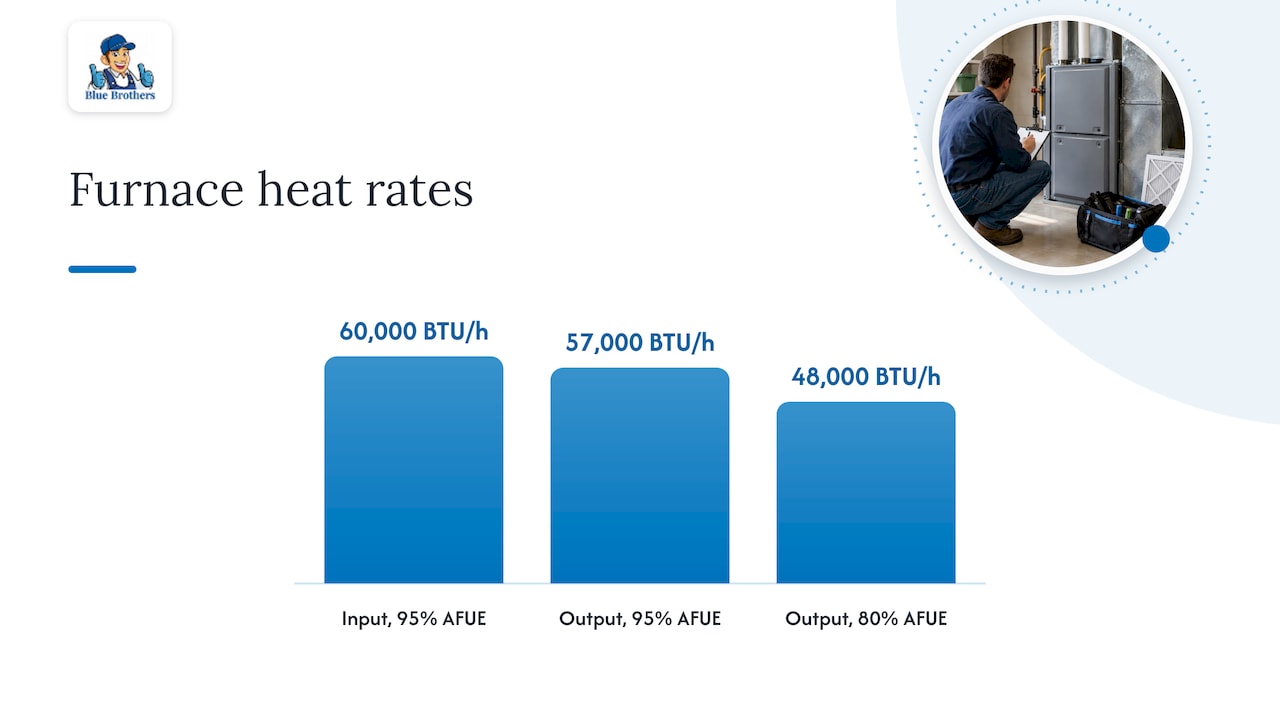
Here is a simple example. A 60,000 BTU input furnace at 95% AFUE delivers about 57,000 BTU of heat (60,000 × 0.95). The same input at 80% AFUE delivers about 48,000 BTU. So when you compare quotes, check whether the BTU figure is input or output. Two furnaces marketed as “60,000 BTU” can heat a house differently.
The quick estimate: BTU per square foot
A common consumer rule is 30 to 60 BTU per square foot depending on climate. The low end suits mild regions and tighter, well-insulated houses. The high end suits cold regions and leaky or poorly insulated ones.
Applied to common house sizes, the arithmetic looks like this:
| Heated floor area | At 30 BTU/sq ft | At 45 BTU/sq ft | At 60 BTU/sq ft |
|---|---|---|---|
| 1,000 sq ft | 30,000 | 45,000 | 60,000 |
| 1,500 sq ft | 45,000 | 67,500 | 90,000 |
| 2,000 sq ft | 60,000 | 90,000 | 120,000 |
| 2,500 sq ft | 75,000 | 112,500 | 150,000 |
The spread is the point. At 1,500 square feet, the gap between the low and high columns is 45,000 BTU, which is the difference between a small furnace and one twice its size. A workshop presentation on CSA F280 load calculations for a Canadian municipality made the same observation: the rule-of-thumb range is so wide that one house could end up with a furnace twice as large as another’s.
Use the table to answer a narrower question: does a quote look plausible? If a contractor proposes 120,000 BTU for a 1,500 square foot home, that is well above the table’s highest figure, and you should ask to see the calculation behind it.

Metric homes
If your plans or listings are in square metres, multiply by 10.76 to get square feet. A 140 m² house is about 1,507 square feet, so the 1,500 row applies.
Why square footage alone misleads
Two houses of identical floor area can need very different furnaces. Several inputs matter more than size.
Climate
Heating equipment is sized to the outdoor design temperature for your location, not to an average winter. NRCan’s guide for natural gas mechanical systems says designers should determine design heat loss using climate data for the building site. A house in Vancouver and one in Saskatoon face very different design days, even at the same square footage.
British Columbia’s Building Code is explicit about it. Section 9.33 of the BC Building Code requires heating systems in winter-use residential buildings to maintain at least 22°C in living spaces at the outdoor winter design temperature, and that design temperature must be determined under the code’s climate provisions.
Insulation and airtightness
Walls, attic, basement and air leakage decide how fast heat escapes. NRCan’s decision guide lists airtightness, window specifications and orientation among the inputs that affect heating and equipment sizing. Better insulation, such as the sandwich panel thermal performance used in some prefab builds, lowers the heat loss through walls and roofs, and a lower heat loss means a smaller furnace can do the job.
This is why an upgrade changes the answer. If you have added attic insulation, replaced windows or air-sealed the basement since the last furnace went in, the old furnace’s size is no longer a reliable guide.
Windows, orientation and layout
Large north-facing glass loses more heat than a small south-facing window that also collects sun. ASHRAE notes that a real load calculation considers construction, solar orientation, insulation R-values, room and floor arrangement, windows and doors as well as climate. Open-concept plans, vaulted ceilings and finished basements each shift the load in ways a square-foot rule cannot see.
Ductwork
A furnace only helps if its heat reaches the rooms. Leaky, undersized or crushed ducts, and ducts running through cold spaces, waste output. Duct condition affects both comfort and how hard the furnace must work, so it belongs in the sizing conversation, and in the maintenance one too (more on that below).
Efficiency
As shown above, the same heat requirement translates into a different input rating depending on AFUE. A high-efficiency unit can carry a lower input BTU number while delivering the same heat to your home.
How the right size is actually calculated
In Canada, the method is CSA F280. NRCan’s Heating with Gas guide says furnace size should come from a heat-loss calculation based on CSA F280, which looks at the home’s size, insulation levels and envelope airtightness. The same guide says an estimate based only on floor area, or swapping in a furnace equal to the old one, is not adequate in most cases.
A technical presentation on the standard describes it as a way to calculate heat loss and heat gain for selecting equipment in Part 9 buildings, with results given in BTU per hour or watts. Part 9 covers most houses and small buildings. The calculation uses the area of each wall and assembly, its thermal resistance, and the difference between indoor and outdoor design temperatures.
In plain terms, the calculator does this:
- Measures every surface that touches the outdoors: walls, ceiling or roof, floors over unheated space, foundation walls, windows and doors.
- Assigns each a thermal resistance (R-value or U-value) based on how it is built.
- Multiplies by the gap between your target indoor temperature and the outdoor design temperature for your location.
- Adds air leakage and ventilation requirements.
- Sums everything into a total design heat loss in BTU/h.
Then the equipment is chosen to satisfy that total. NRCan’s zoning duct guide puts it simply: heating equipment should be selected to meet the total design heating load.
What to ask for
When a contractor visits for a replacement quote, ask for:
- The F280 heat-loss result for your specific house, in writing.
- The assumptions: design temperature, R-values, window specs and air leakage rate.
- The furnace’s output BTU, AFUE and how it compares to the calculated load.
- What the quote includes: the unit, fittings, duct or piping changes, balancing and removal of the old furnace.
ASHRAE advises homeowners to have the contractor do the load calculation, and says a contractor unwilling to do so may not be the right choice. That is US guidance, but the logic applies anywhere.
What happens if the furnace is too big or too small
Oversized
Bigger feels safer, and it is the more common mistake. An oversized furnace costs more to buy and can cause comfort problems through short cycling: it heats fast, shuts off, then restarts, leaving uneven temperatures and more wear. NRCan’s guide reports that quoted equipment sometimes reached two to four times the calculated design heat loss. The same document says F280 analysis can improve comfort, reduce first cost and lower the risk of callbacks.
If you are choosing between staging options, our guide on single vs two stage furnaces explains how a two-stage unit handles mild days better than a single-stage one.
Undersized
An undersized furnace may not meet the design load, so it runs for long stretches and the house can lag behind the thermostat on the coldest days. The target is neither big nor small. It is a unit matched to the calculated load.
Worked example: a 1,500 square foot house
Suppose a 1,500 square foot two-storey house with average insulation. The rule of thumb gives a range of 45,000 to 90,000 BTU. A plausible workflow looks like this:
- Use 45 BTU per square foot as a mid-point to get roughly 67,500 BTU as a sanity check.
- Receive two quotes: one for a 60,000 BTU furnace and one for 100,000 BTU. The second is above the rule-of-thumb ceiling, so you ask why.
- Ask each contractor for the F280 heat-loss figure. If the calculation says the house loses 38,000 BTU/h on the design day, a unit delivering around 40,000 to 50,000 BTU of output is a sensible match, even though the rule of thumb suggested more.
The figures in step 3 are illustrative, not a standard for any house. The point is that a careful calculation can come in below the rule of thumb, especially after insulation and window upgrades, and that the calculation is what protects you from paying for capacity you cannot use.
Replacing an old furnace: do not just match the label
It is tempting to read the old furnace’s nameplate and buy the same number. NRCan warns that replacing with equivalent size is generally inadequate. The old unit may have been oversized from day one, or your home may have changed since.
Before replacing, it helps to know whether replacement is the right call at all. Our 30% rule for repair or replace explains how to weigh repair cost against a new unit. If you are weighing fuel types, see when gas beats electric furnaces, and for very cold regions, our comparison of a heat pump vs furnace in cold climates covers what changes below −20°C.
What a new furnace costs
Price depends on the calculated load, the efficiency rating and the installation scope, so no single national figure fits a 1,500 square foot house. NRCan’s advice is to obtain several firm written Canadian installation quotes that cover the unit, fittings, duct or piping upgrades, balancing and removal of the old equipment. Compare quotes line by line. A low price that leaves out duct work or removal is not lower.
To see what installation involves in our service area, read about furnace installation services in BC, Alberta and Saskatchewan.
Perspective: sizing is half the job
We clean furnaces, ducts, HRVs and coils across British Columbia, Alberta and Saskatchewan, so we spend our working days inside the systems that sizing decisions end up in. Here is how we see it.
A correctly sized furnace still performs badly if its airflow is choked. Dust-loaded filters, a dirty blower or a clogged duct run force a heating system to work harder, whatever its BTU rating. Sizing and cleanliness are two parts of the same question: is the heat you pay for reaching the rooms?
That is why we tell homeowners to treat sizing as a calculation and maintenance as a routine. Get the F280 numbers in writing. Then keep the system clean so the capacity you bought is the capacity you get. A new furnace tied to dirty ducts starts with a handicap, and an installation is a sensible moment to look at the duct side as well.
Our advice on a quote: the best one is not the biggest or the cheapest. It is the one that shows its working.
— Jayce
Keep the right-sized furnace working at full capacity
Once the furnace matches your house, airflow decides how well it performs. We offer furnace cleaning from $50 to $300, depending on the system, and air duct cleaning from $400 to $800. If you have an HRV, HRV cleaning runs $100 to $400. Prices are one-off and published on each service page. If you are planning a replacement, we can also help with furnace installation, and booking a cleaning before winter is an easy way to start the season right. See also why duct cleaning matters before winter.
A short checklist before you buy
- Note your heated floor area and any renovations since the last furnace was installed.
- Use the 30 to 60 BTU per square foot range to know what is plausible.
- Request a CSA F280 heat-loss calculation from each contractor, with assumptions.
- Compare output BTU and AFUE, not just the headline number.
- Get several written quotes with the same scope.
- Have ducts inspected, since a good unit cannot fix poor distribution.
FAQ
What size furnace do I need for a 1,500 square foot house?
The 30 to 60 BTU per square foot rule gives 45,000 to 90,000 BTU for 1,500 square feet. That is only a starting range. The actual figure depends on your climate, insulation and air leakage, and should come from a CSA F280 heat-loss calculation for your house.
How many square feet will a 60,000 BTU furnace heat?
At 30 to 60 BTU per square foot, 60,000 BTU covers roughly 1,000 to 2,000 square feet. Whether it works for your home depends on whether your calculated heat loss is at or below that furnace’s output. Remember that output is lower than input, for example about 57,000 BTU at 95% AFUE.
What happens if my furnace is too big?
It will short-cycle, which can cause uneven temperatures and extra wear, and it costs more to buy. NRCan has reported quoted equipment reaching two to four times the calculated design heat loss, so oversizing is a real risk. A matched unit is the better aim.
Can I size a furnace myself?
You can estimate a range with the square-foot rule, but you should not buy on that estimate. NRCan says a floor-area-only estimate is generally not adequate. Ask a qualified contractor for a documented F280 calculation instead.
Sources
- ASHRAE: Choosing the Right System for Your Home
- Natural Resources Canada: Heating with Gas
- Natural Resources Canada: Master Planning and Decision Guide for Natural Gas Mechanical Systems
- Natural Resources Canada: Zoning Duct Design Guide for Mechanical System Designers
- BC Building Code, Division B, Section 9.33 Heating and Air-conditioning
- CSA F280 HVAC Requirements for Part 9 Buildings
- Mechanical Design Workshop, Presentation 2: CSA F280-12 Load Calculations
- Bob Vila: What Size Furnace Do I Need?
- Sandwich Panel Thermal Performance Explained