Sanitizing air ducts means applying a chemical treatment to duct surfaces after the dust and debris have been physically removed. It does not replace cleaning. Consider it only when an inspection confirms mould, vermin contamination, fire or flood residue, or an odour that persists after you have fixed the cause. Fix moisture and maintain filters first.
TL;DR:
- Canadian rules require biocide labels to state directions and minimum contact times, with rinse instructions when needed; ask contractors for the product name and label.
- Before approving treatment, document the contamination with photos, an inspection report, or lab results, and confirm that the moisture or intrusion source has been fixed.
- Research reviews have not established that routine duct cleaning improves indoor air quality or health, and one residential study found no substantial bioaerosol reduction.
- A qualified crew should use containment and HEPA collection, remove contaminants mechanically, clean the air handler, fan, and coils, then document its work.
Table of Contents
- What is the difference between sanitizing and duct cleaning?
- Which sanitizing agents are used, and what do the rules say?
- When is sanitizing actually appropriate?
- What does the evidence say about risks and limits?
- What should a professional sanitizing service include?
- How can you reduce the need for sanitizing?
- Why I push for proof before any chemical goes in your ducts
- How we help with inspection, cleaning and documented sanitizing
- FAQ
- Sources
What is the difference between sanitizing and duct cleaning?
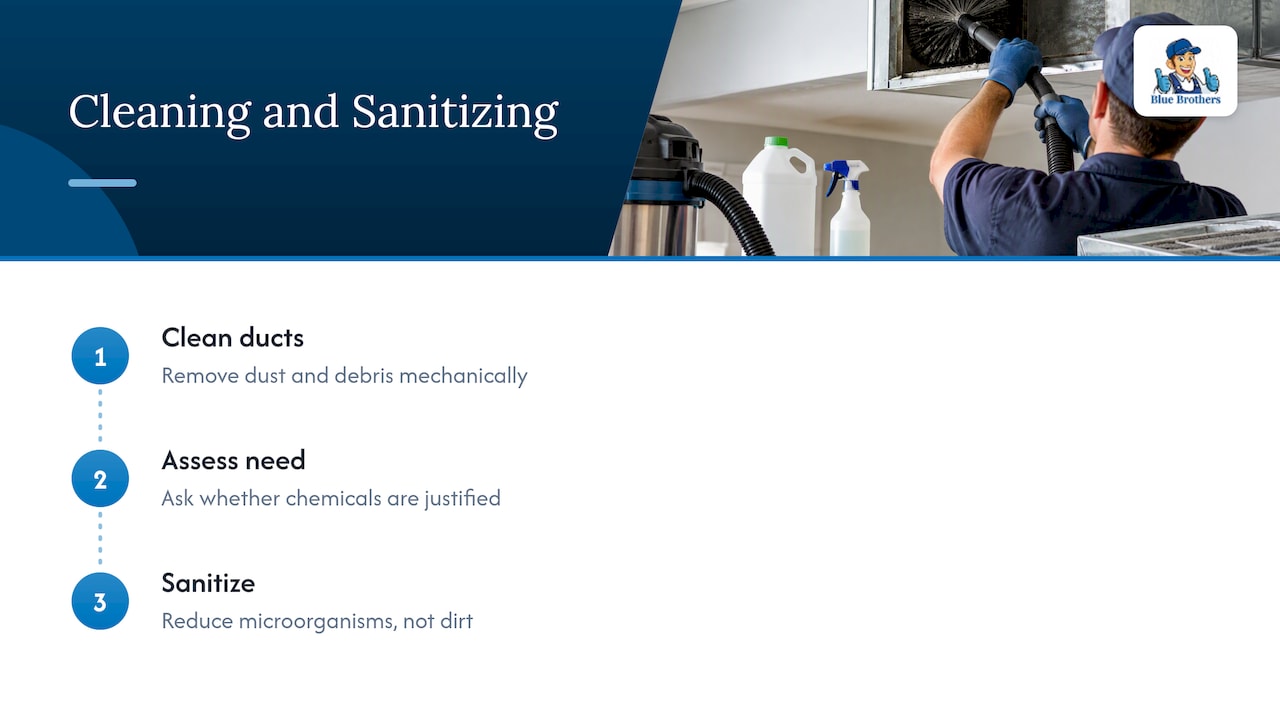
Cleaning and sanitizing do two different jobs, and mixing them up is how homeowners end up paying for the wrong one. Duct cleaning is mechanical. A technician uses HEPA-filtered vacuums, brushes and air tools to pull dust, debris and built-up residue off duct surfaces, and also cleans the fan and coils. That physical removal is the foundation of any duct service.
Sanitizing is a chemical step. It means applying an antimicrobial or biocidal product to surfaces to reduce microorganisms. It does not lift dirt. Spray it over dust and debris that are still in place, and the product can coat the contaminants instead of reaching the surface underneath, which weakens the result.
The order matters for another reason. A Canadian review of duct cleaning methods found that return-duct surface dust often dropped after cleaning, but it also found that biocide use varied widely and advised holding off on applying biocides until their effectiveness and possible effects are better established. So the safe default is simple: remove the source first, then ask whether a chemical step is justified at all.
Which sanitizing agents are used, and what do the rules say?
Industry practice draws on a few families of products. You will hear about general surface sanitizers and biocides, formulations built on peracetic acid or hydrogen peroxide, and other antimicrobial products used as surface treatments. The name on the truck matters less than what is on the label and whether the product is approved for the claim being made.
Canada regulates this. The Biocides Regulations and monograph guidance set out permitted active ingredients, in-use concentrations and minimum contact times for sanitizers and disinfectants. They also require proper labelling and directions for use, including rinse steps where they are necessary.
Regulatory point: Sanitizers and disinfectants in Canada must carry labels with directions for use, minimum contact times and, where needed, rinse statements, as set out in Health Canada’s biocide monograph.
If a contractor proposes sanitizing, ask for these in writing:
- The exact product name and its label directions
- The contact time the label requires
- Whether a rinse step applies
- How the product will be applied and how your household will be kept safe
A contractor who cannot name the product or show its label has not earned the upsell.
When is sanitizing actually appropriate?
Sanitizing earns its place in a short list of situations, and each one should be documented before anyone opens a spray bottle. These include visible or lab-confirmed mould after water intrusion, vermin nesting or infestation in the ducts, fire or flood residue, and stubborn odours traced to duct interiors that did not clear after corrective measures.
Ordinary dust is not on that list. A dusty register or a general worry about allergies rarely justifies a chemical treatment. Health Canada’s guidance suggests a qualified professional inspection when a musty odour or suspected mould in ductwork persists, which is a very different trigger from “the ducts look old.” If a smell is what brought you here, our guide to musty smells from vents walks through checks you can run first.
Use this checklist when you talk to a contractor:
- Has the moisture or intrusion source been found and fixed?
- Is the contamination documented with photos, an inspection report or lab results?
- Will source-removal cleaning happen before any product is applied?
- Are post-service checks or measurements planned?
- Can they show you the product label and safety directions?
What does the evidence say about risks and limits?
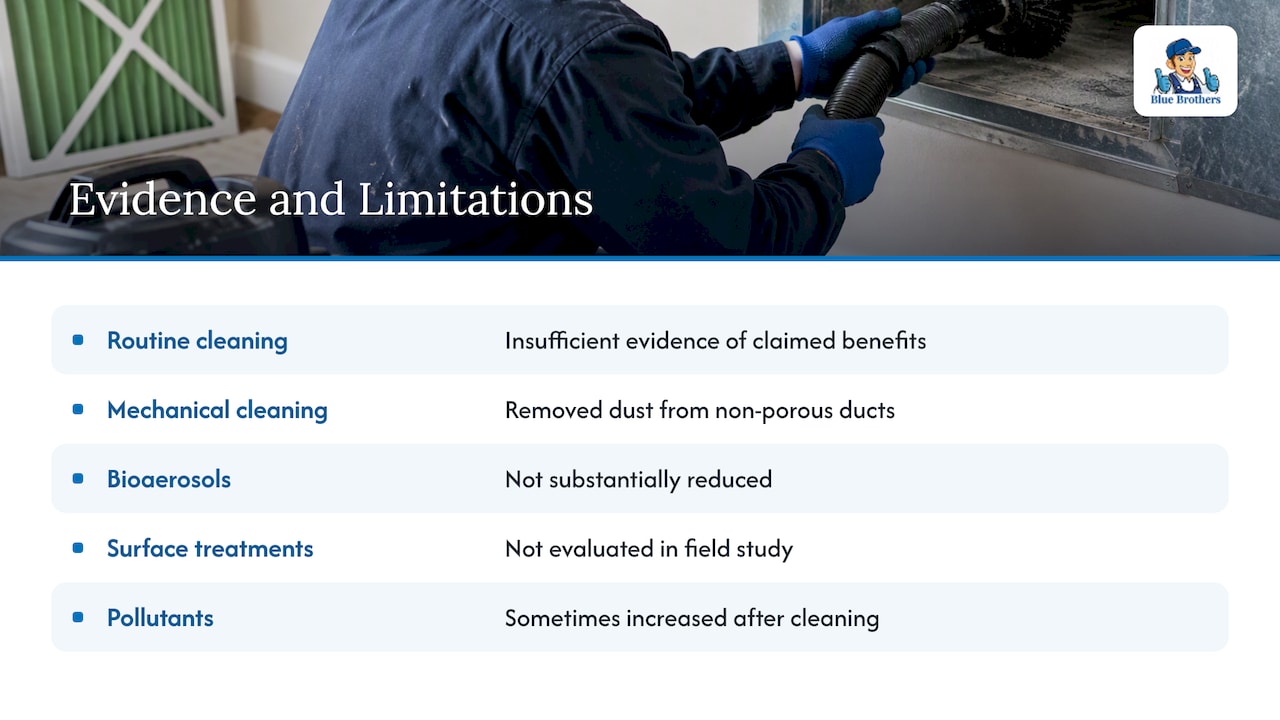
The research is more cautious than most marketing. A review in the National Research Council archive concluded that routine duct cleaning lacks sufficient evidence of improving indoor air quality, occupant health, HVAC performance or energy savings, while acknowledging that ducts can hold dust and microbes and that targeted cleaning may suit some cases.
Ducts can act as reservoirs for dust and microbes, yet routine cleaning has not been shown to deliver the benefits often claimed for it.
Field work points the same way. In an EPA and NADCA residential field study, mechanical cleaning removed deposited dust from non-porous ducts, but it did not substantially reduce bioaerosol levels, and surface treatments were not evaluated at all. A separate literature review found that field studies report variable and sometimes increased pollutant concentrations after cleaning, and it raised health concerns about biocides and sealants.
Work itself can stir things up for a while, so containment and HEPA collection matter. Where biocides are used, standardised testing protocols call for targeted airborne biocide measurements along with pre- and post-cleaning checks.
What should a professional sanitizing service include?
A trustworthy service starts with physical source removal, not a spray. That means HEPA-filtered vacuuming, brushing or air washing of the ducts, plus cleaning the air handler, fan and coils. Contaminants stay out of your living space only if the crew uses containment and negative-air HEPA collection. Guidance for occupants also recommends NADCA-member contractors with certified technicians using that kind of equipment.
If sanitizer is part of the job, expect this paperwork and process:
- Labelled product names and the application method
- Contact times and the safety steps for occupants
- A post-service inspection, with measurements where appropriate
- A written record of what was done and where
Pro Tip: Ask for before and after photos of the same duct sections, and for the product label, before you approve any chemical step.
If your ducts are dirty after construction, a post-renovation duct cleaning check shows what a pro should look at first.
How can you reduce the need for sanitizing?
Prevention does most of the work. Health Canada points to regular HVAC upkeep as the better-documented path: changing filters, cleaning coils and keeping the fan assembly clean have a clearer effect on air quality and efficiency than duct cleaning alone.
- Change filters on schedule and keep coils and drain pans clean
- Book regular furnace and AC service
- Look after your HRV or ERV, humidifier and humidistat, and clean any device that holds water, as federal guidance for indoor air professionals advises
- Seal ducts during renovations and repair leaks quickly
- Schedule an inspection after renovations, water events, animal intrusion or odours that linger
For a plain-language look at the maintenance side, this homeowner article on air vent cleaning benefits covers when the work is worth it. Our own guide on how often to clean your ducts explains realistic timing.
Why I push for proof before any chemical goes in your ducts
My view is simple: documented source removal, safe equipment and a post-service inspection come before any sanitizer. If a contractor pushes sanitizing as a routine add-on for ordinary dusty ducts, treat that as a red flag and ask what they found that justifies it.
— Jayce
How we help with inspection, cleaning and documented sanitizing
We start with what the evidence supports: a proper inspection and thorough cleaning that removes the source. Our team works for homes and for commercial buildings.
Here is where to start:
- Our air duct cleaning service covers inspection and cleaning, with prices of $400–$800 CAD one-off
- Our residential services page lists furnace, dryer vent, coil and HRV cleaning
- Property managers can see our commercial duct cleaning options
Tell us what you are seeing or smelling, and we will book an inspection and give you a clear quote before any work starts.
FAQ
Does sanitizing air ducts actually work?
It can reduce microorganisms on treated surfaces, but only after the ducts have been physically cleaned. Evidence for routine biocide use is limited, and a Canadian review advised holding off on applying biocides until their effectiveness and effects are better understood.
How often should ducts be sanitized?
Not on a schedule. Sanitizing is for documented cases such as confirmed mould, vermin or fire and flood residue, not a yearly routine. Regular filter changes and HVAC maintenance do more for everyday air quality.
Can I sanitize my own air ducts?
We do not recommend it. Products must be used as their labels direct, with set contact times and sometimes rinse steps, and applying them over unremoved dust reduces their effect. If you suspect mould, have a qualified professional inspect first.
Is it normal for a contractor to offer sanitizing with every cleaning?
No. Sanitizing should follow an inspection that documents a reason for it. Ask for the product label, application method and post-service check before agreeing.
Sources
- Duct Cleaning
- Is ventilation duct cleaning useful? A review of the scientific evidence – NRC Publications Archive – Canada.ca
- Canada