Most homes need a duct cleaning after a major renovation, especially when drywall sanding, demolition or uncontained cutting happened near return vents or inside living spaces. The clearest triggers are visible dust blowing from registers, a household member with asthma or allergies, or any job that ran for more than a few days without containment. When those conditions apply, booking a professional cleaning with cleanliness verification the kind NADCA’s standard describes is worth the cost.
TL;DR:
- A review found duct cleaning alone does not reliably improve air quality under normal conditions; pair it with a filter upgrade or portable HEPA filtration.
- If renovation work disturbs old plaster, pipe insulation, or flooring in a home built before the 1990s, test for lead or asbestos before standard cleaning.
- Request an inspection with before and after photos, containment, mechanical agitation, and negative air HEPA vacuuming; ask whether air handler and coil cleaning cost extra.
- Seal work areas, capture sanding dust at the tool, and shut off the HVAC or cover returns during heavy demolition; replace filters afterward.
- Duct cleaning costs $400 to $800 CAD per job, depending on system size, condition, and whether coil or air handler work is included.
Table of Contents
- Why post-renovation duct cleaning matters for air quality and HVAC
- What renovation dust contains and why it matters for your health
- Signs you need a post-renovation duct cleaning
- What a professional post-renovation duct cleaning includes
- How to reduce dust and protect your HVAC during and after renovation
- What years of post-renovation calls have taught us
- Ready for a post-renovation inspection or quote?
- FAQ
- Sources
Why post-renovation duct cleaning matters for air quality and HVAC
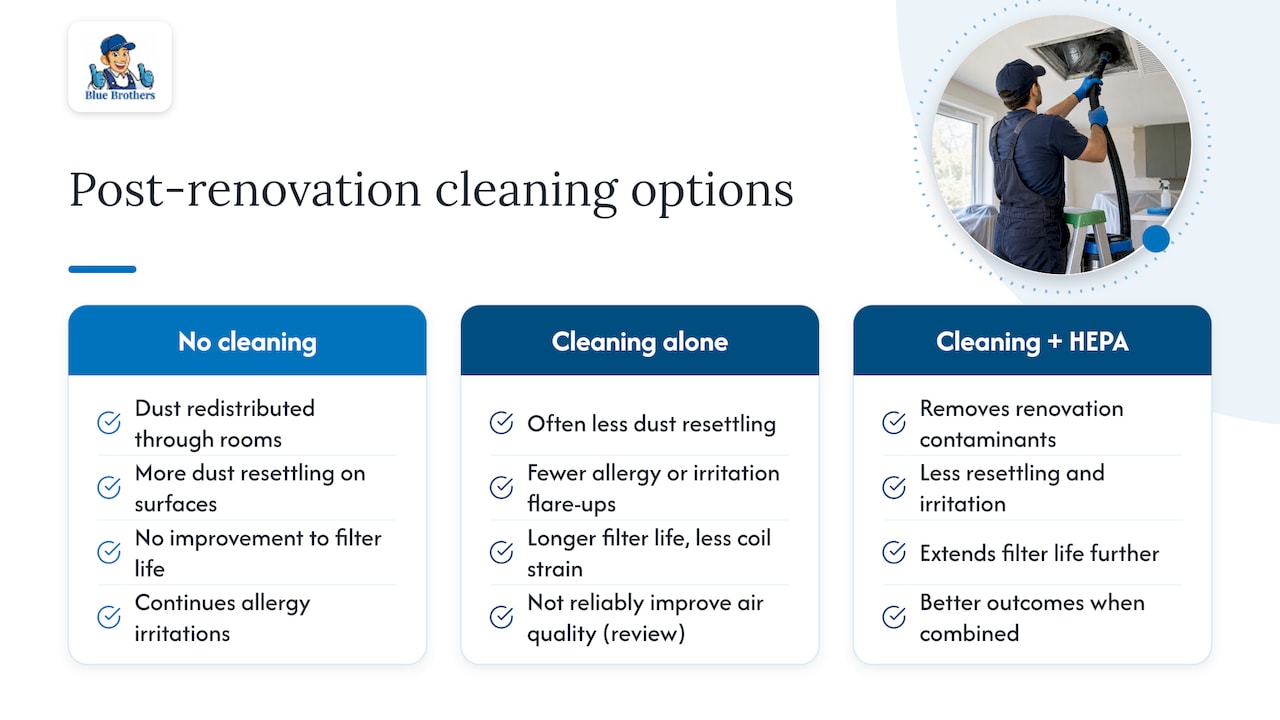
Renovation dust does not settle quietly. Once drywall powder, sawdust or insulation fibres get pulled into a return vent, your HVAC system redistributes them through every room each time it cycles on. That is the core problem with skipping a cleaning after heavy construction work: the contamination does not stay where the work happened.
Homeowners who get ducts cleaned after a dusty renovation often notice less fine dust resettling on furniture and floors, fewer allergy or irritation flare-ups related to HVAC operation, and longer filter life with less strain on coils that would otherwise trap heavy debris. However, results vary with the level of contamination and subsequent maintenance. A Canadian literature review found that duct cleaning alone does not reliably improve air quality under normal household conditions, but combining it with a filter upgrade or portable HEPA filtration can achieve better outcomes.
What renovation dust contains and why it matters for your health
Construction dust is not a single substance. A typical renovation can leave behind drywall dust, wood dust, paint particles, insulation fibres, and in some materials, respirable crystalline silica from cutting concrete, tile or certain stone products. If a home was built before the 1990s and the work disturbed old plaster, pipe insulation or flooring, pause and test for lead or asbestos before continuing, since those require specialized handling rather than standard duct cleaning.
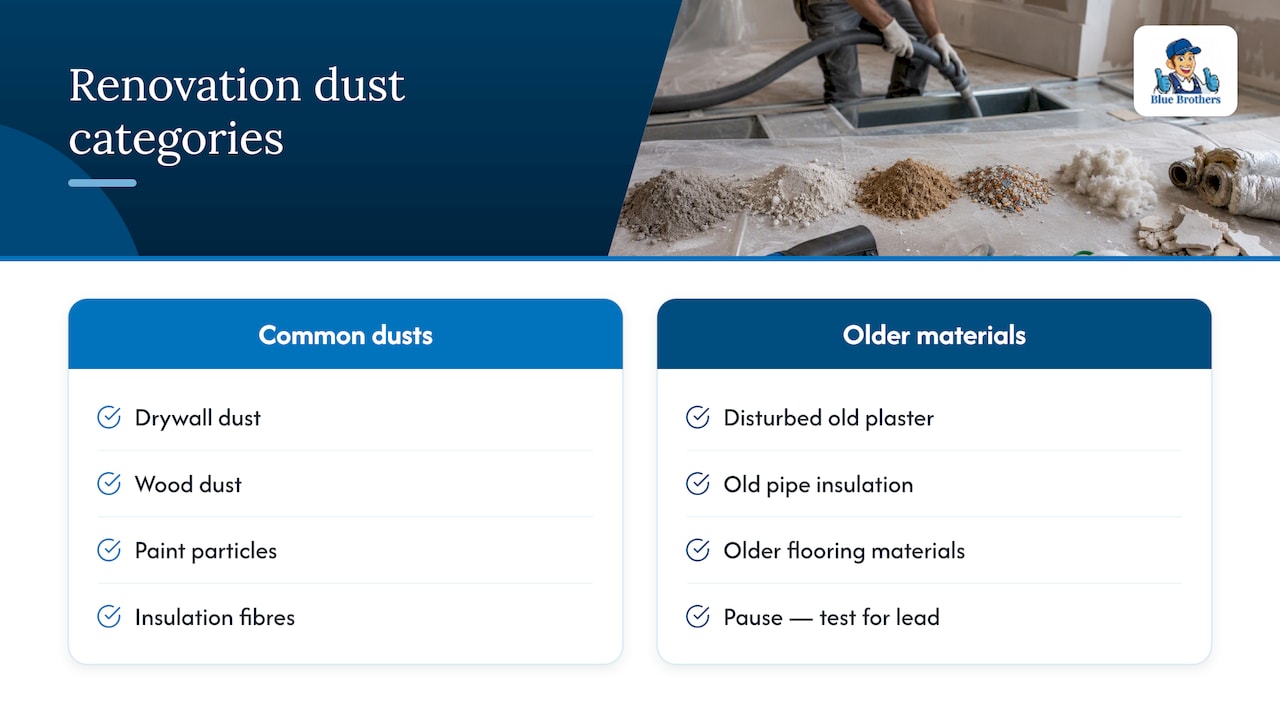
Crystalline silica and wood dust are recognized occupational hazards that can aggravate respiratory conditions when they become airborne, according to the Canadian Centre for Occupational Health and Safety. These particles are small enough to stay suspended and get pulled directly into ductwork during sanding or demolition.
Fine dust circulating through a forced-air system is especially hard on people with asthma, seasonal allergies, young children and older adults, whose airways are more sensitive to repeated low-level exposure.
Signs you need a post-renovation duct cleaning
A few observable clues tell you whether cleaning should move from “maybe” to “book it this week”:
- Dust or visible debris blows out of registers when the HVAC system starts up.
- Heavy sanding, cutting, demolition or uncontained work happened anywhere inside the home, not just in the renovated room.
- Someone in the household developed new coughing, sneezing or congestion that tracks with running the furnace or air conditioner.
- You can see a layer of fine dust on return grilles or inside visible duct sections when you remove a vent cover.
If any of these apply, request an inspection with photo documentation before and after cleaning so you have a record of what was actually removed. Homeowners who want to check a few things themselves first can review simple DIY checks for dust at the vents to decide whether a professional visit is warranted.
What a professional post-renovation duct cleaning includes
A properly run job follows a sequence, not a quick vacuum pass. Expect a technician to:
- Inspect the system first and document conditions with photos, noting which registers and return lines show the heaviest buildup.
- Seal off work areas and use containment so dislodged dust does not spread into clean rooms during the cleaning itself.
- Use mechanical agitation paired with negative-air HEPA vacuuming to pull debris out of the ductwork rather than just stirring it loose.
- Clean accessible registers, grilles, and when needed, air-handler components like the blower and coil.
The NADCA ACR standard sets out these mechanical-cleaning methods along with cleanliness verification options, including visual inspection and a vacuum test, that you can request as proof the job met a recognized benchmark. Documentation matters because the same research cautioning that duct cleaning alone is not a guaranteed fix also found that improperly performed cleaning, without containment or HEPA capture, can temporarily raise airborne particle levels instead of lowering them.
Pro Tip: Ask for before-and-after photos of the dirtiest duct sections in writing. A technician with nothing to show usually has nothing to hide, but a technician with photos has proof.
How to reduce dust and protect your HVAC during and after renovation
Good containment during the job makes any later cleaning faster and cheaper, and sometimes removes the need for one altogether.
- Seal doorways with plastic sheeting and use source-capture tools, such as sanders with on-tool dust extraction, wherever possible.
- Run a portable HEPA air cleaner in the work zone and, if feasible, shut off the HVAC system or seal the return vents while heavy sanding or demolition is underway.
- Once the dusty work ends, replace furnace filters immediately, upgrading to a MERV 13 filter paired with portable HEPA filtration where your system allows it.
- Wipe down accessible registers and grilles by hand before running the furnace or air conditioner again.
- Avoid running forced air at full blast until the worst of the gross dust has been cleared from the work area.
Pro Tip: Before booking, ask the duct-cleaning company whether coil cleaning, air-handler cleaning or filter replacement is included in the quoted scope, since these are often priced separately. For general post-renovation surface cleaning workflows beyond the ductwork itself, resources like Cleaning Point outline practical sequencing for tackling dust room by room.
What years of post-renovation calls have taught us
Not every renovation needs a duct cleaning. A single room refresh with doors kept shut and a shop vac running the whole time rarely contaminates the whole system. The jobs that consistently need professional attention are whole-home renovations, open-concept demolitions, and anything involving unenclosed drywall sanding near a central return.
Our technicians document every job with photos because homeowners deserve proof, not promises. We also encourage asking for scope details in writing before work starts: which registers get cleaned, whether the air handler is included, and whether verification is offered on request. A provider who hesitates to put that in writing is one to question.
Trust is built one documented job at a time, not one sales pitch at a time.
— Jayce
Ready for a post-renovation inspection or quote?
If your renovation checked any of the boxes above, heavy sanding, visible dust at the registers, or a household member feeling it in their lungs, a straightforward next step is requesting a free inspection or quote for air duct cleaning.
When you request a quote, ask specifically for the scope (registers, air handler, coil), containment and documentation practices, and whether NADCA verification is available if you want it. It is also worth asking whether dryer vent cleaning should be bundled in, since renovation dust and lint buildup often get discovered together. We document every job with photos so you can see exactly what came out of your system, not just take our word for it.
This article is general information, not a substitute for advice from a qualified doctor. Consult a qualified healthcare professional about your own circumstances before acting on anything here.
FAQ
What is the 2 foot rule for ducts?
The “2 foot rule” generally refers to inspecting and cleaning duct sections within about two feet of major access points, like the air handler or main trunk lines, since debris concentrates most heavily there. It is a practical inspection shortcut technicians use, not an official regulatory standard, so ask your provider how they define it for your system.
What time of year is best for duct cleaning?
There is no single correct season for duct cleaning, but many homeowners schedule it right after a renovation regardless of time of year, since waiting lets dust recirculate longer. Spring and fall are popular choices because they fall before heavy air conditioning or heating use begins.
How much does Home Depot charge for duct cleaning?
Home Depot does not perform duct cleaning directly and typically refers customers to third-party contractors, so pricing varies by provider and region. For a direct comparison, our air duct cleaning service is priced at $400 to $800 CAD per job, depending on system size and condition.
Does cleaning air ducts really make a difference?
It can, but the effect depends on contamination level and how the cleaning is performed. A Canadian literature review found insufficient evidence that duct cleaning alone consistently improves air quality under normal conditions, but it can meaningfully reduce dust recirculation after heavy contamination events like a renovation, especially when paired with a filter upgrade.
Sources
- CCOHS: Silicosis
- Is ventilation duct cleaning useful? A review of the scientific evidence — NRC
- NADCA the ACR standard (2021 edition)