For most Canadian homes, a HEPA filter is the better choice, because it physically removes the dust, dander, pollen and smoke particles that people actually notice. UV-C light does something different: it inactivates some bacteria and viruses, and it does nothing about particles. The two are not rivals so much as tools for different jobs, and neither replaces a clean duct system and a good furnace filter.
TL;DR
- HEPA removes, UV inactivates. A true HEPA filter captures at least 99.97% of 0.3-micron particles. UV-C only targets living microorganisms, and only if they sit in the light long enough.
- For dust, allergens and smoke, choose HEPA. UV does not remove non-living particles.
- Combined units are rarely worth the extra cost at home. ASHRAE-based guidance says the added benefit over good filtration is small.
- Your furnace probably can’t take a HEPA filter. A MERV 13 furnace filter (if your system allows it) plus a portable HEPA unit is the practical combination.
- Check certification and ozone. Be sceptical of any UV device that promises to “sanitize” your air.
Table of Contents
- What each technology actually does
- UV vs HEPA side by side
- Why UV doesn’t fix what bothers most people
- What the maths says about adding UV to good filtration
- Can you put HEPA in your furnace?
- Buying a UV or combination purifier: what to check
- Which should you choose? A quick decision guide
- Commercial and shared spaces
- Our perspective: fix the system before you buy gadgets
- Where cleaning fits in
- FAQ
- Sources
What each technology actually does
HEPA: a physical filter
HEPA stands for high efficiency particulate air. Health Canada lists HEPA portable air cleaners as one way to lower indoor fine particulate matter. The standard definition of a true HEPA filter is one that captures at least 99.97% of particles 0.3 micrometres across. That covers fine dust, pollen, pet dander and smoke particles. Smaller and larger particles are generally caught even more effectively than that benchmark size.
The key point is that HEPA is subtractive. The particle leaves the air and stays in the filter until you replace it.
UV-C: light that inactivates microorganisms
Germicidal ultraviolet (UV-C) damages the genetic material of bacteria, viruses and mould spores so they can’t reproduce. It is a disinfection method, not a cleaning method. ASHRAE’s filtration and disinfection guidance treats it as a separate category from filters, and the effect depends on dose: how intense the light is and how long the air or surface is exposed.
That matters in a house. Air moves through a furnace or a small purifier quickly, so a microbe may spend only a fraction of a second near the lamp. A UV unit that is too small, too weak or too fast can leave most of the air effectively untreated.
UV vs HEPA side by side
| HEPA filter | UV-C light | |
|---|---|---|
| What it does | Traps particles in dense fibre media | Inactivates bacteria, viruses and mould it can reach |
| Dust, pollen, dander, smoke | Yes | No |
| Bacteria and viruses | Captures those carried on particles or droplets | Can inactivate them, depending on dose |
| Depends on | Airflow, a good seal, filter replacement | Lamp strength, exposure time, clean and current lamps |
| Maintenance | Replace the filter on schedule | Replace lamps on the manufacturer’s schedule and keep them clean |
| Main risk | Restricted airflow if forced into the wrong system | Ozone from some devices, overstated marketing claims |
| Best fit | Everyday home air quality | Targeted uses such as coil or drain pan surfaces, or specialized spaces |
Why UV doesn’t fix what bothers most people
Most complaints we hear about household air are about dust, pet hair, pollen and the stale feeling after a long winter indoors. These are non-living particles. UV light doesn’t change their size or their ability to irritate you. The North Carolina Department of Public Health’s guide to air-cleaning devices is a good neutral reference on what filtration can and can’t do in buildings.
Where UV does have a legitimate role is on surfaces and in specific settings. The ASHRAE Journal discussion of UVGI myths notes that some air “purifiers” are marketed as including UV-C, and that people don’t always understand how much risk reduction it really contributes. Typical uses include keeping cooling coils and drain pans from growing mould, and upper-room systems in places such as clinics.
The Public Health Agency of Canada has also reviewed the evidence on UV germicidal irradiation in occupied rooms (August 2022). It frames UV as one layer among several, alongside ventilation and filtration, not a stand-alone answer.
What the maths says about adding UV to good filtration
Here is the simple logic ASHRAE-based guidance uses. If a filter already removes 60% of infectious material and a UV stage inactivates 90% of what’s left, the total extra reduction from UV is 36 percentage points of the original load. That sounds decent until you compare it with what you pay and maintain. Once your filtration is already good, each additional layer adds less.

In a typical house, the real bottleneck is rarely a lack of light. It is filter efficiency, airflow and whether the system is clean. That is why we’d put money into those first.
Can you put HEPA in your furnace?
Usually not. HEPA media is dense, so it creates high resistance to airflow. A standard residential furnace blower isn’t built to push air through it. Forced in, it can starve the system of airflow, strain the motor or let air slip around the filter edges instead of through it.
The practical split looks like this:
- In the furnace or air handler: use the highest-rated filter your system tolerates, usually MERV 11 to 13. Our guide on choosing MERV 13 or 11 without straining your HVAC explains how to check.
- In the rooms that matter: add a portable HEPA air cleaner, sized to the room, where you sleep or spend the most time. Our piece on pairing MERV 13 with a portable HEPA covers why this protects most homes without an HVAC upgrade.
- On a schedule: check and replace filters regularly. A clogged filter of any rating hurts airflow. See our air filter replacement schedule.
Buying a UV or combination purifier: what to check
This is the part where homeowners get burned. Many portable UV devices are sold with words like “sanitize” or “kills 99% of germs” and very little proof.
- Ozone. Some UV and ionizing devices produce ozone, a lung irritant. Health Canada explains the concerns about ozone in indoor air. Avoid any unit that releases it on purpose.
- Regulation. In Canada, UV radiation-emitting and ozone-generating devices used in homes and businesses can fall under the Pest Control Products Act, as Health Canada sets out in its page on devices subject to the Act. A claim to kill pathogens needs testing behind it.
- Enforcement. The Competition Bureau has cracked down on deceptive claims about UV and other products made without the testing the law requires.
- Third-party test data. Look for published results that reflect real rooms, not only lab conditions, and for an independent certification of low ozone output.
- Running costs. Add up replacement HEPA filters, UV lamp changes and electricity before you compare prices.
Which should you choose? A quick decision guide
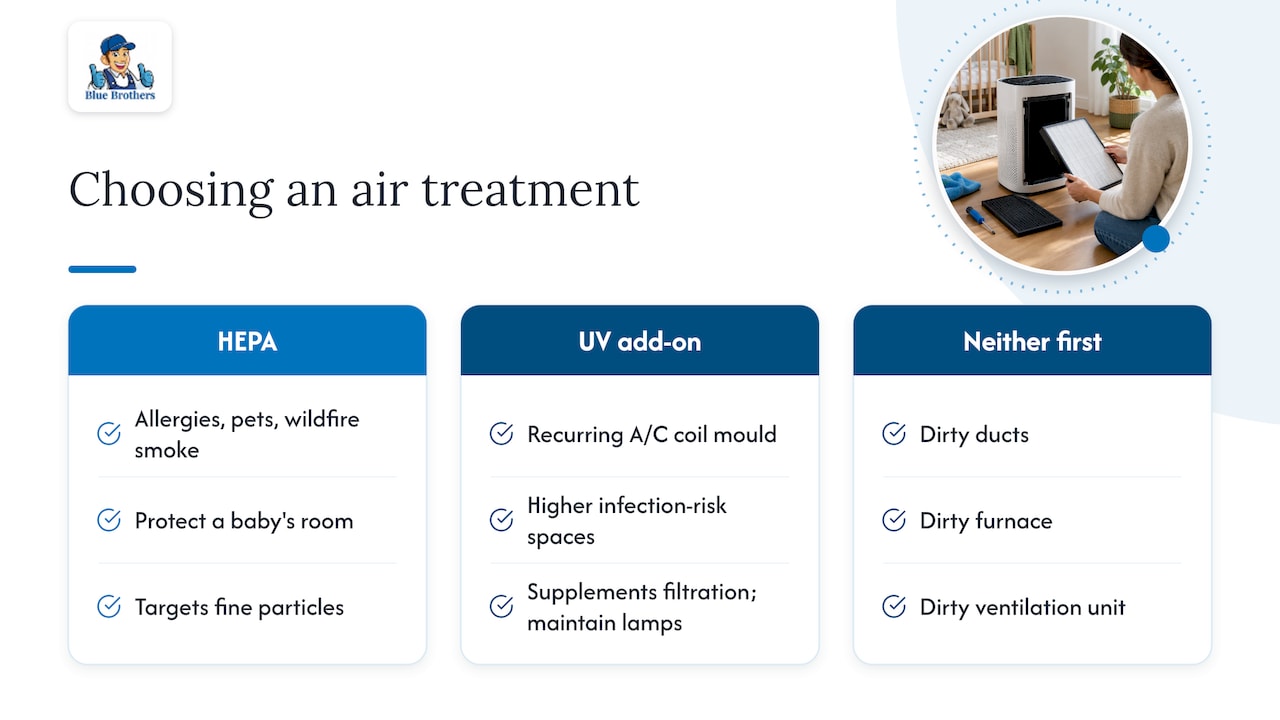
Choose HEPA if you have allergies, pets, wildfire smoke in summer, or a baby’s room to protect. Particles are the problem, and HEPA is the proven answer. Health Canada points to portable HEPA units for exactly this fine-particle problem.
Consider a UV add-on if a professional has identified a specific need, such as recurring mould growth on an A/C coil, or you manage a space with higher infection risk. Even then, it supplements filtration. ASHRAE’s guidance stresses that lamps must be kept clean and replaced on schedule, because dust on the lamp blocks the light.
Choose neither first if your ducts, furnace or ventilation unit are dirty. A purifier in the living room does little for the air that is also circulating through a neglected system.
Commercial and shared spaces
The same logic holds outside the home, with higher stakes. In offices, workshops and industrial buildings, the problem is often settled dust on surfaces and in overhead structures, which no purifier will lift. If you manage such a space, a specialized crew handling industrial dust accumulation in Winnipeg shows what high-dusting work involves. Commercial HVAC systems also benefit from professional duct cleaning for businesses before anyone adds filtration upgrades.
Our perspective: fix the system before you buy gadgets
We clean ducts, furnaces, HRVs and coils across Saskatchewan, British Columbia and Alberta, and the pattern repeats. People call us after buying an air purifier that didn’t change the dust on their shelves. When we open the system, the cause is usually obvious: a clogged filter, debris in the ducts, a dirty blower or a coil that hasn’t been touched in years.
Our view is plain. Source control and mechanical filtration come first. Keep the furnace filter at the highest rating your system handles, keep it changed, keep the ducts and equipment clean, and ventilate properly. Then, if you want extra protection in a bedroom, add a portable HEPA unit from a maker that publishes real test data.
UV has a place, but it’s a narrow one. We would not tell a family to pay for a UV purifier to solve a dust problem, and we’re wary of any device that promises to sanitize your home’s air with a light bulb.
— Jayce
Where cleaning fits in
A clean system gives any filter, HEPA or otherwise, a fair chance. Here is what we offer, with our published prices:
- Air duct cleaning: $400-$800 CAD, one-off.
- Furnace cleaning: $50-$300 CAD, one-off.
- HRV cleaning: $100-$400 CAD, one-off.
- Air conditioning coil cleaning: $100-$400 CAD, one-off.
If you’re not sure where to start, our residential cleaning page lays out the services for homes in BC, Alberta and Saskatchewan. Ask us what your system needs before you spend on a purifier.
FAQ
Is a UV air purifier better than HEPA?
Not for most homes. HEPA removes dust, pollen, dander and smoke particles, while UV-C only inactivates certain microorganisms and does nothing about particles. UV works best as a supplement in specific situations, not as a replacement.
What are the downsides of a UV air purifier?
The light must reach microbes for long enough, and airflow through small devices is fast. Lamps need cleaning and replacing, and some devices can produce ozone. Marketing claims are often hard to verify, so look for independent test data.
Is it worth buying a HEPA plus UV combination unit?
There is no known harm in having both, but the added purchase price, power use and lamp upkeep rarely pay off in a standard home. If you want one, make sure the HEPA part is a true HEPA filter and the unit has low ozone certification.
Can I install a HEPA filter in my furnace?
Generally no. HEPA media restricts airflow too much for a typical residential furnace blower. Use a MERV 11 to 13 filter in the furnace if your system allows it, and add a portable HEPA unit for rooms where you want the strongest protection.
Sources
- Fine particulate matter, Health Canada
- Filtration / Disinfection, ASHRAE
- Indoor Environmental Quality and Air-Cleaning Devices, NC DPH
- UV germicidal irradiation evidence summary, Public Health Agency of Canada
- Devices subject to the Pest Control Products Act, Health Canada
- Competition Bureau on deceptive marketing claims, Canada.ca