For most homes, a MERV 13 central filter paired with a portable HEPA cleaner in high-occupancy rooms gives the best balance of filtration, airflow and cost. True in-duct HEPA rarely fits a standard residential furnace because of pressure drop and fan limits. Check your current filter’s MERV rating and your furnace manual before buying anything, or ask a technician to confirm what your system can handle.
TL;DR:
- MERV 13 filters are optimal for most homes, balancing efficient particle capture with manageable pressure drop for common residential HVAC systems.
- In-duct HEPA filters rarely fit standard furnaces due to airflow restrictions, so portable HEPA units are more practical for high-risk rooms.
- Moving beyond MERV 13 offers diminishing returns, with MERV 16 providing only marginal additional benefits unless system capacity allows for it.
- Upgrading filters without checking system pressure limits or ensuring proper sealing can reduce airflow and negate filtration improvements.
- Regular replacement and duct cleaning are essential to maintain filter performance and prevent recontamination, especially after a system or filter upgrade.
Table of Contents
- What is a MERV rating and how does the MERV scale work?
- What is HEPA and how do true HEPA filters perform?
- Comparing MERV and HEPA by particle size and real-world performance
- HVAC system considerations: pressure drop, fan capacity and fit
- Choosing and combining filters for your home’s needs
- Keeping filters working: replacement and monitoring
- Why clean ducts and a well-maintained system matter as much as the filter
- What actually moves the needle on indoor air
- How we help your filtration upgrade actually work
- FAQ
- Sources
- Key sources and standards to read next
What is a MERV rating and how does the MERV scale work?
MERV stands for Minimum Efficiency Reporting Value, a scale from 1 to 16 that measures how well a filter captures particles of different sizes. The rating comes from ASHRAE Standard 52.2, which groups particles into three bands: E1 (0.3 to 1 micron), E2 (1 to 3 microns) and E3 (3 to 10 microns). A higher number means the filter traps more particles in each band, but the practical jump between ratings matters more than the number alone.
Here is what common household ratings tend to capture:
- MERV 8: catches larger particles like dust, lint and pollen, standard in many builder-grade furnaces.
- MERV 11: adds better capture of pet dander and fine dust, a common upgrade for allergy sufferers.
- MERV 13: captures much smaller particles, including fine PM2.5 and many bacteria-sized particles.
- MERV 16: approaches HEPA-level capture for some particle sizes, though few residential systems can run it.
MERV is an efficiency measure, not a health guarantee. Each-pass removal efficiency, how much of a particle size gets trapped on a single pass through the filter, is a more honest way to think about real-world performance than the MERV number by itself.
What is HEPA and how do true HEPA filters perform?
True HEPA means a filter captures at least 99.97% of particles at 0.3 microns, the hardest particle size to trap. That specification is strict, and it is why terms like “HEPA-like” or “HEPA-type” on consumer products are marketing language, not a certified standard.
A few practical points matter more than the label:
- Form factor: most true HEPA filtration happens in portable air cleaners with a dedicated, sealed blower, not inline in a furnace duct.
- Why in-duct HEPA rarely works at home: standard residential furnace blowers aren’t built to push air through HEPA-density media, so airflow and heating or cooling performance suffer.
- What HEPA does not remove: gases and volatile organic compounds pass right through particle filters, HEPA included.
- Placement matters: a portable HEPA unit needs unobstructed airflow and the right room size to perform as rated.
Comparing MERV and HEPA by particle size and real-world performance
The honest answer to “is MERV 13 the same as HEPA” is no, but the practical gap for household air quality is smaller than the numbers suggest. A peer-reviewed modelling study on home ventilation filters found that MERV 12 and MERV 13 filters produce large, clinically relevant reductions in common asthma and allergy triggers, while moving up to MERV 16 delivers only marginal additional benefit in most household settings.
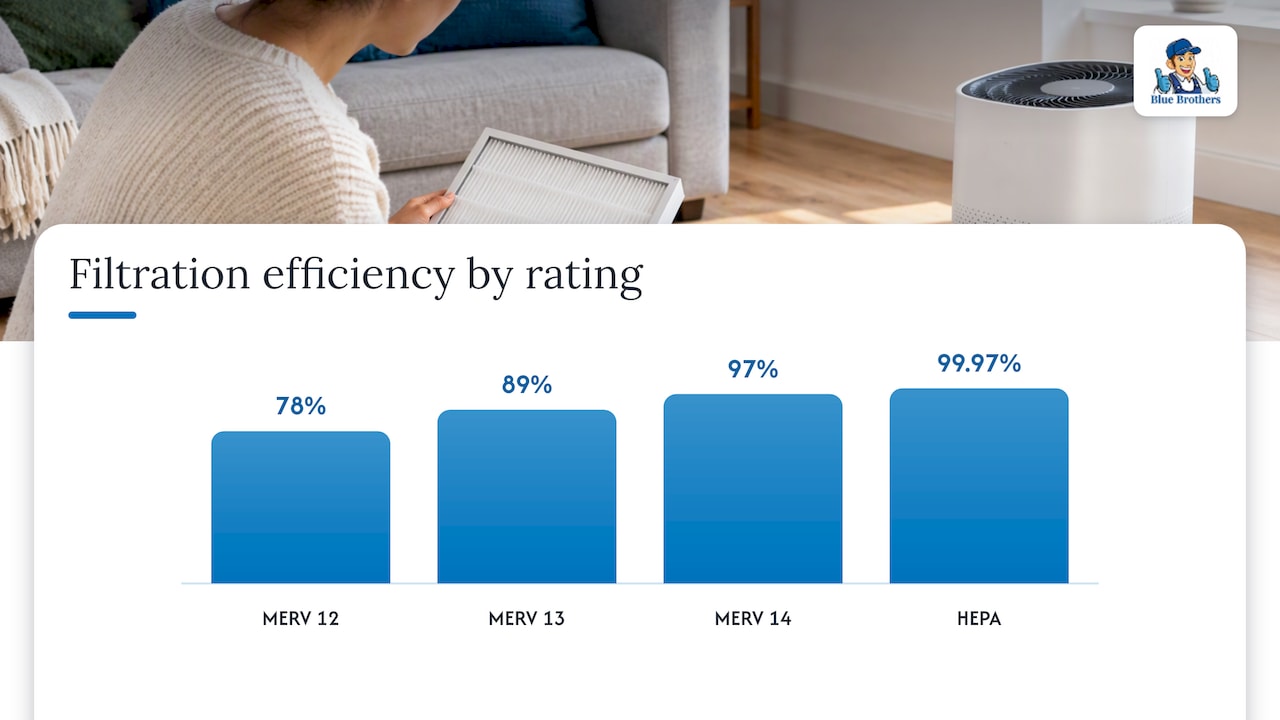
An ASHRAE technical study on viral filtration found mean efficiencies rising sharply with MERV rating in tested runs, MERV 12 filters averaged about 78%, MERV 13 about 89% and MERV 14 about 97%, a meaningful jump for a filter that still fits most residential systems.
A few things decide whether “MERV 16 equals HEPA” is even a fair comparison:
- Media form factor: pleated filter media behaves differently than the dense mat used in a sealed HEPA unit.
- Pressure drop: a MERV 16 filter restricts airflow far more than a MERV 13, often beyond what a furnace blower can handle.
- Flow rate: HEPA’s 99.97% figure assumes a controlled, lower flow rate through a purpose-built housing, not a furnace pushing air at full blower speed.
For most homes chasing better air quality without replacing HVAC equipment, MERV 13 is where the efficiency curve bends in your favour.
HVAC system considerations: pressure drop, fan capacity and fit
Swapping in a higher-MERV filter isn’t a simple one-for-one upgrade. Denser filter media increases resistance to airflow, called pressure drop, and that resistance can reduce the air your system moves, strain the fan motor or leave rooms unevenly heated or cooled. ASHRAE’s own guidance on MERV filtration stresses that system compatibility and proper sealing matter as much as the rating itself.
Before you upgrade, take these steps:
- Check your furnace or air handler specs for the maximum pressure drop or filter rating it’s designed to handle.
- Compare pressure-drop ratings between your old and new filter rather than relying on the MERV number alone.
- Inspect the filter slot for gaps or poor sealing that let unfiltered air bypass the filter entirely.
A filter that doesn’t seal properly lets air slip around its edges instead of through the media, which defeats the purpose of upgrading at all.
Pro Tip: Ask your HVAC technician to compare the new filter’s rated initial pressure drop against your old one before you buy a case of them.
Choosing and combining filters for your home’s needs
Start with one rule: upgrade your central filter to the highest MERV your system supports, aiming for MERV 13, then add portable HEPA units where they matter most, bedrooms, home offices, or any room where someone spends most of their time.
- Allergy-focused homes benefit most from a MERV 13 central filter plus a HEPA unit in the bedroom, since that’s where exposure time is longest.
- Immune-compromised occupants often need a dedicated HEPA unit in their primary room, since central filtration alone may not hit the air-exchange rate a vulnerable person needs.
- Wildfire smoke or heavy PM2.5 concerns call for prioritizing portable HEPA with a verified clean air delivery rate over squeezing a few more MERV points out of the furnace filter.
When buying, confirm the physical size matches your filter slot exactly, look for a rigid, sealed frame rather than a flimsy cardboard edge, check the manufacturer’s stated pressure-drop figure, and make sure replacement filters for any portable unit are easy to find before you commit to that model.
Keeping filters working: replacement and monitoring
A MERV 13 filter that sits dirty for six months performs worse than a clean MERV 8; for advice on maintaining your system and making the most of upgrades, consider resources on HVAC web design that books calls. Most central filters need replacement every 60 to 90 days, but pets, smoking, wildfire smoke or heavy dust can cut that interval in half.
Watch for these signs a filter or portable unit is falling behind:
- Noticeably weaker airflow from vents or the portable unit’s outlet.
- Visible dust buildup on surfaces shortly after cleaning.
- A rise in energy bills, which often signals the system working harder against a clogged filter.
Simple habits help: write the replacement date on the filter frame, check that it’s seated and sealed each time, vacuum return vents, and call for HVAC service if airflow drops noticeably between changes.
Why clean ducts and a well-maintained system matter as much as the filter
A dirty duct system undermines even the best filter. Dust and debris trapped in ductwork, clogged coils and poor sealing let contaminants re-enter the airstream downstream of the filter, so the rating on the box stops reflecting what actually reaches your lungs. We handle duct cleaning, furnace cleaning, HRV cleaning and AC coil cleaning, each one addressing a piece of the system that supports whatever filter you’ve chosen.

If you notice dust settling again shortly after cleaning, uneven airflow between rooms, a persistent musty smell or allergy symptoms that haven’t improved after a filter upgrade, those are signs worth a professional look rather than another filter swap.
What actually moves the needle on indoor air
The biggest mistake homeowners make is chasing the highest MERV number instead of matching a filter to what their system can actually run. A MERV 13 filter your furnace handles well, backed by a portable HEPA unit in the room that matters most and a duct system that’s actually clean, beats a MERV 16 that chokes your airflow or a HEPA unit shoved in a corner where it can’t pull air properly. Fit, seal and upkeep do more for your air than one extra number on a box. If you’re unsure what your system can take, book a check before you spend money guessing.
— Jayce
How we help your filtration upgrade actually work
A new filter only performs as well as the system behind it. We provide cleaning services that clear the debris and buildup that cuts into airflow and filter performance.
Clean ducts and a serviced furnace mean better airflow through your new filter, lower allergen load in circulated air and reduced fire risk from clogged vents. If you’re upgrading your filtration and want the rest of the system pulling its weight, book a duct cleaning or request a quote for furnace or HRV service.
FAQ
What MERV rating is equal to HEPA?
MERV 13 and 14 come closest in practical terms for many household pollutants, with peer-reviewed modelling showing large reductions in common allergens at those ratings.
Is MERV 10 too high for residential systems?
MERV 10 is generally fine for most residential furnaces and doesn’t typically cause airflow problems. The concern with higher resistance filters starts around MERV 13 and above, where checking your system’s pressure-drop tolerance matters more.
Is MERV 11 considered HEPA?
No, MERV 11 is well below HEPA-level filtration and captures mostly dust, pollen and pet dander rather than the fine particles HEPA is built to catch. It’s a solid mid-range upgrade for general dust control, not a HEPA substitute.
Is HEPA better than MERV 16?
True HEPA captures a higher percentage of the smallest particles than MERV 16 under its own tested conditions, but the comparison depends heavily on airflow, placement and system fit. ASHRAE’s guidance notes that few residential HVAC systems can actually run a MERV 16 filter without airflow problems, which can make a correctly placed portable HEPA unit the more practical choice at home.
Sources
- Reducing patients’ exposures to asthma and allergy triggers in their homes: an evaluation of effectiveness of grades of forced air ventilation filters
- Debunking myths about MERV, air filtration — ASHRAE
Key sources and standards to read next
For system-specific advice, consult your furnace manufacturer’s specifications or an HVAC technician alongside these references:
Recommended
- Stop Wasting Heat: How Clean Air Ducts Improve Furnace Efficiency in Winter
- ❄️ Cold Outside, Clean Inside: How Duct Cleaning Keeps Your Home Comfortable All Winter
- Save More This Winter: How a Clean Furnace and Duct System Boost Efficiency
- Maximize Heating Efficiency with Professional Furnace Cleaning