For most Canadian homes, a disposable pleated filter with a known MERV rating is the safer pick. A washable electrostatic filter can work well, but only if you wash and dry it on a strict schedule, and its real performance is harder to know. If anyone in your house has allergies or asthma, the pleated filter is the more dependable choice. If you want a reusable filter and will keep up with the upkeep, electrostatic is a fair option for a standard furnace.
The filter type matters less than most people think, though. Fit, sealing and airflow often decide how clean your air actually gets. Below we cover how each type works, where each one falls short, and how to choose without straining your furnace.
TL;DR
- Pleated (disposable): consistent, known efficiency until it clogs. Replace it on schedule. Best for allergies, asthma and anyone who wants low-effort upkeep.
- Washable electrostatic: reusable and gentle on airflow, but studies cited by one HVAC reference report efficiency can drop by half or more within 30 days without proper washing and drying.
- Powered electronic cleaners are a different product. The US EPA warns that some can produce ozone, a lung irritant.
- Size and seal matter as much as type. Air that slips around a loose filter is never cleaned.
- Before going to a higher MERV, check what your furnace was designed to handle.
Table of Contents
- What “electrostatic” actually means
- How pleated filters work
- How washable electrostatic filters work
- Side-by-side comparison
- Understanding MERV before you choose
- Fit and sealing beat filter type
- What about ozone and electronic air cleaners?
- Electrostatic vs HEPA
- Which one should you choose?
- Replacement and washing schedules
- Our perspective
- When the filter isn’t enough
- FAQ
- Sources
What “electrostatic” actually means
The word is used for two quite different products, and that is where most of the confusion starts.
Passive washable electrostatic filters. These are the permanent panels with a metal or plastic frame and layered fibres or mesh. Air moving across the fibres builds a static charge that attracts dust. You take the panel out, rinse it, let it dry fully and put it back. They typically come in 1-inch thicknesses that fit standard furnace slots.
Charged disposable pleated filters. Many throwaway pleated filters use fibres with an electrostatic charge to help trap fine particles. You will see this on retailer pages such as Home Depot Canada’s furnace filter listings, which carry electrostatically charged pleated options. So “electrostatic vs pleated” is not always either/or. A pleated filter can also be electrostatically charged.
Powered electronic air cleaners. These use a high-voltage field to charge and collect particles. They are a separate category from a simple filter, and they come with the ozone question covered below.
This article compares the first two: the washable electrostatic panel and the standard disposable pleated filter.
How pleated filters work
A pleated filter folds its media (polyester, a cotton-polyester blend or other synthetic) into an accordion shape. According to HVAC.best, that folding greatly increases surface area compared with a flat-panel filter. More surface area means more room to collect dust and, usually, a higher efficiency at a given airflow.

The key advantage is predictability. A pleated filter’s rating describes the filter you are actually installing, and its performance stays fairly steady until it loads up with dust and needs replacing. You do not have to do anything except swap it on time.
The downsides are real too:
- You buy them again and again, and they go in the garbage.
- A very dense, high-MERV pleated filter can restrict airflow in a furnace that was not designed for it.
- A dirty filter that stays in too long strains the blower.
How washable electrostatic filters work
The appeal is simple: buy once, wash, reuse. They tend to be less restrictive to airflow than a dense pleated filter, and they cut down on disposable waste. Industry experts commonly say people choose them for cost savings and less waste, but that only pays off with consistent, rigorous upkeep, according to the same HVAC.best guide.
The catch is what happens between washes. That guide reports that passive electrostatic filters may test at a high MERV equivalent when clean, but can lose 50% or more of their initial capture efficiency within 30 days if not properly washed and dried. Treat that as one source’s summary of the research, not a guarantee for every product. It does point at the real problem: the number on the box describes a clean filter on its best day.
A damp filter put back into the furnace is another risk. Moisture on a filter in a warm duct is not what you want, so let the panel dry completely before reinstalling.
Side-by-side comparison
| Factor | Disposable pleated | Washable electrostatic |
|---|---|---|
| Upfront cost | Low per filter, but repeat purchases | Higher once, then reusable |
| Ongoing effort | Swap on schedule | Wash and fully dry, often monthly |
| Consistency | Steady until loaded | Varies; can fall off quickly if neglected |
| Fine-particle capture | Mid to high MERV options available | Often lower in real use than pleated options |
| Airflow resistance | Rises with MERV and with dust load | Generally lower |
| Waste | Filters go to landfill | Little waste |
| Best for | Allergies, asthma, hands-off households | Careful maintainers, mild needs |
This lines up with what practitioners tell homeowners. The research we reviewed says experts overwhelmingly recommend quality disposable pleated filters for households with allergies, asthma or sensitivities, because their efficiency is known and steady. One consumer-facing comparison reaches the same conclusion: no electrostatic filter matches a high-MERV pleated filter on fine-particle capture.
Understanding MERV before you choose
Filters are rated using the Minimum Efficiency Reporting Value, or MERV. Health Canada’s guidance explains that a higher number means a better ability to capture smaller particles. The same page notes that MERV 13 or higher is recommended for recirculated air where possible, and that a MERV 13 filter is at least 85% efficient on particles in the 1 to 3 micron range. That guidance is a draft for office buildings, so use it as a reference point for homes, not a rule.
For new homes, Natural Resources Canada’s R-2000 standard calls for a medium-efficiency filter with a minimum MERV rating of 13 where air-circulating heating or cooling is installed. That is a voluntary, high-performance standard, not what every existing furnace expects.
Look for the MERV-A rating on electrostatic filters
A standard MERV rating on a charged-media filter is often based on its clean performance. ASHRAE notes the rating system has a variant, MERV-A, that accounts for efficiency loss over time. If an electrostatic filter lists a MERV-A value, that is the more honest number to compare. If it lists only a MERV, ask what conditions it was tested under.
Do not jump to MERV 13 blindly
Higher MERV is not automatically better for your furnace. Health Canada’s guidance warns that a system not designed for the extra pressure drop can suffer airflow restriction or overheating, so check your equipment manual or ask an HVAC professional before going above what the system was built for. For a full walk-through, see our guide on choosing MERV 13 or 11 without straining your HVAC.
Fit and sealing beat filter type
Here is the part most comparison articles skip. A lab rating assumes air goes through the filter. In a real furnace, gaps let air go around it. ASHRAE’s research summary on comparing laboratory and in-situ performance of residential filters reports that lab ratings can overstate real-world efficiency and understate pressure drop, because they do not capture problems like air bypass. Our research reading of that work is that a wrong-sized or poorly seated filter can hurt your air more than the choice between pleated and electrostatic.
Practical checks:
- Measure the slot, not the old filter. Nominal sizes such as 16x25x1 differ from actual dimensions. Read the size printed on the existing filter’s frame and compare it with the slot.
- Look for gaps. If you can slide a finger beside the filter, air is bypassing it. Panel-style electrostatic filters with rigid frames can be easier to seat well, but only if the size is right.
- Check the door or cover. A loose filter cabinet door lets unfiltered air in.
- Seal the surrounding leaks. Air sealing around the building envelope also affects how the whole system performs. This guide on reducing HVAC costs with building air sealing covers the envelope side of that picture.
And the fan has to run for any filter to work. The Government of Canada’s home ventilation guidance says a forced-air system must be properly installed, maintained and operated, and it points to following the owner’s manual, including replacing filters regularly. The guidance also suggests running the fan continuously rather than only during heating and cooling cycles for better results. Check your furnace manual first, since fan settings and electricity use differ between motor types.
What about ozone and electronic air cleaners?
If you are shopping for “electrostatic” products, be careful which one you are buying. The US EPA summary of residential air cleaners explains that electronic air cleaners, including some electrostatic designs, can produce ozone, either as a by-product or by design. The same source says ozone can react with household cleaners and air fresheners to create harmful by-products such as ultrafine particles and formaldehyde, even at concentrations below public health standards. You can read the details on the EPA’s residential air cleaner page.
A passive washable panel that just uses airflow-generated charge is not the same as a powered unit. Still, if you are considering anything with a plug or a high-voltage cell, read the manufacturer’s ozone information first and talk to an HVAC professional.
Electrostatic vs HEPA
A reader question that comes up often: is an electrostatic filter better than HEPA? No. A true HEPA filter is a different class and typically needs its own fan, because the media is too dense for a normal furnace blower. For most homes, a well-fitted MERV 11 or 13 filter in the furnace plus a portable HEPA unit in the rooms that matter most covers the need without touching the HVAC system. We lay that out in MERV 13 plus a portable HEPA.
There is also work underway on better media. Canadian company Zentek, for example, is developing coated pleated filters designed to improve viral filtration without the pressure drop penalty of thicker filters, as described by Innovation, Science and Economic Development Canada. That is worth watching, but you should judge any product on its tested performance rather than its coating.
Which one should you choose?
Choose pleated if:
- Someone at home has allergies, asthma or another sensitivity.
- You have pets, renovation dust or wildfire smoke seasons to deal with.
- You would rather set a reminder than wash a panel every month.
- You want a rating you can trust from day one.
Consider washable electrostatic if:
- Your furnace is older, the manual calls for a low-restriction filter and you do not want a dense pleated media.
- You will really wash it, dry it fully and keep a spare so the furnace is never running without one.
- Your main aim is protecting the equipment from large debris, not fine-particle control.
Skip both and call a professional if:
- You see dust blowing from the vents even with a fresh filter.
- Your filter clogs unusually fast.
- Airflow from the registers feels weak.
In those cases the filter is not the problem, and the ducts, blower or coils may need attention.
Replacement and washing schedules
For pleated filters, check the filter monthly and replace it when it looks loaded. Many 1-inch filters need replacing every one to three months, depending on pets, dust and use, but follow the manufacturer’s label. Our guide on monthly air filter checks and airflow loss explains what to look for.
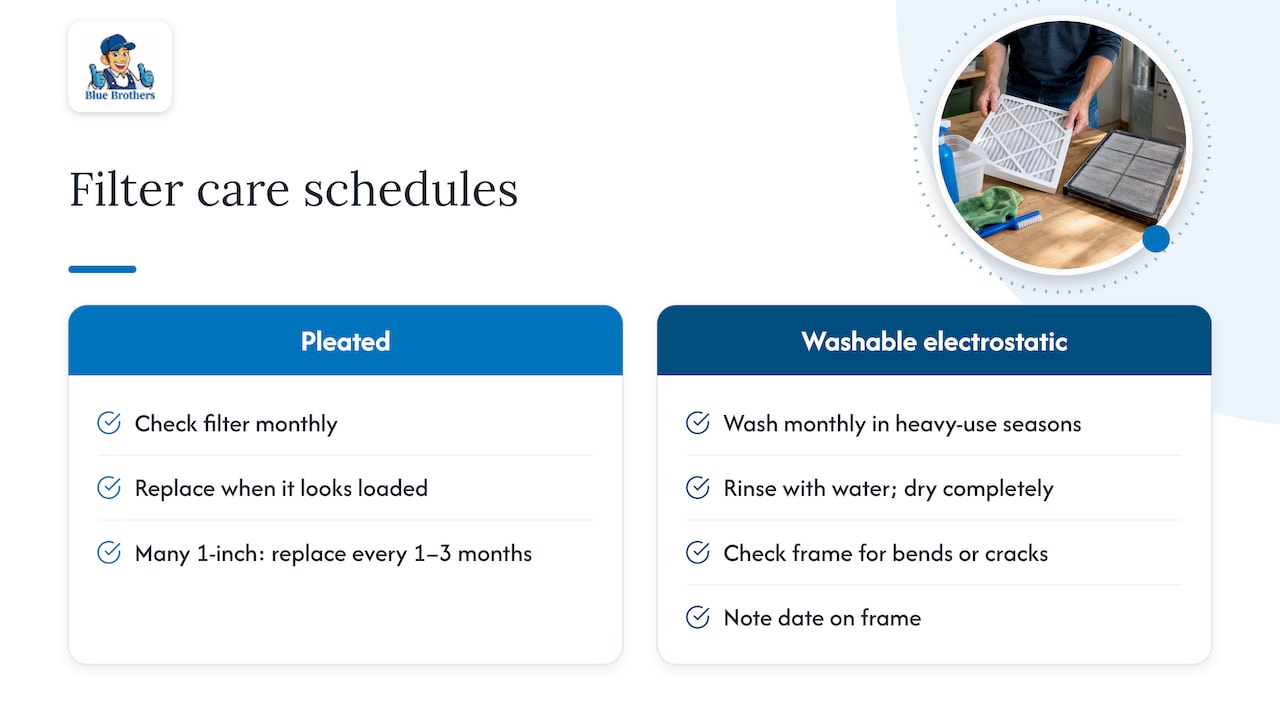
For washable electrostatic filters, plan on a monthly wash during heavy-use seasons. Rinse with water, let it dry completely and check the frame for bends or cracks that would let air slip by. Note the date on the frame so you do not forget.
Our perspective
We clean ducts, furnaces, HRVs and coils across British Columbia, Alberta and Saskatchewan, so we see what filters leave behind. Our experience, and the research above, point the same way: the best filter is the one that fits, is sealed and gets changed on time.
We would steer most homeowners to a properly sized disposable pleated filter at a MERV level their furnace can handle. It is predictable, and predictable beats clever when you cannot see inside your ductwork. We are not against washable filters. We just find they work only for people who treat washing as a monthly habit, and we would rather you know the trade-off before you buy.
We also want to be clear on what a filter cannot do. It protects the system from this point forward. It does not remove dust that has already settled in your ducts or on a furnace blower. If you have lived in your home through renovations, or you are not sure when the ducts were last cleaned, a good filter and clean ducts work together.
— Jayce
When the filter isn’t enough
If your filter keeps clogging, or you can see dust at the registers, we can inspect and clean the system behind the filter. Our air duct cleaning is listed at $400 to $800 CAD, and furnace cleaning at $50 to $300 CAD, depending on the home and system. If you have an HRV, our HRV cleaning covers the filters and core there too. Request a quote and we will tell you what your system actually needs.
FAQ
What are the disadvantages of an electrostatic air filter?
The main one is upkeep. A washable panel has to be rinsed and fully dried regularly, and its efficiency can fall off quickly if you skip that. The MERV on the label may reflect a clean filter, so real-world performance is harder to predict than with a pleated filter.
Are electrostatic filters better than pleated?
Not for most households. Electrostatic filters win on reusability and low airflow resistance. Pleated filters win on consistent, known efficiency, which matters most if you have allergies or asthma.
What type of furnace filter is the healthiest?
For health, a well-fitted, disposable pleated filter at a MERV your furnace can handle is the usual recommendation. Health Canada’s guidance favours MERV 13 or higher where the system allows it. Check your furnace manual or ask an HVAC professional before moving up.
Is an electrostatic filter better than a HEPA filter?
No. HEPA captures far finer particles, but a true HEPA filter usually can’t be used in a standard furnace. A portable HEPA unit paired with a good furnace filter is the common approach.
Sources
- Health Canada: draft guidance on ventilation in office buildings
- Government of Canada: home ventilation and filtration guidance
- US EPA: Residential Air Cleaners, second edition
- HVAC.best: HVAC filter types compared
- JourneymanHQ: electrostatic vs pleated filter
- ASHRAE: comparing laboratory and in-situ filter performance
- ASHRAE: filtration and disinfection
- Natural Resources Canada: R-2000 Standard
- ISED Canada: Zentek filters
- Home Depot Canada: air and furnace filters