Supply vents deliver heated or cooled air into a room. Return vents pull room air back to your furnace or air handler so it can be heated, cooled and filtered again. Hold your hand or a tissue to the grille: air blowing out means supply, a gentle pull means return. Both sides are equally important, and a blocked or dirty one throws the whole system off.
This guide covers how to identify each type, where they belong in a Canadian home, the mistakes we see most often and what to do when either side is clogged.
TL;DR
- Supply vents blow conditioned air into rooms. Return vents draw air back to the furnace, air handler or air conditioner.
- The quick test: feel for air blowing out (supply) or a slight suction (return). Return grilles are usually larger and often have no damper.
- Never close or block return vents, and be wary of closing supply vents in unused rooms to save energy. It can strain the blower and create moisture problems.
- Return vents do not belong in bathrooms, kitchens or garages. Those spaces need exhaust fans that vent outdoors.
- Dust loads up on both sides of the duct system. If grilles are dusty or airflow is weak, a professional duct cleaning is the next step.
Table of Contents
- What each vent does
- How to tell supply and return vents apart
- Where return vents belong, and where they do not
- The mistakes that cost homeowners money
- Return and supply vents in a tight Canadian home
- Why dirty ducts affect both sides
- Our perspective
- Cleaning the supply and return sides: what to expect
- Book a duct cleaning
- A quick home check you can do this weekend
- FAQ
- Sources
What each vent does
Your forced-air system is a loop. The furnace or air conditioner conditions air, ducts carry it out, and a second set of ducts brings it back. University of Florida extension describes the two sides this way: the supply side delivers conditioned air through room registers, and the return side withdraws indoor air and sends it back to the equipment.
Supply vents (also called registers) are the openings you feel blowing warm air in January or cool air in July. Trane notes that supply vents are also known as heat registers, and they deliver air from your furnace, heat pump or air conditioner.
Return vents (also called return air grilles) are the openings where air leaves the room. Carrier explains that without a return path, the system cannot circulate air efficiently, which leads to uneven temperatures. A furnace can only push out as much air as it can pull in.
Think of it as breathing. Supply is the exhale, return is the inhale, and the system works well only when both are free and balanced.
How to tell supply and return vents apart
Most people can sort their vents in under a minute. Use several clues together rather than just one.
1. The airflow test
Turn the furnace fan on (set your thermostat fan to “On” rather than “Auto”). Hold a tissue or a sheet of toilet paper near the grille. If it blows away, it is a supply. If it sticks to the grille or is pulled toward it, it is a return. Angi describes the same feel test: supply vents push air out, while return vents create a slight, detectable suction.
2. Size and shape
Return grilles are typically larger than supply registers, because the system needs a big opening to pull in the same volume of air without noise. A typical supply register in a bedroom might be a small rectangle, while a return can be a big slatted grille, sometimes with a filter slot behind it.
3. Position
Supply vents often sit high on walls or in ceilings, or on the floor under windows in many older Canadian homes. Returns are commonly located low on walls or in ceilings, depending on the home’s design. Location is a clue, not a rule, so confirm with the airflow test.
4. Dampers and louvres
Supply registers usually have adjustable louvres or a lever. Return vents often lack dampers entirely, and per the Angi guide they should never be closed.
| Supply vent | Return vent | |
|---|---|---|
| What it does | Pushes heated or cooled air into the room | Pulls room air back to the furnace or air handler |
| Airflow you feel | Air blowing out | Gentle suction |
| Typical size | Smaller, medium-sized | Larger |
| Typical location | Floor, high on walls or ceiling | Low on walls, or ceiling, often in hallways or common areas |
| Damper | Often adjustable | Often none |
| Can you close it? | Only with care, see below | No |
Where return vents belong, and where they do not
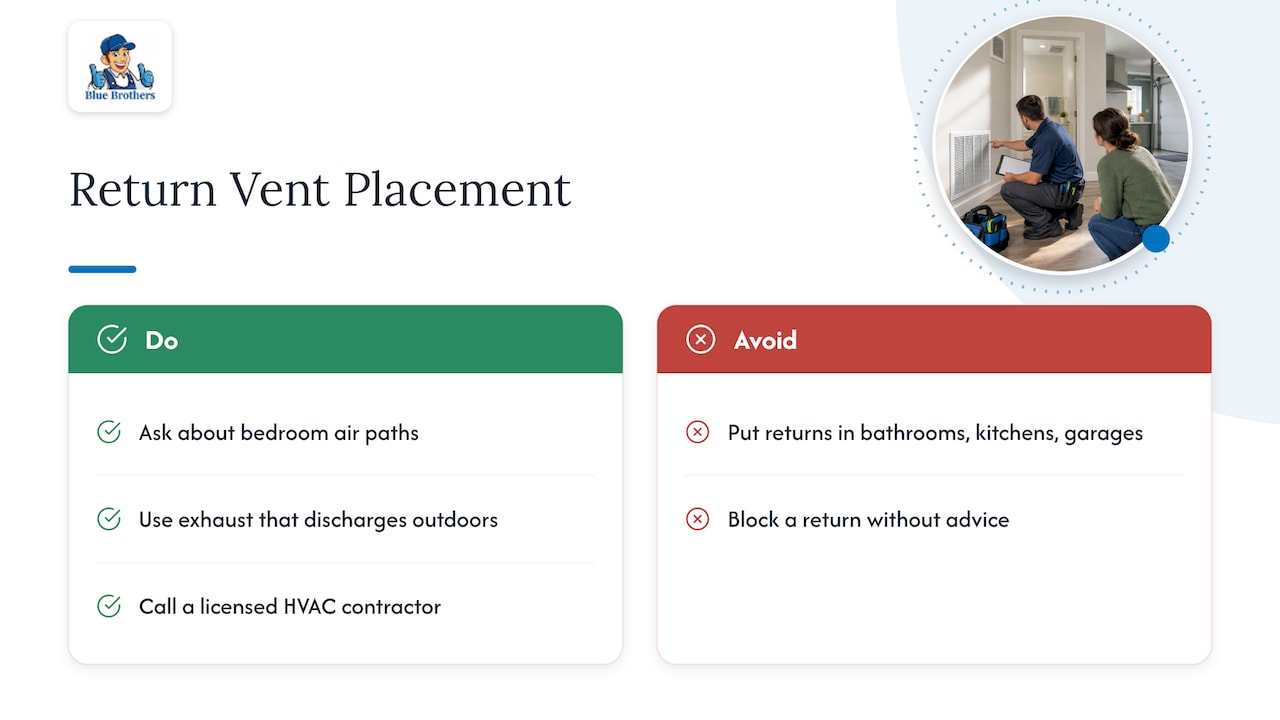
Some homes have a return in every room. Others have one or two large central returns, usually in a hallway or main living area. Both designs can work. When bedroom doors are closed, though, a room with only a supply vent has nowhere for air to go, which can leave it pressurised and stuffy. The U.S. Department of Energy’s building science guide on ducted returns says dedicated returns help keep air pressure balanced between rooms, and that they are critical to an energy-efficient system. If you have a bedroom that is always too hot or cold with the door shut, an air path (a door undercut, a transfer grille or a ducted return) is worth asking an HVAC contractor about.
Where a return should not be matters just as much. Natural Resources Canada guidance on ventilation says returns should not be placed in high-moisture or contaminated spaces such as bathrooms, kitchens or garages, because they would pull moisture, odours and pollutants straight into the HVAC system. Those rooms should rely on dedicated exhaust ventilation that discharges outdoors.
If you spot a return grille in a garage or a bathroom, that is worth a call to a licensed HVAC contractor. Do not try to block it yourself without advice, since changing airflow can affect combustion appliances and system balance.
The mistakes that cost homeowners money
Closing supply vents in unused rooms
It sounds sensible: shut the vent in the guest room and save heat. In practice, Carrier warns that closing vents creates pressure imbalances that strain the blower motor and lower efficiency. It can also cause uneven temperatures and moisture issues, which may encourage mold in unventilated zones. If a room is rarely used, a partial adjustment is a better idea than a full shut-off, and when in doubt ask your HVAC technician how much your particular system tolerates.
Blocking returns with furniture, rugs or drapes
A sofa pushed against a low return grille chokes the system. The blower works harder, filters load up faster and rooms feel stale. Keep at least a clear zone in front of every return, and keep supply registers uncovered too.
Forgetting the filter
The filter sits on the return side of most furnaces, either at the furnace itself or behind a return grille. A clogged filter restricts the whole return path. Check it on a regular schedule, and replace it according to the manufacturer’s instructions for your model.
Assuming a ventilation system is the same as the duct system
Health Canada’s ventilation guidance is clear that simply having a ventilation system is not enough: it must be maintained and operated properly. In an airtight, newer home, the supply and return ducts for heating and cooling are one system. The HRV or ERV (heat or energy recovery ventilator) is another, bringing in fresh air and exhausting stale air.
Return and supply vents in a tight Canadian home
Modern energy-efficient houses leak very little air. That saves heat, but it also means pollutants, humidity and odours stay inside unless you ventilate on purpose. Health Canada says mechanical ventilation is required to achieve good indoor air quality in airtight houses. The same page cites a general target of roughly 5 to 10 litres per second of outdoor air per occupant, though the right figure depends on house volume, activities and pollutant sources.
This is where people mix up the terms. An HRV has its own set of ducts, with “supply” and “exhaust” or “return” ports, and in many homes it ties into the furnace ductwork. That is a separate topic from your furnace’s return-air grilles, but the two interact. If you are managing humidity in a tight home, a simple hygrometer helps you see what is happening. This guide to condensation control with an inexpensive humidity meter explains how to aim for a 40 to 50% relative humidity range in a sealed building. Persistent condensation on windows, despite working vents, is a signal to have both the ventilation and duct systems checked.
HRV filters and cores need periodic cleaning too. We cover this in our HRV cleaning service, and if you are in Regina, we have a dedicated page for HRV cleaning in Regina.
Why dirty ducts affect both sides
Dust does not stay on the supply side. Return grilles pull in household dust, pet hair and fibres, and the return ducts carry that to the furnace. The supply side then distributes whatever got past the filter. Over years, debris collects in both runs, on the blower and on the coils.
Signs that the system needs a closer look:
- Dust collecting on or around supply registers soon after you clean
- Visible lint or grime inside return grilles
- Weak airflow from some vents, or rooms that never reach the set temperature
- Noisy return grilles, which can mean restriction
- A musty smell when the furnace or air conditioner starts
- Filters that clog much faster than they used to
None of these proves the ducts are dirty, since a blocked filter, closed damper or leaky duct can cause similar symptoms. A technician with a camera can tell you in minutes. For more on what poor winter air can do in homes, see our article on how dirty ducts affect your health.
If you or someone in your home has asthma or allergies, talk to your doctor about triggers. Duct cleaning is one part of reducing dust, not a medical treatment.
Our perspective
When our technicians open a duct system, we look at both sides, and the return side is the one homeowners rarely think about. Supply registers get wiped and vacuumed because they are visible. Returns are often forgotten, even though every bit of dust in the house passes through them first.
We also see the vent-closing habit often. People shut registers in basements or spare rooms in winter, then wonder why the furnace sounds strained or why a back bedroom feels damp. Our advice is simple: leave returns fully open and unobstructed, keep supply registers mostly open, and clean the grilles themselves a few times a year with a vacuum brush.
Our approach to a job is meticulous and tailored: we check how the home is laid out, where the returns and supplies are, and what the system needs, rather than running a generic routine. Our technicians are certified, and we publish clear pricing with no hidden fees. If you are not sure whether your system needs cleaning, ask us, and we will tell you honestly. We also offer round-the-clock support and emergency service when something goes wrong.
— Jayce
Cleaning the supply and return sides: what to expect
A full duct cleaning addresses the supply runs, the return runs, the registers and grilles, and usually the furnace blower compartment. The goal is to remove built-up dust and debris from the whole air path, not just the visible ends.
What we cover on a typical residential visit:
- Inspection of registers, returns and accessible duct runs, to see what the system looks like before work starts.
- Cleaning of supply and return ducts with specialised equipment that loosens and extracts debris.
- Register and grille cleaning, including the large return grilles.
- Furnace and blower check, since this is where both sides meet. Furnace cleaning can be booked separately if you only need that.
- Walk-through so you can see the finished work.
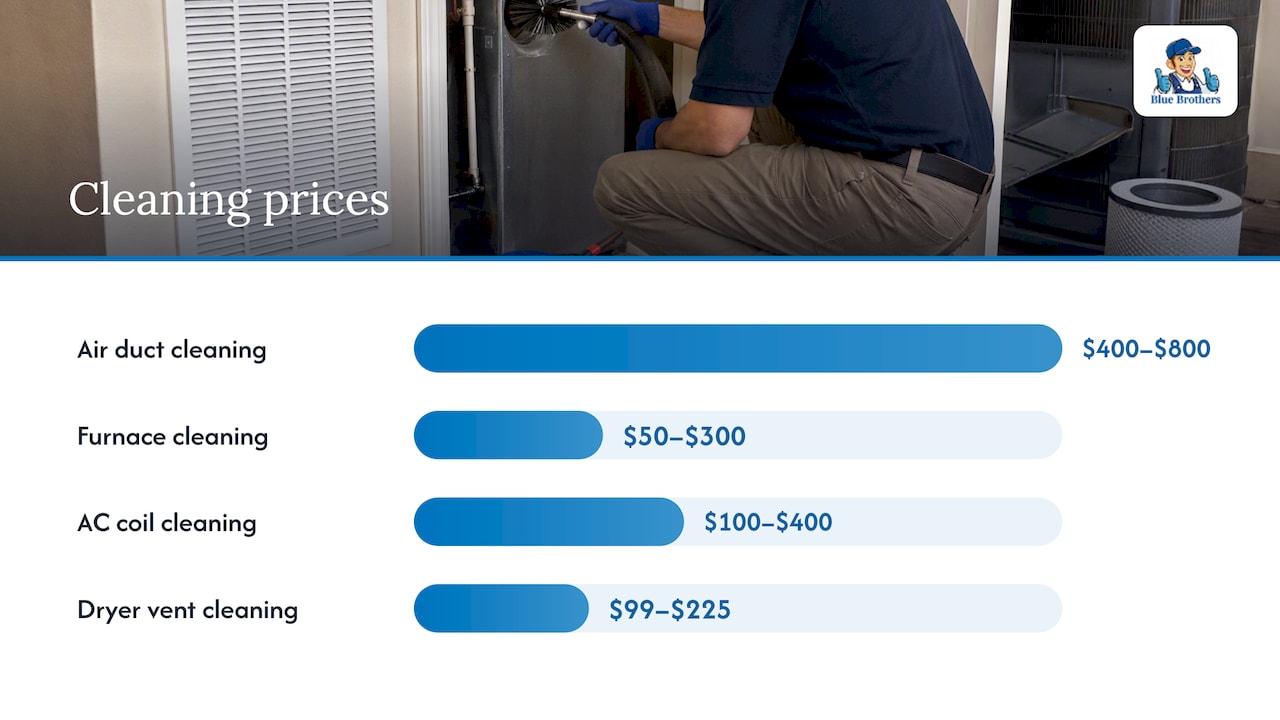
For reference, our published prices are $400 to $800 for air duct cleaning, $50 to $300 for furnace cleaning and $100 to $400 for air conditioning coil cleaning. The final price depends on the size and layout of your home and how many runs there are.
Dryer vents are a separate system again. They are not part of your supply and return loop, but a clogged one is a fire risk and a drain on efficiency. Our dryer vent cleaning is priced at $99 to $225.
Book a duct cleaning
If your registers are dusty, airflow is uneven or it has been years since anyone looked inside your ducts, we can help across British Columbia, Alberta and Saskatchewan. See our residential duct cleaning page, or request a quote and tell us about your home. Property managers can look at our commercial duct cleaning services.
A quick home check you can do this weekend
- Turn the furnace fan to “On” and walk through the house with a tissue. Label each grille as supply or return with a sticky note.
- Count the returns. If you have only one or two, check whether bedrooms with closed doors feel different from the rest of the house.
- Move furniture and rugs away from every return.
- Make sure the supply registers in your main rooms are open.
- Check the furnace filter and replace it if it is dirty.
- Look inside the return grilles with a flashlight. Heavy lint or grime means it is time for a professional look.
- Note any return in a bathroom, kitchen or garage, and ask an HVAC contractor about it.
FAQ
Are supply and return vents the same?
No. Supply vents deliver heated or cooled air into a room, while return vents draw air back to the furnace or air conditioner. They connect to separate duct runs, and they differ in size, position and often in whether they have a damper.
How can I tell if a vent is supply or return?
Turn the system fan on and hold a tissue to the grille. If it blows away, it is a supply. If it clings to the grille, it is a return. Returns are also usually larger and often have no adjustable louvres.
Can I close a return vent?
You should not. Return vents are part of the path that lets the system breathe, and closing one restricts airflow, strains the blower and can unbalance room pressures. If a return is noisy or you dislike the look of it, ask an HVAC contractor about alternatives instead of covering it.
Why do returns need to be in separate places from supplies?
The system works best when conditioned air can travel across a room before being drawn back. The U.S. Department of Energy notes that dedicated returns help balance air pressure between rooms. Exact distances depend on the home’s design, so an HVAC designer should set them rather than a general rule.
Do both supply and return ducts need cleaning?
Yes, since dust and debris collect throughout the system. A thorough duct cleaning covers both runs, the grilles and the blower area, so the whole air path is cleaned.
Sources
- Return Air vs. Supply Air: What’s the Difference? (Angi)
- What Is an HVAC Return Air Vent System? (Trane)
- Return Air Vent System: What It Is & Why It Matters (Carrier)
- Heat Recovery Ventilators (Natural Resources Canada)
- Ventilation and the indoor environment (Health Canada)
- HVAC Ducted Returns (Building Science Education, U.S. Department of Energy)
- Energy Efficient Homes: The Duct System (University of Florida IFAS Extension)