Micro-mesh guards are the most reliable choice for most homes, blocking pine needles and shingle grit that other designs let through, while reverse-curve hoods work well for heavy leaf loads and screens or foam suit tight budgets and short-term fixes. Government guidance still recommends clearing eavestroughs twice a year regardless of the guard installed, and even a full-service provider like Blue Brothers treats gutter upkeep as part of a broader maintenance routine rather than a one-time fix.
TL;DR:
- Micro-mesh guards are the most effective at blocking fine debris like pine needles and shingle grit, with over 98% debris filtration in tests, and require only an annual rinse.
- Reverse-curve guards are best for heavy leaf loads but are visible from the ground and prone to overshoot during intense storms; professional installation is recommended.
- Screens and foam inserts are cheaper options suited for light tree cover or temporary fixes, but they have shorter lifespans and higher maintenance needs, especially in harsh climates.
- Material choice significantly impacts durability and environmental footprint, with stainless steel lasting decades and plastic or foam requiring frequent replacements.
- Regular inspections and maintenance remain essential regardless of the guard type, and proper sizing and compatibility with gutter profiles are key to avoiding leaks and overflow.
Table of Contents
- At-a-glance comparison of gutter guard types
- How micro-mesh guards filter fine debris
- Reverse-curve and hooded guards for heavy leaf loads
- Screen and snap-in mesh inserts for tighter budgets
- Brush and foam inserts and why homeowners often replace them
- Choosing materials for climate and long-term durability
- How to choose the right gutter guard for your property
- Installation tips and a realistic maintenance schedule
- Typical lifespan and how much upkeep to expect
- Cost ranges: DIY materials versus professional installation
- Matching guard types to your gutter style and size
- What guards do to water flow and drainage
- Common drawbacks by guard type
- Environmental impact and material sustainability
- Why gutter readiness matters as part of home upkeep
- How Blue Brothers supports your home maintenance routine
- Sources
- FAQ
At-a-glance comparison of gutter guard types
Each guard type trades off differently between fine-debris filtration, upkeep, and price. Before picking one, it helps to see how they stack up side by side.
- Micro-mesh: blocks pine needles and shingle grit, needs a light annual rinse, costs more upfront but rarely needs replacing.
- Reverse-curve or hood: sheds large leaves well, lets fine debris through, usually needs professional installation and carries a visible roofline profile.
- Screen or perforated panels: stops big leaves cheaply, misses needles and grit, tends to sag or clog faster than mesh.
- Brush inserts: simple to drop in and remove for cleaning, but fine debris still gets past the bristles.
- Foam inserts: cheapest option, but breaks down under UV exposure and can trap moisture that encourages mould.
For debris type, only micro-mesh reliably keeps out needles and grit, according to long-form testing from This Old House. On cost shape, DIY kits across every category run cheaper in materials but skip the labour and warranty that come with a professional install. Warranty terms vary widely by brand and installer, so it is worth asking what is actually covered before assuming a guard is a lifetime fix.
How micro-mesh guards filter fine debris
Micro-mesh guards use a layer of tightly woven metal, usually stainless steel, with openings fine enough to stop needles and grit while still letting water through. Reviewers note that openings under roughly 100 microns are needed to reliably block pine needles, while coarser weaves let them slip through, according to testing from The Roofing Brief.
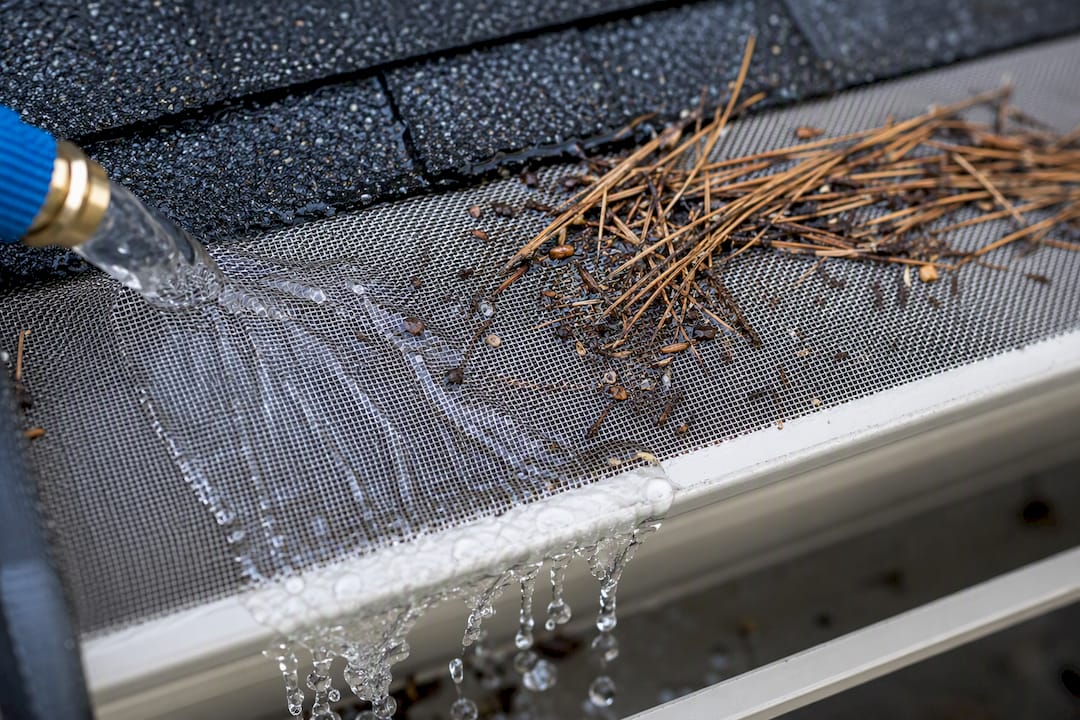
Multiple 12-month comparative tests found premium micro-mesh systems block more than 98% of debris in test conditions, with DIY stainless kits performing close to premium installs in many of the same tests. The main gap between a DIY kit and a professional system is warranty coverage and installation quality, not the mesh itself.
The most common failure mode is a thin film of pollen or shingle grit building up on the surface during heavy rain, which can cause water to overshoot the gutter instead of draining through. A light rinse once a year usually clears it.
Reverse-curve and hooded guards for heavy leaf loads
Reverse-curve guards, sometimes called hooded or surface-tension guards, use a curved nose that lets water cling to the surface and flow down into the gutter while leaves and larger debris slide off the front edge. They are a common choice under mature deciduous trees where leaf volume, not fine grit, is the main problem.
- Best suited to properties with heavy leaf drop and less concern about pine needles or grit.
- Usually installed by a professional because the curve has to align precisely with the roofline.
- Visible from the ground, which some homeowners see as a downside compared to lower-profile mesh.
- Prone to overshoot in intense storms and does little to filter fine debris, per reviews from This Old House.
Screen and snap-in mesh inserts for tighter budgets
Coarse perforated screens and snap-in mesh inserts sit a step below full micro-mesh systems in both price and performance. A basic perforated screen has larger holes designed mainly to stop whole leaves, while a finer mesh insert filters smaller particles but still lets more through than true micro-mesh.
- Coarse screens block leaves but pass needles, seeds, and shingle grit.
- Finer inserts catch more debris but wear out or warp faster than stainless mesh.
- Both suit rental properties, temporary fixes, or homes with light tree cover.
- Lifespan tends to run shorter than mesh or metal hoods, especially in freeze-thaw climates.
Brush and foam inserts and why homeowners often replace them
Brush guards are cylindrical bristle inserts that sit inside the gutter channel, catching leaves while letting water and smaller debris pass around the bristles. They are easy to install without tools and just as easy to pull out for cleaning, which makes them popular as a stopgap.
- Brush: drop-in installation, no fasteners needed, fine debris and grit still get through.
- Brush: bristles need periodic removal to clear built-up leaves and seeds.
- Foam: cheapest upfront option available at most hardware stores.
- Foam: holds moisture, which can encourage mould growth and speeds up material breakdown under UV exposure, per product comparisons from HomeNestor.
Pro Tip: Treat brush and foam inserts as a one-to-two-season fix rather than a permanent solution, especially on a roof with heavy tree cover.
Choosing materials for climate and long-term durability
Material matters as much as guard type when it comes to how long a system lasts. Stainless steel resists corrosion and UV damage better than any other common option, which is why it shows up in most premium micro-mesh and reverse-curve systems. Aluminum splits the difference: lighter and cheaper than stainless, still reasonably durable, but more prone to denting and gradual corrosion near coastlines. Plastic and uPVC guards cost the least but crack and discolour faster in freeze-thaw cycles or strong sun, and foam degrades fastest of all.
| Material | Corrosion resistance | Typical use case |
|---|---|---|
| Stainless steel | High | Premium micro-mesh and hood systems |
| Aluminum | Moderate | Mid-range mesh and screen guards |
| uPVC or plastic | Low | Budget screens and clip-on inserts |
| Foam | Low | Short-term or low-cost inserts |
The trade-off is straightforward: paying more upfront for stainless steel usually means decades between replacements, while cheaper plastics and foam mean repeat purchases every few years.
How to choose the right gutter guard for your property
The right guard depends on what is actually falling on your roof and how your gutters are set up, not on whichever product has the flashiest packaging. Work through this before buying anything.
- Identify the dominant debris: pine needles and shingle grit point to micro-mesh, while broad leaves point to reverse-curve or coarse screens.
- Check your roof pitch, since steep roofs shed water faster and can overwhelm undersized or clogged guards.
- Measure your gutter size and profile so the guard you choose actually fits without gaps.
- Factor in snow and ice exposure, since some guard designs shed snow better than others.
- Set a realistic budget that accounts for installation, not just material cost.
- Ask any installer about warranty terms, expected lifespan, and whether the guard requires under-shingle mounting that could void a roof warranty.
Watch for red flags like installers who want to slide guards under existing shingles without checking your roofing warranty, or marketing that claims a guard needs zero maintenance ever. No guard eliminates the need to check gutters at all.
Installation tips and a realistic maintenance schedule
Guards only perform as well as the gutters underneath them. Before installing anything, clean out existing debris, re-secure loose hangers, and run a hose through the system to confirm it drains properly.
- Check guards each spring after pollen season and again each fall after leaves drop.
- Rinse micro-mesh from the ground using a hose attachment rather than climbing a ladder for routine cleaning.
- Look for sagging sections or pulled fasteners after major storms.
- Remember that guards do not replace attic insulation or ventilation when it comes to preventing ice dams; they work alongside proper insulation, not instead of it.
Pro Tip: Book gutter and attic checks for the same week each spring and fall so neither one gets forgotten.
Typical lifespan and how much upkeep to expect
Lifespan varies more by material than by guard type. Stainless steel micro-mesh and reverse-curve systems commonly outlast plastic screens and foam inserts by a wide margin, since corrosion resistance and UV stability drive most of the difference. Foam is the shortest-lived option, breaking down within a few seasons in sunny or wet climates, while brush inserts last longer physically but need frequent clearing to stay effective.
Maintenance needs to follow a similar pattern. Micro-mesh needs only an occasional rinse to clear the fine film of pollen or grit that builds up over a season, which testing from The Roofing Brief notes is cheaper over time than replacing degraded foam or plastic repeatedly. Reverse-curve guards need less frequent debris removal but benefit from a visual check after major storms to confirm water is still tracking into the gutter rather than overshooting.
Screens and brush inserts sit in the middle: they do not last as long as metal systems, and they need more frequent attention because they let more debris through in the first place. Whatever type you choose, the government guidance to inspect eavestroughs twice a year still applies. A guard reduces how often you need to clean, it does not eliminate the task.
Cost ranges: DIY materials versus professional installation
Price shape depends heavily on whether you install the guard yourself or hire a professional, and on which material you pick. DIY micro-mesh kits often run a few dollars per linear foot in materials, while premium professionally installed micro-mesh or reverse-curve systems can run $15 to $35 per linear foot installed, a gap that mostly reflects labour, warranty, and install quality rather than the mesh itself.
Screen and perforated panels sit near the bottom of the price range in both DIY and professional categories, since the material is simpler to manufacture and install. Brush and foam inserts are the cheapest option available almost anywhere, which explains their popularity as a first purchase, though the earlier sections cover why many homeowners end up replacing them.
The bigger financial question is not which guard costs less today but which one avoids repeat purchases. A stainless steel system installed once can outlast several rounds of foam or plastic replacements, which narrows the real cost gap over a decade even though the upfront price looks higher.
Matching guard types to your gutter style and size
Not every guard fits every gutter. Standard 5-inch and 6-inch K-style gutters, the most common residential profile, accept most micro-mesh, screen, and reverse-curve systems designed for retail sale. Half-round gutters, more common on older or heritage homes, often need a guard specifically profiled for that shape since flat mesh panels do not seat properly on a curved edge.
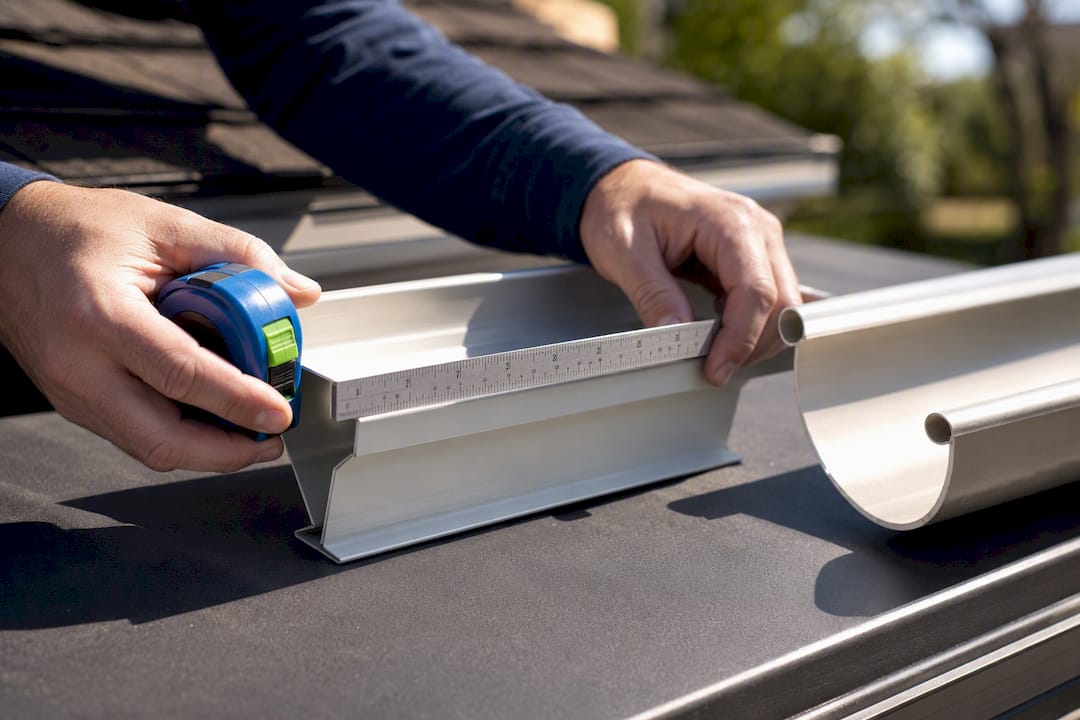
Gutter size also affects capacity. A narrow gutter paired with a bulky reverse-curve hood can struggle to handle heavy rainfall, since the hood’s curve takes up interior space that would otherwise carry water. Wider gutters have more room to spare and tend to handle any guard type without capacity issues.
Before buying, measure your gutter’s width and profile and check the manufacturer’s fitment guide rather than assuming a universal fit. A guard that is close enough to fit but not properly seated is a common cause of leaks and overshoot down the line, and it is one of the easier problems to avoid with a quick measurement.
What guards do to water flow and drainage
Every guard changes how water enters the gutter to some degree, and the differences matter more in heavy rain than in a light drizzle. Micro-mesh filters water through thousands of small openings, which works well under normal conditions but can allow overshoot if a film of grit or pollen builds up on the surface, as testing from The Roofing Brief notes.
Reverse-curve guards rely on water clinging to a curved surface, a principle that works reliably in moderate rain but can lose its grip during intense downpours, sending water past the gutter entirely rather than into it. Screens and brush inserts generally interfere less with flow since they have larger openings, but that same openness is why they filter less debris.
None of this means gutters with guards drain worse than open gutters overall. It means the type of guard determines how it behaves at the extremes, and homeowners in areas with intense seasonal storms should weigh overshoot risk alongside debris filtration when picking a type.
Common drawbacks by guard type
Every guard type comes with a trade-off, and knowing the common one in advance saves a lot of frustration.
Micro-mesh guards cost more upfront and can develop a surface film that causes overshoot if left unrinsed for too long. Reverse-curve guards are visible from the ground, usually require professional installation, and let fine debris through even though they handle leaves well, according to reviews from This Old House. Screens and perforated panels sag or clog faster than metal systems and need more frequent clearing. Brush inserts pass fine debris around the bristles and need periodic removal to stay effective. Foam inserts hold water, which speeds up mould growth and material breakdown under UV exposure, per comparisons from HomeNestor.
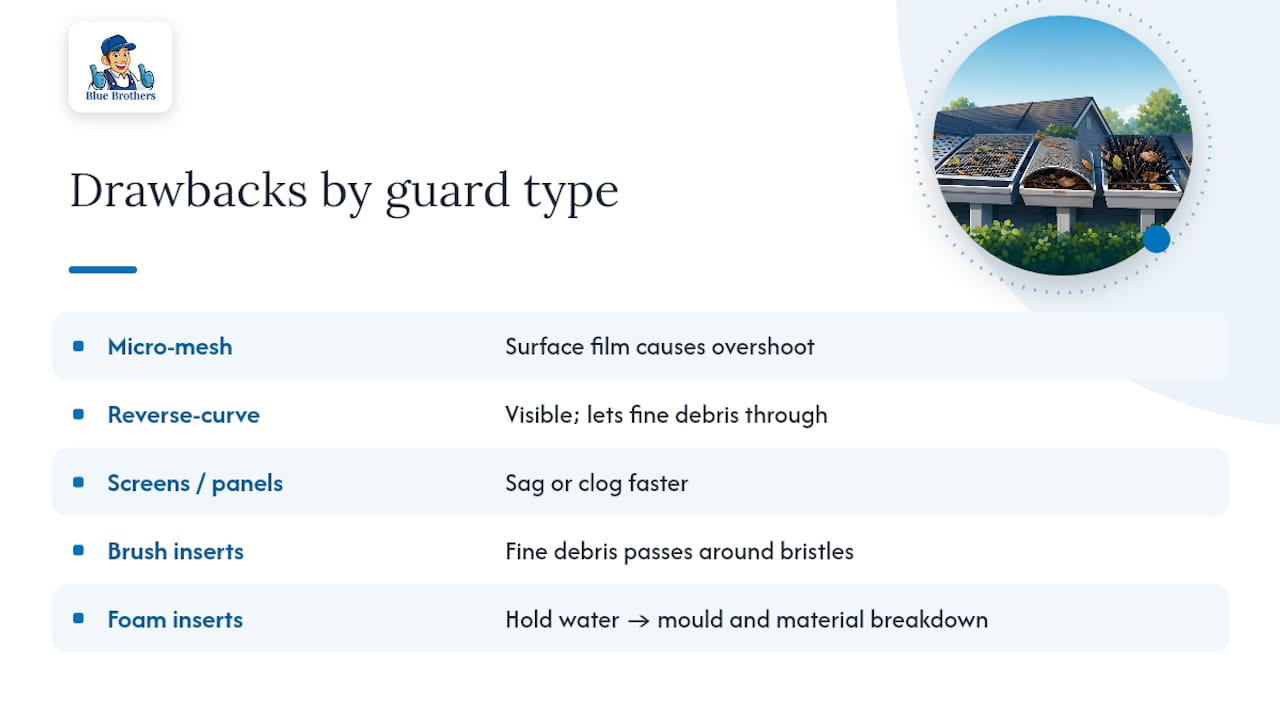
None of these drawbacks make a guard useless. They just mean the “install it once and forget it” promise sold by some marketing rarely holds up in practice, and a realistic maintenance routine matters no matter which type you pick.
Environmental impact and material sustainability
Material choice affects more than durability, it also shapes how much waste a gutter guard produces over its lifetime. Stainless steel and aluminum are both recyclable at the end of their service life, and because they last decades rather than seasons, they generate less waste overall despite the higher manufacturing footprint of metal production.
Plastic, uPVC, and foam guards are cheaper to produce but break down faster, meaning a homeowner may replace them several times over the same period a metal system stays in place. That repeated replacement adds up in landfill waste, even though each individual unit is inexpensive. Foam in particular degrades under UV exposure into smaller fragments rather than breaking down cleanly.
For homeowners weighing sustainability alongside performance, a durable metal option installed once tends to leave a smaller footprint than several rounds of budget plastic or foam replacements, even before factoring in the debris-filtration difference.
Why gutter readiness matters as part of home upkeep
Gutter guards reduce debris, but they do not replace seasonal inspection or the attic insulation work that actually prevents ice dams and water intrusion. We see gutter care as one piece of a wider maintenance routine, alongside checks on ducts, vents, and attic ventilation that affect how a home handles moisture and heat through the seasons. If you are unsure whether your setup needs a closer look, a professional inspection is worth the call before problems compound.
— Jayce
How Blue Brothers supports your home maintenance routine

Picking the right gutter guard only solves part of the water-management picture. Home maintenance services are available across various regions to cover parts of a home gutters alone cannot fix, including duct, vent, and furnace checks that keep air moving properly through the colder months.
- Furnace cleaning to keep heating systems running efficiently through winter.
- Dryer vent cleaning to reduce fire risk from lint buildup.
- Air duct cleaning to support indoor air quality alongside your home’s ventilation.
If your gutters, attic, or ducts have not been checked in a while, request a quote for duct cleaning and get a clear plan for the parts of your home that guards cannot cover on their own.
Sources
- Canada
- Best gutter guards 2026: 8 Brands Tested | The Roofing Brief
- This Old House — Best gutter guards
FAQ
What type of gutter guard is best?
Micro-mesh, especially stainless steel versions, is generally the best-performing type because it blocks fine debris like pine needles and shingle grit that other designs let through. It needs an occasional rinse but avoids the frequent clogging that screens, brush, and foam inserts are prone to.
What are the worst gutter guards for common use?
Foam inserts tend to underperform over time because they hold moisture, which can encourage mould growth and speeds up breakdown under UV exposure. Brush inserts also let fine debris pass around the bristles, making both options weaker long-term choices than mesh or reverse-curve systems.
What is the best gutter guard for a snowy climate?
There is no single best type for snow, since guards do not prevent ice dams on their own. Resolving attic insulation and ventilation issues matters more than guard choice, and government guidance on snow and ice recommends addressing heat loss before relying on any guard to manage runoff.
What are the three types of gutters?
The three most common residential gutter profiles are K-style, half-round, and box gutters, each shaped differently along the front edge. K-style is the most widely used in North America, while half-round appears more often on older or heritage homes, and gutter guard compatibility depends on matching the guard to the correct profile.