Clean your gutters at least twice a year, once in spring and once in fall, with fall being the priority visit since it happens right before the freeze that causes ice dams. That’s the baseline for a typical home. If you’ve got heavy tree cover, live somewhere that gets hit with frequent storms, or have a roof with lots of valleys, bump that up to three or four cleanings a year, and always add a spot check after any severe wind or rain event.
TL;DR:
- Homeowners with heavy tree cover or frequent storms should increase gutter cleaning frequency to three or four times per year and check after severe weather events.
- Fall cleaning is crucial for preventing ice dams, ideally done after leaf fall and before the first hard freeze to reduce winter water damage risks.
- Using micro-mesh guards can significantly reduce cleaning frequency but does not eliminate the need for occasional maintenance or downspout checks.
- Inspection from the ground with binoculars or a safe ladder technique helps identify issues early, especially before climbing onto the roof.
- Professional help is recommended for homes over two stories, steep pitches, or if you feel uncomfortable with ladder work, ensuring thorough inspection and early damage detection.
Table of Contents
- Gutter cleaning frequency: the seasonal schedule that actually works
- What actually changes how often you need to clean
- Signs your gutters need cleaning right now
- Seasonal timing and the ice dam connection
- How to inspect your gutters safely, step by step
- Should you clean your gutters yourself or hire a service?
- Do gutter guards actually reduce how often you need to clean?
- A realistic cleaning habit that doesn’t turn into a chore
- When it’s time to call in a professional exterior team
- Sources
- FAQ
Gutter cleaning frequency: the seasonal schedule that actually works
Government flood-prevention guidance recommends cleaning eavestroughs at least twice a year, in early spring and late fall, as part of a seasonal maintenance checklist to reduce flood and water damage risk. That’s the anchor point for everything else in this article. But the exact timing matters almost as much as the count.
Spring window: late April to early May. Wait until seed pods, maple keys, and pollen clusters have mostly dropped. Clean too early and you’ll be back up the ladder in three weeks doing the same job.
Fall window: late October into November. This is the visit that carries the most weight. You want it after the bulk of leaf fall but before the first hard freeze locks everything in place. Miss this window and you’re heading into winter with a trough full of wet leaves sitting against your fascia board.
Here’s how that baseline shifts depending on your property:
- Low-tree lot with guards installed: once a year is often realistic, usually the fall visit, with a quick spring glance to confirm nothing’s blocked.
- Typical suburban home with a few trees nearby: the standard twice-yearly schedule, spring and fall.
- Heavy tree cover, especially conifers or a canopy overhanging the roof: three to four cleanings, roughly every 10 to 12 weeks during the growing season.
- Any home, any season: inspect after a severe storm and spot-clean if debris has piled up, regardless of where you are in your regular schedule.
That storm rule deserves its own mention. Strong wind or heavy rain can dump a season’s worth of debris into your gutters in an afternoon, and a quick spot inspection after a major storm catches problems before they cause overflow at your foundation.
What actually changes how often you need to clean
The twice-a-year baseline is a starting point, not a rule that fits every roofline. A few variables push that number up or down, sometimes significantly.
Tree species and proximity matter more than tree count. A single overhanging maple drops far more debris into a gutter than three pines set back from the roofline. Oaks shed slowly through fall and into early winter, which can push your fall cleaning later than the standard window. Pines drop needles year round in smaller, steadier amounts, which tends to clog fine mesh guards faster than it clogs open troughs.
Local weather patterns matter. Regions with frequent spring storms or heavy pollen seasons need closer attention during those windows, even if the rest of the year is quiet.
Gutter and roof design play a bigger role than most homeowners realize. Shallow-profile gutters, multiple roof valleys, and long unbroken roof runs all funnel more debris into fewer collection points, and those points clog faster.
Guard type changes the math entirely. Micro-mesh systems reduce build-up more effectively than foam inserts or coarse screens, which we’ll get into further down.
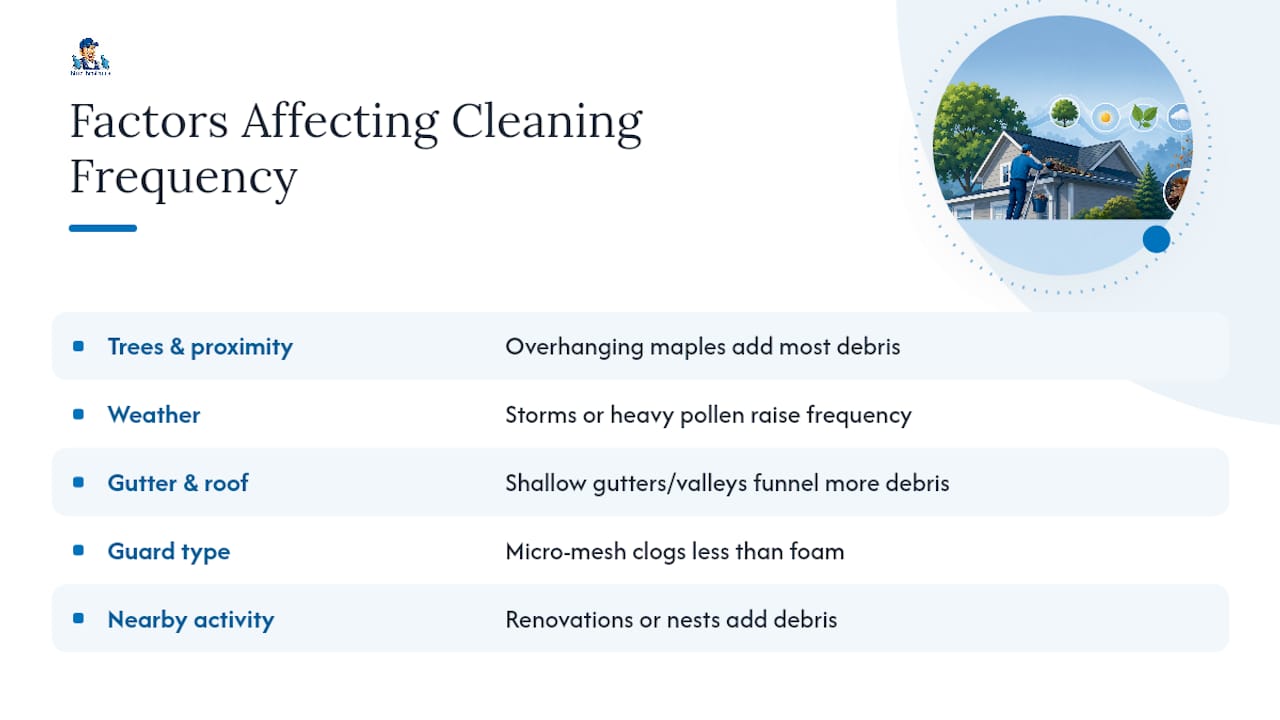
Nearby construction or nesting birds add debris nobody accounts for. A renovation next door, or a robin’s nest tucked into a downspout, can throw off even a well-planned schedule.
Pro Tip: Keep a one-line log on your phone every time you clean, just the date and what you found. After two seasons, you’ll know your home’s real rhythm instead of guessing from a generic calendar.
Signs your gutters need cleaning right now
You don’t need to climb a ladder to know something’s wrong. Watch for these signals first:
- Overflow during rain. Water streaming down the siding instead of channelling through the downspout is the clearest sign of a blockage.
- Wet spots or staining on the fascia board. This usually means water has been sitting in the trough long enough to soak through, not just passing through.
- Visible vegetation, sagging sections, or rusted seams. A gutter growing weeds is a gutter holding standing water, and sagging sections mean the hangers are under more weight than they were built for.
- Pooling at the foundation or new dampness in the basement. By the time water shows up here, the gutter system has already failed at its one job.
If you’re not sure, run a simple ground test: turn a hose on at the roof edge and watch where the water goes. A functioning system channels it straight down the downspout and away from the foundation. If it backs up, overflows, or trickles out slowly, you’ve found your blockage without ever leaving the ground.
Seasonal timing and the ice dam connection
Clogged gutters are one of the main contributors to ice dam formation, since water backs up against the blockage, freezes at the eaves, and forces melt water under the shingles instead of off the roof. Government flood guidance treats fall cleaning as a direct line item in flood and water damage prevention, precisely because it happens right before that freeze cycle sets in.
That’s why the fall window matters more than the spring one. Clean after leaf fall but before the first hard freeze, and you’ve removed the material most likely to trap water at the worst possible moment.
- Clear snow and ice buildup around downspouts through winter, since government preparedness guidance recommends keeping downspouts and foundation-adjacent snow clear to reduce meltwater intrusion.
- Watch for uneven melt patterns on the roof, a sign of trapped heat escaping unevenly through the attic.
- A roof rake, used from the ground, can clear excess snow load near the eaves without anyone climbing onto the roof.
Here’s the part most homeowners miss: if ice dams keep forming year after year despite a clean gutter system, the problem usually isn’t the gutters at all. Natural Resources Canada points to attic insulation and ventilation gaps as the root cause in most repeat cases. Warm air escaping into the attic melts snow unevenly, and that meltwater refreezes at the colder eaves regardless of how clean your gutters were in November.
How to inspect your gutters safely, step by step
Start from the ground, every time. A pair of binoculars and a walk around the perimeter will tell you more than you’d expect: sagging sections, visible debris, staining under the drip line.

If you decide to climb, ladder placement is where most injuries happen. Follow the 4:1 rule, meaning the ladder base sits one foot out from the wall for every four feet of height, and use a stabilizer or stand-off bar rather than leaning the ladder directly against the gutter, since the aluminum channel can bend under that kind of load.
Once you’re safely positioned, the actual cleaning follows a short sequence:
- Remove large debris by hand or scoop, working away from the downspout so you’re not pushing material toward the exit point.
- Flush the trough with a hose, moving toward the downspout to confirm water flows freely.
- Check that the downspout itself is clear, not just the trough. A clogged downspout with a clean trough still backs up water.
- Inspect hangers, brackets, and seams for looseness or corrosion while you’re already up there.
Pro Tip: If you see bent sections, persistent blockages you can’t clear with a hose, fascia rot, or a roofline with more than two storeys or steep valleys, that’s your cue to stop and call a professional rather than push further.
A single-storey clean typically takes 30 to 90 minutes depending on debris load and home height. Two-storey homes take longer and carry more fall risk, which is exactly where the DIY math starts to shift.
Should you clean your gutters yourself or hire a service?
The honest answer depends on your roof, not your budget alone. A single-storey home with easy ground access and no steep pitch is a reasonable DIY job for most homeowners comfortable on a ladder. Anything beyond that starts tilting toward professional help.
- Hire a professional when: your home is two storeys or more, the roof has steep or complex sections, you’re working around ice or winter conditions, or ladder work simply makes you uneasy. None of that is a bad reason.
- A proper professional visit should include: a full inspection, flushing the trough, clearing the downspouts, and a written note on the condition of hangers, seams, and fascia so you have a record for next year.
- Cost and frequency trade off against each other. A one-off visit costs more per call than a standing seasonal arrangement, but if your home only needs the twice-yearly baseline, one-off visits may still work out cheaper overall than a recurring contract built for a heavier-debris property.
If you’re weighing this against other seasonal home maintenance, a home maintenance services overview is worth a look before you commit to a full DIY routine or a standing service contract.
Do gutter guards actually reduce how often you need to clean?
They can, but the type matters more than most product pages let on. Micro-mesh guards typically cut cleaning down to about once a year in homes that would otherwise need two or three visits, since the fine mesh blocks most debris while still letting water through.
Foam inserts and basic screens tend to underperform. Foam can trap fine debris and even encourage small plants to root inside the gutter itself, while coarse screens let seed pods and needles through and then struggle to shed them.
- Micro-mesh costs more upfront, but the payback shows up over several years of avoided cleaning visits, not in the first season.
- Guards reduce frequency, they don’t eliminate maintenance. Debris still accumulates on top of the mesh over time and needs the occasional cleaning every couple of years to keep water moving freely.
- Downspouts still need checking even with guards installed, since guards protect the trough, not the exit point.
A realistic cleaning habit that doesn’t turn into a chore
Most homeowners either overdo this or ignore it completely, and neither approach holds up over a few years. The habit that actually sticks is simple: log the date every time you clean, glance up after any major storm, and treat the fall cleaning as the one you never skip, since it’s doing the most work against ice dam risk heading into winter.
Everything else, spring cleaning, guard upgrades, extra visits for heavy tree cover, is a refinement on top of that one non-negotiable fall visit. If a job ever looks past what you’re comfortable doing on a ladder, that’s not a moment to push through. Call a professional instead.
— Jayce
When it’s time to call in a professional exterior team
There are homes where the ladder math just doesn’t work in your favour, and steep pitches, two-storey heights, or ice-season conditions are exactly where the risk outweighs the savings. Some home service providers offer tailored service for homeowners who want the job done right without climbing onto a roof they’re not equipped to be on, including professional home security enhancements to keep your property safe alongside maintenance.

A professional visit does more than clear leaves. A trained team inspecting your gutters at height will often catch early fascia rot, loose hangers, or downspout blockages that a ground-level glance would miss entirely, the same kind of hidden water damage that turns into a much bigger repair bill if it sits unnoticed through a winter. Professional services often include clear pricing and no hidden fees, so you know the cost before any work begins, and round-the-clock support can ensure that urgent issues are handled promptly.
If your home’s exterior maintenance list has grown past just gutters, from duct cleaning to seasonal furnace checks, a single call can cover more of that list than a weekend of DIY ever will. Reach out through the Bluebrothers site to request a quote for your next seasonal visit.
Sources
- Canada
- Keeping the heat in — Section 5: Roofs and attics – Natural Resources Canada
- How to clean gutters safely: Complete guide 2026 – NearbyHunt
FAQ
What’s the little-known trick for cleaning gutters faster?
Work away from the downspout, not toward it, when clearing large debris by hand. Pushing material toward the exit point just creates a fresh clog at the one spot you need clear, so scoop outward and let the final hose flush carry loose material down and out.
How long does gutter cleaning normally take?
A single-storey home typically takes 30 to 90 minutes, depending on debris load and how many downspouts need checking. Two-storey homes or properties with steep valleys take longer and often make more sense as a professional job.
What’s the best time of year to clean gutters?
Spring, in late April to early May after pollen and seed drop, and fall, in late October to November after leaf fall but before the first hard freeze. The fall visit carries more weight since it directly reduces ice dam risk heading into winter.
What happens if you never clean your gutters?
Debris buildup causes water to overflow at the trough instead of channelling through the downspout, which leads to fascia rot, foundation erosion, basement dampness, and ice dams that can force meltwater under the shingles. These are the exact failure points flood prevention guidance flags as reasons to stay on a regular cleaning schedule.
Do gutter guards mean I never have to clean again?
No. Micro-mesh guards can cut cleaning down to about once a year, but debris still builds up on top of the mesh over time and needs occasional attention every few years. Downspouts also still need checking regardless of what guard system sits on the trough above them.