Check your furnace filter monthly and replace it regularly or sooner if it looks loaded. HRV and ERV filters need cleaning or replacement every few months, per the CMHC’s maintenance guidance. Commercial systems should skip the calendar entirely and replace filters based on differential pressure readings or the building’s own operations manual.
TL;DR:
- Regularly check and replace furnace and HVAC filters every three months or sooner if they appear loaded or airflow diminishes.
- HRV and ERV filters require cleaning or replacement every one to three months, with annual core inspections based on household activity and outdoor air quality.
- Commercial HVAC systems should use differential pressure monitoring to determine filter replacement, not fixed dates, to accommodate occupancy and outdoor air conditions.
- Signs indicating an early filter change include visible dirt, weaker airflow, higher energy bills, or increased indoor particulate load from smoke, pets, or renovations.
- For thorough system maintenance, schedule pre-season inspections, including coil cleaning and duct checks, especially if airflow issues or air quality problems persist.
Table of Contents
- Recommended replacement schedule by system type
- Signs your filter needs changing sooner
- Choosing the right filter for your system
- How to check and replace your filter safely
- What a pre-season professional inspection covers
- Why filter care is only half the maintenance picture
- Book professional cleaning when filters aren’t enough
- Where to check for model-specific guidance
- Sources
- FAQ
Recommended replacement schedule by system type
The right air filter replacement schedule depends on what the filter is attached to, not just how many months have passed.
For forced-air furnaces and central HVAC, Natural Resources Canada recommends checking the return grille monthly and replacing or cleaning the filter at least every three months, or sooner if it looks loaded. A monthly glance costs nothing and catches problems before they strain the blower motor.
HRV and ERV systems run on a shorter cycle. Filters should be cleaned or replaced regularly depending on household activity and outdoor air quality, and the core itself needs an annual inspection even when filters look clean. A homeowner-facing guide from NordAir Atlantic walks through the same rhythm and adds simple steps for wiping down the core between professional visits.
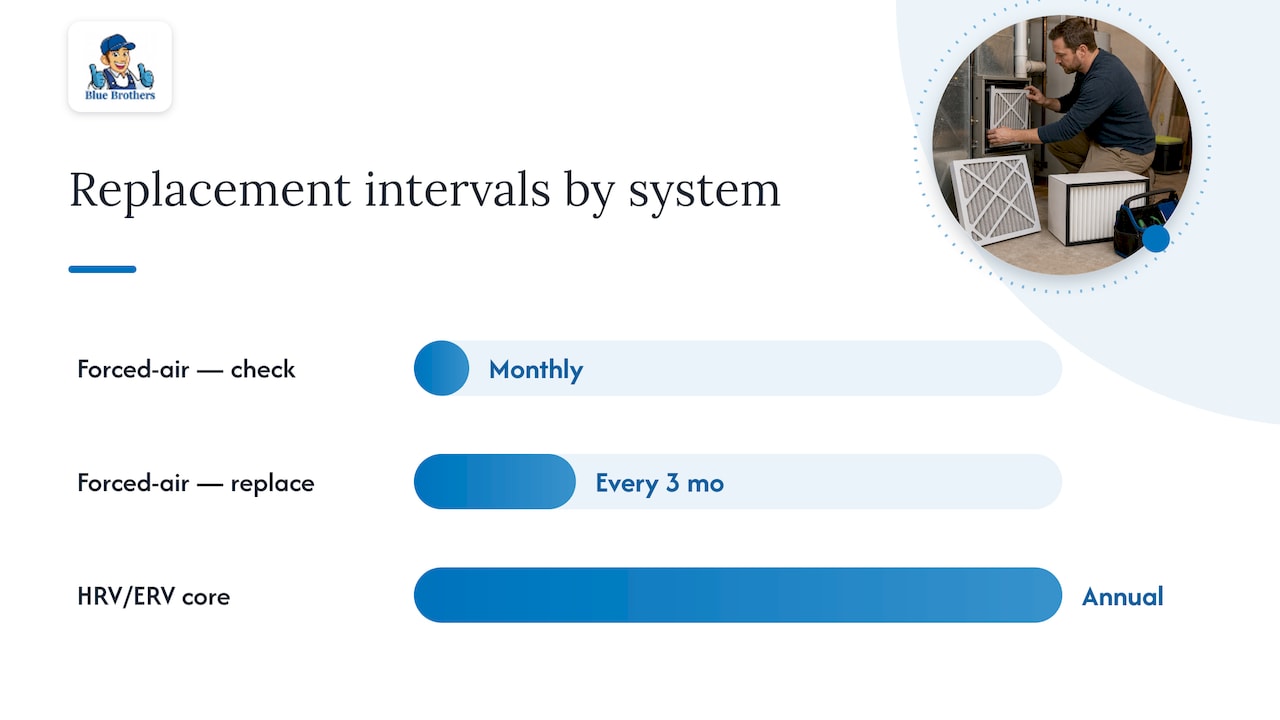
Commercial HVAC operates differently. Rather than a fixed interval, ASHRAE’s maintenance guidance points facility operators toward condition-based replacement using differential pressure, or ΔP, monitoring. A gauge measures resistance across the filter bank: as the filter loads with particulate, resistance climbs, and once it crosses the threshold set in the building’s operations and maintenance manual, the filter gets swapped regardless of the date on the calendar. This protects airflow better than a fixed schedule because filter loading depends on occupancy, outdoor air quality and duty cycle, not the number on a wall calendar.
A few seasonal habits tie the schedule together:
- Book a professional check in spring before cooling season starts, and again in fall before the furnace runs hard.
- Replace forced-air filters on a fixed reminder, then confirm visually rather than trusting the date alone.
- Treat HRV or ERV filter changes as a separate task from the annual core service.
Signs your filter needs changing sooner
Calendar schedules are a starting point, not a guarantee. Several situations call for an earlier change:
- The filter media looks grey, matted or visibly packed with dust when held up to light.
- Airflow at the registers feels weaker than usual, or the system runs longer to reach the same temperature.
- Energy bills climb without an obvious cause, or the furnace short-cycles, turning on and off more often than normal.
- A renovation, wildfire smoke event, heavy pollen season or new pet in the house adds particulate faster than the filter can handle.
- High occupancy or a household member who smokes indoors increases the load between changes.
A quick monthly check takes under a minute: pull the filter partway out and hold it up to a light source. If you can’t see light coming through, it’s overdue.
Pro Tip: Keep a spare filter on hand in the correct size so a loaded filter never gets left in place because a replacement isn’t nearby.
Choosing the right filter for your system
Fit matters as much as filtration rating. A filter that’s slightly undersized lets air bypass the media entirely, pulling dust past the frame instead of through it, which defeats the purpose of changing it on schedule at all.
- Measure the existing filter’s dimensions before ordering a replacement, and confirm the airflow direction arrow matches the unit.
- For general home use, a mid-range MERV rating balances particle capture with airflow; for allergy relief, a higher MERV within the equipment’s rated limit captures more pollen and dander.
- Check the furnace or air handler manual for a maximum MERV rating before buying a higher one. Exceeding it restricts airflow and can strain the blower.
- Health Canada notes that portable HEPA purifiers can supplement filtration for allergen-sensitive households, but they work alongside HVAC filter care, not instead of it.
How to check and replace your filter safely
Routine filter checks don’t require special tools, just a consistent process.
- Turn off the furnace or air handler before opening the filter compartment.
- Note the airflow direction arrow printed on the filter frame before removing it.
- Slide the old filter out and inspect it against a light source.
- Compare it to a new filter of the same size to confirm you’re buying the right one.
- Install the new filter with the arrow pointing toward the equipment, then restore power.
- Write the change date on the filter frame or a nearby reminder card.
Reusable, washable filters are appropriate for lower-dust households; rinse and fully dry them before reinstalling to avoid mould growth. If the filter housing is cracked, access is blocked by ductwork, or you suspect mould or rodent contamination inside the cavity, stop and call a technician rather than working around the problem. Restricted airflow from a neglected filter also increases strain on the blower motor over time, which is one reason a one to three month interval matters for HRV and ERV units specifically.
What a pre-season professional inspection covers
Filter changes handle the day-to-day, but they don’t catch everything a system needs.
- A pre-season furnace check inspects burners, heat exchanger condition, condensate drains and safety controls before the heating load ramps up.
- Coil cleaning removes buildup that filters can’t catch, restoring the heat transfer efficiency lost to a dirty coil.
- HRV and ERV units need a periodic core inspection and balance verification, often best handled by a certified technician when performance drifts from expected ventilation rates.
- Scheduling heating system checks in fall and cooling checks in spring lines up maintenance with the season that’s about to demand the most from the equipment.
Skipping these visits doesn’t just risk comfort. Neglected maintenance tends to raise energy costs and shorten equipment life, which is why an annual contractor visit pairs well with the filter habit you’re already building.
Why filter care is only half the maintenance picture
A clean filter is the cheapest, highest-return maintenance task in the house, but it only protects what’s downstream of it. Dust that bypasses a poorly fitted filter, or that accumulated in the ducts before you started checking monthly, doesn’t disappear because the filter is now clean.
Field experience with duct systems points to a simple fix for the most common failure: people forget to check filters because the air handler is buried in a crawlspace or closet. Moving primary filtration to an accessible return grille, where that’s possible, turns a monthly chore into something anyone in the household can do in thirty seconds. Pair that habit with an annual contractor visit for furnace cleaning or duct service, and the two together cover what a filter alone cannot.
— Jayce
Book professional cleaning when filters aren’t enough
Filter changes keep particulate out of your system, but they don’t remove what’s already built up in the ducts, coils or dryer vent. Professional services handle the parts of the system a filter can’t reach: air duct cleaning, furnace cleaning, HRV cleaning, dryer vent cleaning and air conditioning coil cleaning, often offered with clear pricing and no hidden fees.
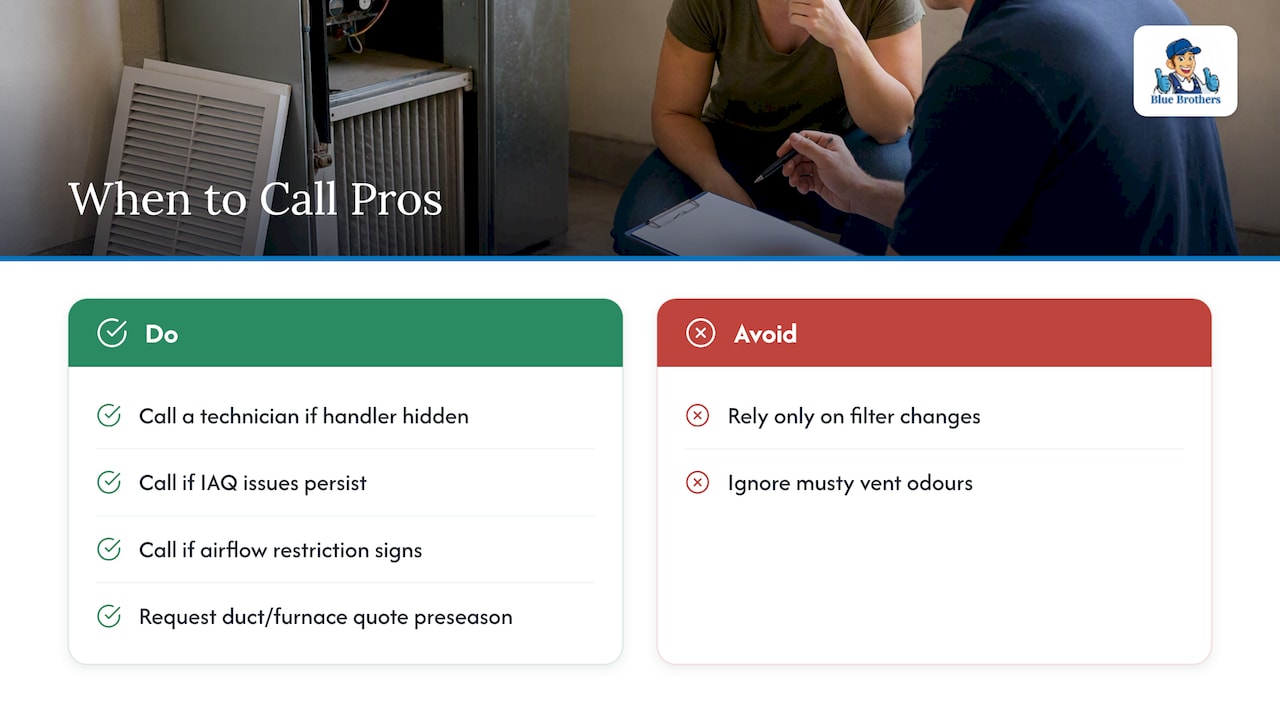
Call a technician when the air handler is buried behind finished walls or a tight crawlspace, when indoor air quality issues persist despite regular filter changes, or when you notice signs of airflow restriction like longer furnace run times or musty odours from the vents. These usually point to buildup a filter never touched.
If a pre-season inspection is on your list this year, request a quote for duct cleaning or furnace service and get the rest of the system checked while the filter habit takes care of the day-to-day.
Where to check for model-specific guidance
For details specific to your equipment, start with the owner’s manual, which sets the manufacturer’s maximum MERV rating and recommended service intervals. Beyond that, Natural Resources Canada, Health Canada, CMHC and ASHRAE publish the guidance behind the schedules in this article. A certified technician can confirm what applies to your specific system.
Sources
- How to maintain a heat recovery ventilator — CMHC
- Keeping the heat in — Natural Resources Canada
- Improve indoor air quality in your home — Health Canada
- ASHRAE maintenance guidance (Standard 180 references)
FAQ
How often should I change my furnace filter?
Check it monthly and replace it regularly, though a household with pets, renovations or heavy dust may need to change it sooner, according to Natural Resources Canada. Visible dust buildup or reduced airflow are signs to replace it early.
What MERV rating is best for allergies?
A higher MERV rating within your equipment’s rated limit captures more pollen and dander, but exceeding the manufacturer’s maximum can restrict airflow and strain the blower. Check the furnace or air handler manual before upgrading, and consider a portable HEPA purifier as a supplement rather than a replacement.
How often should HRV or ERV filters be cleaned?
HRV and ERV filters should be cleaned or replaced every one to three months, with a full core inspection at least once a year, per CMHC’s maintenance guidance. A homeowner’s guide covers simple steps for wiping the core between service visits.
How do commercial buildings decide when to replace filters?
Commercial systems typically use differential pressure, or ΔP, monitoring rather than a fixed calendar, replacing filters once resistance crosses the threshold set in the building’s operations and maintenance manual. This approach follows ASHRAE’s maintenance guidance for commercial HVAC upkeep.
Does Blue Brothers offer furnace and duct cleaning services?
Certain companies provide air duct cleaning, furnace cleaning, HRV cleaning, dryer vent cleaning and air conditioning coil cleaning, sometimes with clear pricing and no hidden fees. You may request a quote from providers offering pre-season inspection or routine cleaning services.