Gas furnaces usually cost less to run in cold climates where natural gas is available, while electric resistance furnaces cost less to buy but more to operate over time. Cold-climate heat pumps and hybrid systems often beat electric resistance on cost and frequently come close to gas, sometimes beating it on emissions. The exceptions are mild climates, homes with cheap renewable electricity, and owners planning to sell soon, where the lower upfront cost of electric wins out.
TL;DR:
- Gas furnaces recover heat faster in extreme cold but require proper venting and combustion safety measures to prevent backdrafting risks.
- Electric furnaces have lower initial costs but depend heavily on electrical capacity and often have higher operating costs in cold climates without renewable electricity.
- Heat pumps and hybrid systems can save homeowners significant energy and emissions, especially when the grid is low-carbon and the home is well-insulated.
- Long-term owners in regions with access to natural gas tend to benefit most from gas or hybrid systems, while short-term owners may prefer electric options due to upfront savings.
- Ensuring ducts are clean and systems are properly tuned is crucial to achieving rated efficiency for either furnace type.
Table of Contents
- How gas and electric furnaces actually produce heat
- What gas and electric furnaces cost to buy and run
- Reading efficiency labels and weighing the emissions trade-off
- Matching the right furnace to your climate and home
- Combustion safety, venting, and what to check before installing
- Where heat pumps and hybrid systems fit in
- What I’d actually check before deciding
- How Blue Brothers helps you get real numbers, not guesses
- Sources
- FAQ
How gas and electric furnaces actually produce heat
A gas furnace burns natural gas at a burner, transfers that heat through a heat exchanger, and vents the combustion byproducts outside. Many modern units use sealed combustion, drawing outside air directly to the burner rather than pulling air from inside the house. An electric furnace skips combustion entirely: electric current runs through resistance coils that heat up like a toaster element, with no flame, no exhaust, and no venting required.
Both types typically distribute heat the same way, through forced-air ductwork, so airflow and duct condition affect comfort and efficiency regardless of fuel source.
- Gas furnaces heat air faster per cycle, which matters in extreme cold.
- Electric furnaces have simpler mechanics with fewer moving parts tied to combustion.
- Efficiency for gas units is measured in AFUE (Annual Fuel Utilization Efficiency), while EnerGuide labels let you compare AFUE across models on one scale.
What gas and electric furnaces cost to buy and run
Upfront costs depend heavily on what is already in place. Installing a gas furnace where no gas line exists means trenching, permitting, and venting or chimney work on top of the unit itself. Electric furnaces skip the gas hookup, but if your electrical panel cannot handle the added load, you are looking at a panel upgrade, which erases much of the upfront savings.
Replacing a furnace with a much higher AFUE model can cut fuel use significantly, according to Natural Resources Canada, which is the single biggest lever most homeowners have over lifetime cost.
Operating costs come down to three things: local fuel prices, the furnace’s AFUE (or a heat pump’s coefficient of performance), and how many heating degree days your home sees each winter. A short ownership horizon of two or three years often favours electric’s lower purchase price, since you will not stay long enough to recover a gas furnace’s higher installation cost through lower bills. Long-term owners in cold regions with gas access usually come out ahead running gas, unless electricity is unusually cheap locally.
- Pull your last 12 months of energy bills and note the fuel type and any AFUE rating listed on your current unit.
- Compare that AFUE to the ENERGY STAR benchmark of 95% or higher for condensing gas furnaces.
- Ask any contractor quoting a replacement to itemize gas line, venting, or panel upgrade costs separately from the unit price.
Reading efficiency labels and weighing the emissions trade-off
AFUE measures how much fuel energy becomes usable heat over a heating season, and it does not count the electricity a furnace’s fans and controls use, according to Natural Resources Canada’s gas heating guidance. Modern condensing gas furnaces commonly reach 90% to 98% AFUE, and Canada’s energy efficiency regulations require most new residential units to hit around 95%.
EnerGuide labels display a furnace’s AFUE to help compare models side by side, a comparison tool detailed on Natural Resources Canada’s EnerGuide page rather than relying on manufacturer marketing claims.
- Gas combustion always produces carbon dioxide on-site, regardless of AFUE.
- Electric furnace emissions depend entirely on how the local grid generates power.
- Heat pumps cut emissions most where the grid is already low-carbon, since they move heat instead of generating it from resistance or combustion.
Matching the right furnace to your climate and home
Severe winter climates put gas furnaces at an advantage for peak heating load, since they recover heat quickly during extended cold snaps. Cold-climate air-source heat pumps have narrowed that gap considerably, but their output still drops at extreme low temperatures, so check a model’s rated performance at your region’s coldest typical readings before counting on it alone.
- In mild climates or well-insulated homes, electric resistance or a heat pump is often genuinely competitive on cost.
- If your electrical panel is already near capacity, adding an electric furnace’s full load may force a panel upgrade that changes the economics.
- Converting a home from baseboard heaters to central forced-air ductwork for a furnace swap can be expensive, and the payback depends on how long you plan to stay.
Pro Tip: Before comparing quotes, have your ductwork inspected. Leaky or clogged ducts can quietly undercut even a high-efficiency furnace’s rated performance.
Combustion safety, venting, and what to check before installing
Gas furnaces need proper venting to move combustion byproducts outside, and sealed-combustion designs draw their air from outside rather than from inside the home, which reduces backdrafting risk in airtight modern builds, according to ULC Canada’s field evaluation guidance. Backdrafting becomes a real concern in tightly sealed homes without enough combustion air supply, which is why combustion testing during installation matters.
- Working carbon monoxide detectors are non-negotiable in any home with a gas furnace.
- Permits and inspections are typically required for gas line work and venting changes.
- Gas furnaces need periodic burner and heat-exchanger checks; electric furnaces need element and blower servicing instead.
- Clean ducts and a properly inspected HVAC system reduce fire and combustion-related risks alike.
Ask any technician quoting a gas installation what combustion testing they perform and how they verify proper venting before signing off.
Where heat pumps and hybrid systems fit in
Cold-climate air-source heat pumps (CC-ASHPs) are frequently the better option than a straight electric furnace replacement. CanmetENERGY found homeowners switching from electric resistance to a CC-ASHP save roughly $700 to $1,900 a year, with smaller savings against natural gas depending on the region.
Hybrid systems pair a heat pump with a gas furnace and use smart controls to switch automatically between the two depending on outdoor temperature and running cost.
- NRCan test homes using hybrid systems with smart switching saw substantial energy and greenhouse gas reductions compared with running a gas furnace alone.
- A heat pump component also provides cooling in summer, adding value a furnace alone cannot.
- Homeowners planning to stay put for years, with enough electrical capacity, are the best candidates for a hybrid or heat pump upgrade over a like-for-like electric furnace swap.
What I’d actually check before deciding
Three questions settle most of this. What does fuel cost where you live, and is natural gas even available on your street? Does your electrical panel have room for a heat pump or electric furnace without an upgrade? And how many years do you plan to stay in the home?
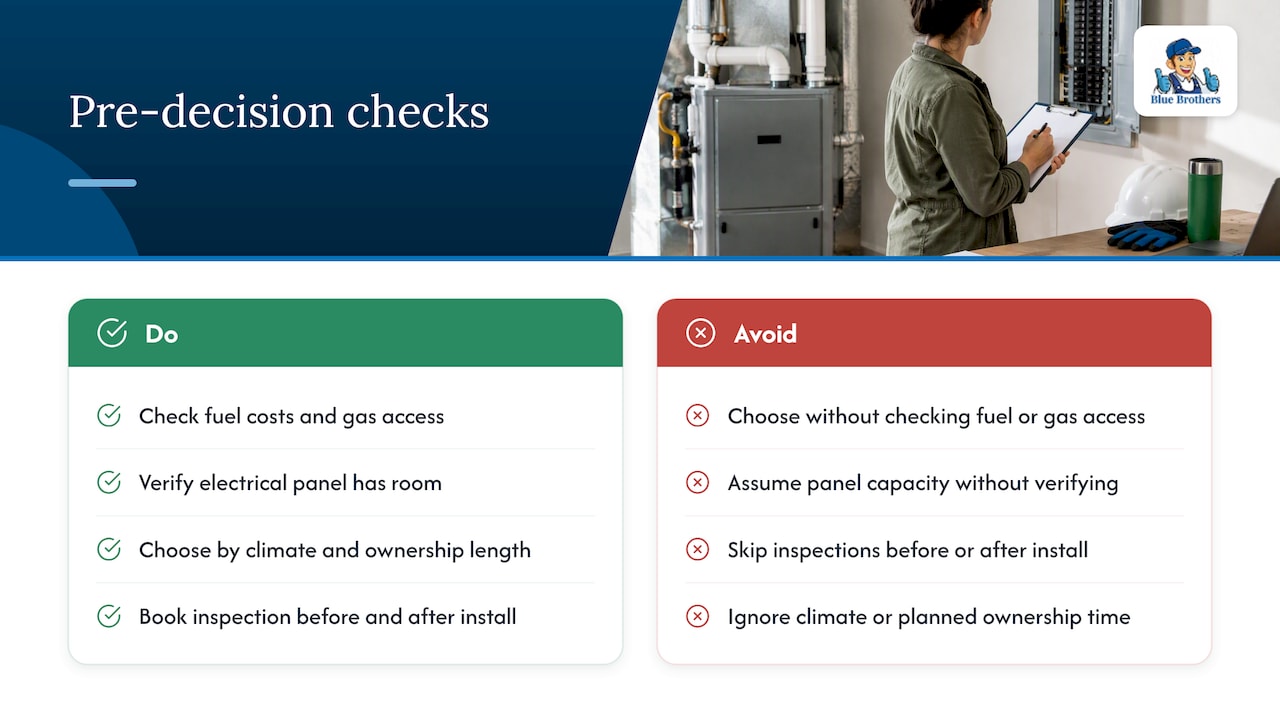
For most cold-climate homes with gas access and long ownership horizons, gas or a hybrid system wins. For mild climates, all-electric homes, or short-term owners, electric resistance or a heat pump often makes more sense.
Whichever you pick, clean ducts and a tuned furnace change the real-world numbers. Book an inspection before you get replacement quotes, and again after installation to confirm the system is actually performing as rated.
— Jayce
How Blue Brothers helps you get real numbers, not guesses
A furnace’s rated AFUE only holds up if the ducts moving that air are clean and the unit itself is properly tuned. Blue Brothers offers furnace cleaning and duct cleaning to certified technicians’ standards, so the efficiency numbers you compare between gas and electric options reflect how the system will actually perform in your home, not just its factory rating.

- Book a furnace and duct inspection before collecting replacement quotes, so contractors are pricing against real airflow conditions.
- Schedule a post-installation cleaning and commissioning check to confirm your new system hits its rated efficiency.
- Add a dryer vent cleaning check while technicians are on-site, since blocked vents strain HVAC systems in similar ways.
Get a quote for furnace cleaning or duct cleaning before your next heating decision.
Sources
FAQ
What are the most common problems with electric furnaces?
Electric furnaces most often run into worn heating elements, blower motor failures, and tripped breakers from overloaded circuits. Unlike gas units, they have no combustion parts to fail, but their operating costs tend to climb faster as electricity rates rise.
Can I replace my gas furnace with an electric furnace?
Yes, but your electrical panel needs enough spare capacity to handle the furnace’s full load, which sometimes requires a panel upgrade. It is worth comparing that upgrade cost against a heat pump or hybrid system, which can offer lower operating costs than straight electric resistance.
Which lasts longer, an electric or gas furnace?
Both types typically last many years with regular maintenance, and lifespan depends more on installation quality, usage, and upkeep than on fuel type. Gas furnaces need periodic burner and heat-exchanger checks, while electric furnaces rely on element and blower servicing to reach their expected service life.
What are the downsides of a gas furnace?
Gas furnaces require proper venting and combustion safety checks, including carbon monoxide detectors, to manage backdrafting risk in airtight homes. They also cost more upfront to install where no gas line exists, and they produce on-site carbon dioxide emissions that an electric furnace does not.