The best seasonal checklist for a Canadian home has three layers. Monthly safety checks run all year. A fall freeze-up round gets the house ready before the ground locks. Spring and summer rounds deal with water, drainage and cooling. Fall is the heaviest of these, and it is the season we are in now, so start there if you have not yet. Below you will find what to do and roughly when, with the vent, duct and air-quality tasks that most generic lists skip.
TL;DR
- Test smoke and carbon monoxide alarms and GFCI outlets every month, and check your furnace filter monthly too.
- Fall is the big job: eavestroughs, exterior water lines, weatherstripping, furnace, HRV and a dryer vent check before freeze-up.
- Timing depends on your region and the year’s weather, so treat month names on any checklist as a guide only.
- Duct cleaning is usually a every-two-to-four-year task, while dryer vents need attention at least once a year.
- Print the schedule, tick items off, and keep it for next year.
Table of Contents
- Why the weather matters more than the calendar
- Monthly habits that run all year
- Fall checklist: the freeze-up round
- Winter checklist: keep things running
- Spring checklist: water first
- Summer checklist: cooling and the outdoors
- Air quality tasks to fold into every season
- A year at a glance
- Our view: what most checklists leave out
- Hand off the vent and duct items
- FAQ
- Sources
Why the weather matters more than the calendar
A checklist that says “do this in October” is useful in Toronto and not much help in Fort McMurray. The Canada Mortgage and Housing Corporation says seasonal timing varies by area and by year, so its Home Maintenance Schedule is a general guide rather than a set of fixed months. The same document suggests you print it and reuse it as a checklist every year. It was last revised in 2010, so use it for the routine and check newer local guidance for anything technical.
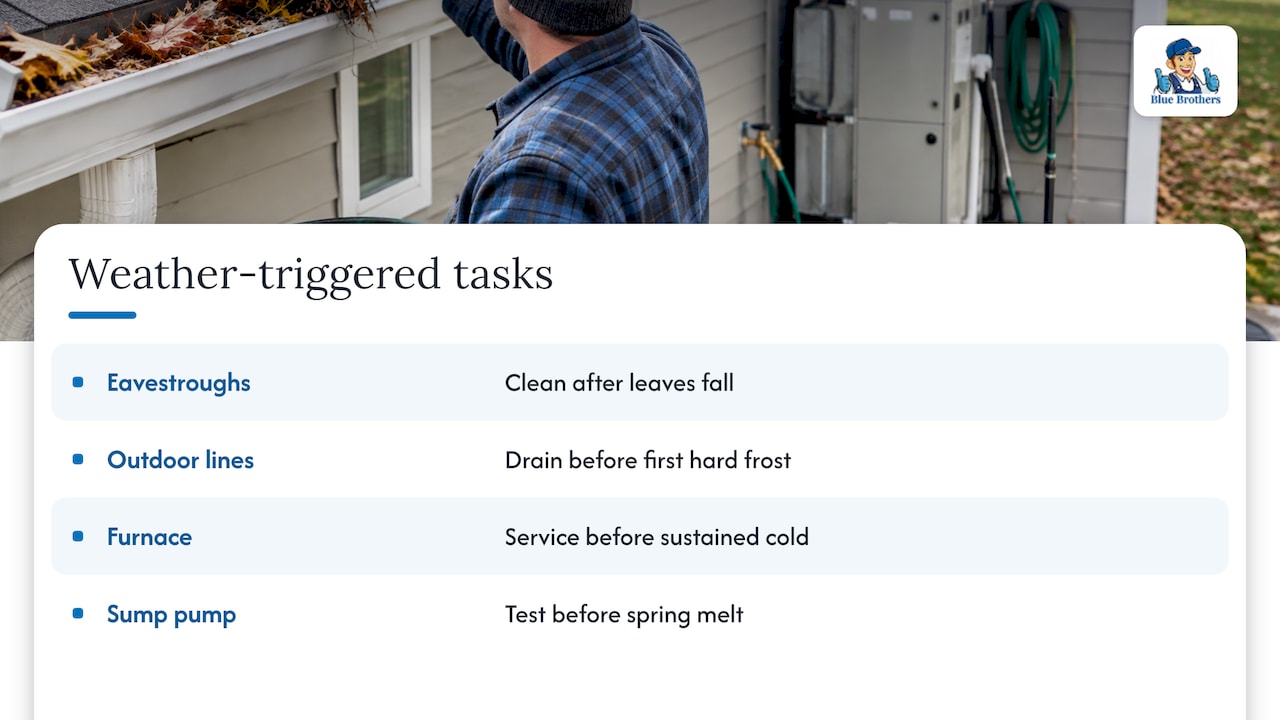
A practical rule: tie each task to a trigger, not a date. Clean the eavestroughs once the leaves are down. Drain outdoor lines before the first hard frost. Service the furnace before the first stretch of sustained cold. Test the sump pump before the spring melt. If you live on the Prairies or in the interior of British Columbia, your triggers arrive earlier than they do on the coast.
Monthly habits that run all year
These take minutes and prevent most of the serious surprises. Insurers make the same point: TD Insurance notes that steady monthly tasks make seasonal checklists easier to manage and stop small problems from building up.
- Smoke and carbon monoxide alarms. The City of Calgary advises testing alarms monthly by pressing each device’s test button. It also advises replacing carbon monoxide detector batteries twice a year, or as the manufacturer directs.
- GFCI outlets. CMHC says to press the test button monthly. The reset button should pop out. If it does not, call a licensed electrician.
- Furnace filter. Calgary recommends checking it monthly for condition and cleanliness, and changing it with the seasons. Our own monthly air filter check guide walks through how to read a filter.
- Range hood filter. CMHC lists monthly cleaning. If you are choosing or replacing a hood, see our notes on ducted versus ductless range hoods.
- Vents. CMHC asks you to confirm that intake, exhaust and forced-air vents are not blocked by snow or debris.
A simple way to make them stick is a recurring phone reminder on the first of the month. Put the alarm test, the GFCI test and the filter look in one five-minute round. If you have young children, the same walk-through is a good moment to review other recurring safety actions, such as this babyproofing checklist for stairs.
Fall checklist: the freeze-up round
Fall is busy because everything has to be ready before freeze-up. The Ontario new-home warranty body Tarion publishes a fall maintenance checklist whose items hold up well across the country. Group them by where you work.
Outside
- Eavestroughs and downspouts. Clear them so water flows away from the foundation. Saskatchewan Home Warranty’s fall checklist includes checking for obstructions and confirming drainage away from the house. Homes with heavy tree cover need more frequent cleaning; our gutter cleaning frequency guide explains how to judge it.
- Exterior water lines. Drain hoses and exterior lines, store the hoses, and shut off the exterior water supply, as Tarion lists.
- Roof. Look for damaged shingles, flashing and seals. TD Insurance puts roof inspection on its fall list too, along with trimming trees and shrubs.
- Doors and windows. Check weatherstripping and seal around frames. Tarion and Saskatchewan Home Warranty both list this.
- Landscaping. Tarion’s list includes winterizing landscaping and dealing with leaves.
Inside
- Furnace. CMHC suggests servicing a gas furnace every two years and an oil furnace every year, or as the manufacturer recommends. Do the filter now regardless. If your furnace is ageing and you are weighing a big bill, our 30% rule for repair versus replacement helps. For very cold regions, see also our comparison of heat pumps and furnaces below −20°C.
- HRV. Tarion’s checklist includes checking and cleaning the heat recovery ventilator. Saskatchewan Home Warranty adds cleaning HRV filters and the range hood filter where you have them.
- Humidifier and humidity. Tarion lists cleaning the humidifier and watching humidity and window condensation. Lethbridge Weather, a local site, reports that CMHC suggests cleaning portable humidifiers two or three times over the season.
- Fireplace and chimney. TD Insurance lists inspecting fireplaces and chimneys among its indoor fall tasks, alongside checking the attic and basement.
- Alarms and GFCIs. Do the monthly test, and swap in fresh carbon monoxide detector batteries.
- Emergency kit. TD Insurance recommends preparing one before winter.
Dryer vent
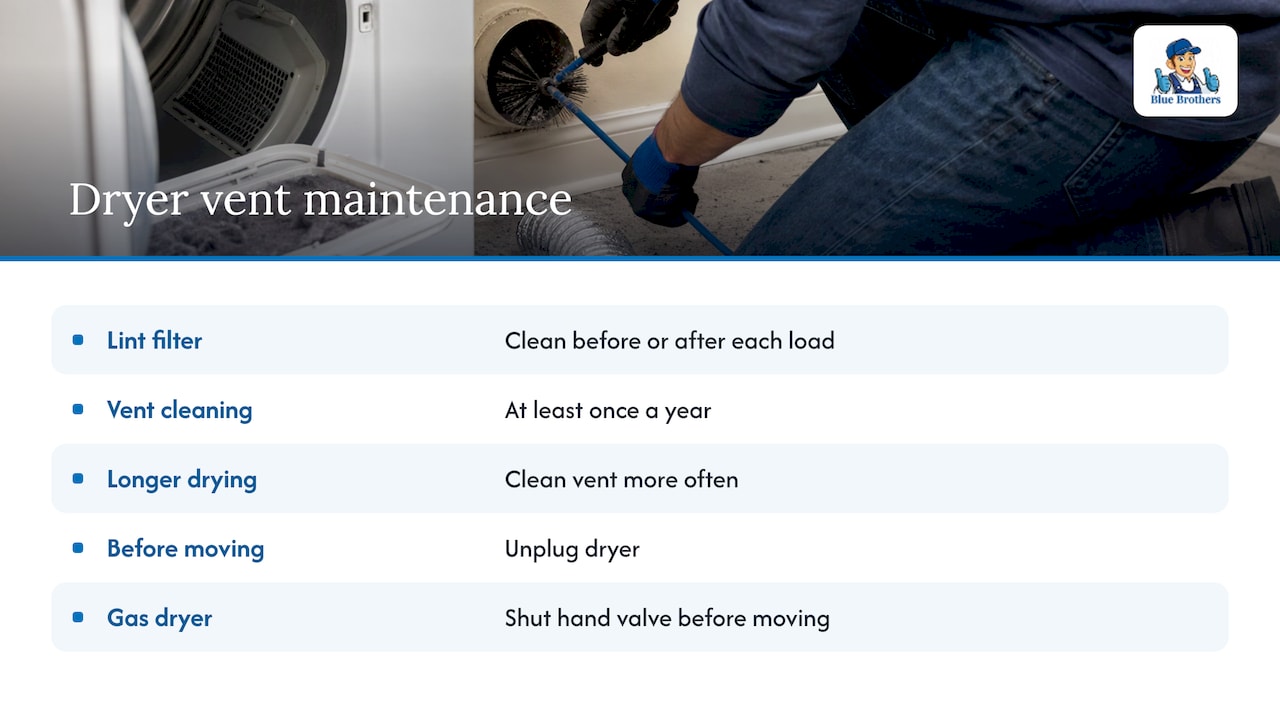
Most Canadian lists mention the lint trap and stop there. The vent itself deserves a fall look. Seattle’s Fire Department, in a clothes dryer exhaust memo, advises cleaning the vent at least once a year, or more often if clothes take longer to dry, and cleaning the lint filter before or after each load. That guidance is from the United States, but the physics is the same here. The U.S. Department of Energy’s dryer venting guide adds safety steps: unplug the dryer before moving it, shut off the hand valve on a gas dryer, and watch for screws or fittings that poke into the vent and catch lint.
If your dryer is taking two cycles, run our 10-minute dryer checks first. Roof-terminated vents are a different matter, and we explain why rooftop vents are best left to professionals.
Winter checklist: keep things running
Winter is mostly maintenance by observation. Keep the monthly round going, and add these:
- Clear snow from furnace, HRV, dryer and other exterior vents so they can breathe, as CMHC advises.
- Check the furnace filter monthly. Heavy use in cold weather loads it faster.
- Watch for window condensation, which Tarion treats as a sign to review indoor humidity.
- Keep the emergency kit stocked and the batteries fresh.
- Look at the attic and basement for dampness. Health Canada, in its ventilation and indoor environment guidance, recommends repairing water leaks to control dampness.
Winter is also when many people notice dusty vents or a stuffy house, because windows stay closed for months. Our guides on why dust shows up at vents and on home comfort through a Canadian winter cover what is normal and what is not.
Spring checklist: water first
Spring in Canada is about meltwater. Ready Home Canada’s seasonal checklist, which draws on federal flood-damage reduction guidance, suggests cleaning eavestroughs and downspouts twice a year. It also suggests inspecting foundations and grading annually, and testing sump pumps and backwater valves annually.
In practice that means:
- Walk the perimeter after the snow goes. Look for settled soil or cracks, and make sure the ground slopes away from the foundation.
- Clear the eavestroughs again, since fall’s job is rarely the last one.
- Test the sump pump by lifting the float or pouring water into the pit. If you have a backwater valve, have it checked.
- Check the roof for winter damage.
- Reset the household: change filters, test alarms, and replace carbon monoxide batteries (the second change of the year).
Summer checklist: cooling and the outdoors
Summer is the quiet season, and the best time for the jobs that need good weather and no rush. Outside, inspect siding, trim and exterior seals, and fix what winter loosened. Inside, get the cooling side ready. If you have central air, the coil needs to be clean to move air efficiently; our air conditioning coil cleaning service runs between $100 and $400 depending on the system.
This is also a good time to book jobs that will be hard to get in November: a gas furnace service, duct cleaning, or a renovation. If you are planning renovations, our 30 to 60 minute rule for stopping renovation dust keeps the work from spreading dust through the ducts.
Air quality tasks to fold into every season
Health Canada’s advice is simple: reduce the sources of contamination inside the home. That includes fixing leaks that cause dampness and maintaining fuel-burning appliances properly. Beyond that, the tasks above do most of the work for indoor air:
| Task | How often | Source |
|---|---|---|
| Check furnace filter | Monthly, change with the seasons | City of Calgary |
| Clean range hood filter | Monthly | CMHC |
| Clean HRV filters | Part of the fall round | Saskatchewan Home Warranty |
| Duct cleaning | Every two to four years, depending on the home | City of Calgary |
| Dryer vent | At least once a year | Seattle Fire Department |
| Gas furnace service | Every two years | CMHC |
The two-to-four-year range for ducts is wide on purpose. A house with pets, a recent renovation, smokers or allergy sufferers sits near the short end. A newer, lightly used home sits near the long end. Our notes on how dirty ducts affect your health in winter and why duct cleaning matters before winter go further.
A year at a glance
| Season | Priority | Typical tasks |
|---|---|---|
| Fall | Freeze-up readiness | Eavestroughs, outdoor water lines, weatherstripping, roof, furnace and HRV, dryer vent |
| Winter | Observation | Clear vents of snow, filter checks, humidity and condensation, leak watch |
| Spring | Water | Grading, eavestroughs, sump pump and backwater valve, roof check |
| Summer | Outdoors and cooling | Exterior repairs, AC coil, booking furnace and duct work early |
| Every month | Safety | Alarms, GFCIs, filters, range hood, vents |
Our view: what most checklists leave out
We clean ducts, dryer vents, furnaces, HRVs and commercial exhaust systems every week, and the pattern is consistent. Homeowners are diligent about gutters and weatherstripping because they can see them. The airflow side of the house is out of sight, so it slips.
That is why we would add three lines to any Canadian checklist: a dryer vent check at least once a year, a furnace and HRV round every fall, and duct cleaning on a schedule that fits your home rather than a guess. Neglected dryer vents carry a real fire risk, and a clogged system works harder and costs more to run.
Our technicians are certified, our pricing is clear with no hidden fees, and we offer round-the-clock support, including emergency service. If you would rather hand off the vent and duct items on your list, that is exactly what we are here for.
Jayce
Hand off the vent and duct items
If the fall round has more on it than you want to take on, we can take the airflow jobs. Our published ranges are $400 to $800 for air duct cleaning, $99 to $225 for dryer vent cleaning, $50 to $300 for furnace cleaning and $100 to $400 for HRV cleaning. We work in British Columbia, Alberta and Saskatchewan, for homes and for businesses.

To get a quote, start at bluebrothers.ca or see our residential duct cleaning page. Restaurants and commercial kitchens can ask about grease exhaust and hood cleaning to NFPA 96 standards.
FAQ
What home maintenance should I do every year?
Do the monthly safety checks, plus one round per season. Each year that means clearing eavestroughs, draining outdoor water lines, checking the roof and weatherstripping, servicing heating equipment and cleaning HRV filters. Clean your dryer vent at least once a year as well.
Is there a free printable home maintenance checklist?
Yes. CMHC’s Home Maintenance Schedule is free and designed to be printed and reused every year. It is a general guide, so adjust the timing to your local climate. You can also copy the table in this article.
What should I do in October?
Focus on freeze-up. Clear eavestroughs, drain and shut off exterior water lines, check weatherstripping and the roof, change the furnace filter, clean the HRV and test every alarm. Tarion’s fall checklist covers these items.
How often should ducts be cleaned?
The City of Calgary recommends every two to four years, depending on the home. Pets, renovation dust, smoking and allergies point toward the shorter interval. If you are unsure, a technician can look at your system and tell you what they find.
Sources
- CMHC Home Maintenance Schedule
- City of Calgary home maintenance guidance
- TD Insurance seasonal home maintenance
- Tarion fall home maintenance checklist
- Saskatchewan Home Warranty fall maintenance checklist
- Seattle Fire Department clothes dryer exhaust memo
- U.S. Department of Energy dryer venting guide
- Health Canada ventilation and the indoor environment
- Ready Home Canada seasonal checklist