A grease duct cleaning checklist has four parts: what your staff checks every week, what you do to prepare for the cleaning crew, what a certified crew must clean and inspect, and what paperwork you keep afterwards. This guide walks through each part for kitchens in British Columbia, Alberta and Saskatchewan, with the rules that sit behind each line.
TL;DR
- Check hoods, filters and ducts every week. BC’s fire code sets inspections at intervals of no more than 7 days, and Weyburn, Saskatchewan, asks for weekly checks too.
- Professional cleaning frequency follows the NFPA 96 schedule: monthly for solid fuel, quarterly for high-volume cooking, semi-annually for moderate volume, annually for low volume.
- Lock out electrical switches, keep fire suppression working, and never use flammable solvents during cleaning.
- Get a written service report with dates, areas cleaned, areas omitted and the next due date, and keep it on site.
- Our grease exhaust and hood service is published at $400 to $800 CAD per job.
Table of Contents
- Weekly checks your kitchen staff can do
- How much grease is too much
- How often the whole system needs professional cleaning
- Before the crew arrives
- What a professional should clean and inspect
- Safety steps during the cleaning
- After the cleaning: records to keep
- Our perspective
- Book a hood and exhaust cleaning
- FAQ
- Sources
Weekly checks your kitchen staff can do
The cheapest fire prevention in a restaurant is a short weekly look at the exhaust system. It does not replace a professional cleaning. It tells you when one is due.
The British Columbia Fire Code (Division B, Section 2.6.1.3) requires hoods, ducts and filters that collect combustible deposits to be inspected at intervals of no more than 7 days, and cleaned if the buildup creates a fire hazard. The Town of Weyburn’s restaurant exhaust requirements say hoods, grease removal devices, fans and ducts should be checked and cleaned regularly, before surfaces become heavily contaminated with grease or oily sludge.
A weekly walk-through from floor level:
- Canopy surfaces. Look for a visible grease film or drips forming below the hood.
- Baffle filters. Check they are seated, not warped, and not bent. Remove and wash them on your normal schedule.
- Grease troughs and channels. They should drain freely and not be packed with sludge.
- Lighting covers and lenses. Make sure they are intact and not coated.
- Rooftop grease containment. Look for a full collection pan, overflow, or damage around the fan base.
- Fan belt and fan noise. A cracked, loose or worn belt, or a new vibration, goes in the log.
- Access panels. Look for grease seeping at panel edges or joints.
- Fire suppression. Check the gauge reads in its normal range and that nozzles are free of grease. Do not remove nozzle caps, and do not spray cleaning chemicals on fusible links.
- Log entry. Date it, sign it, note anything abnormal.
If your kitchen is in Quebec, the provincial building regulator publishes a weekly verification form that uses a depth gauge comb to judge whether deposits are enough to sustain a fire. It also stresses that the maximum acceptable grease height should be set with a specialist.
For a printable version of this walk-through, see our kitchen hood inspection checklist.
How much grease is too much
The question staff ask most is “how do we know when it needs cleaning?” The standard answers it with a number, not a feeling.
The NFPA 96-2024 revision report describes a grease depth gauge comb. Surfaces other than fan housings are to be cleaned when deposits reach 0.078 in. (2000 μm), and fan housings at 0.125 in. (3175 μm). The same report notes that the grease depth requirements have moved from the cleaning section of chapter 12 into the inspection section.
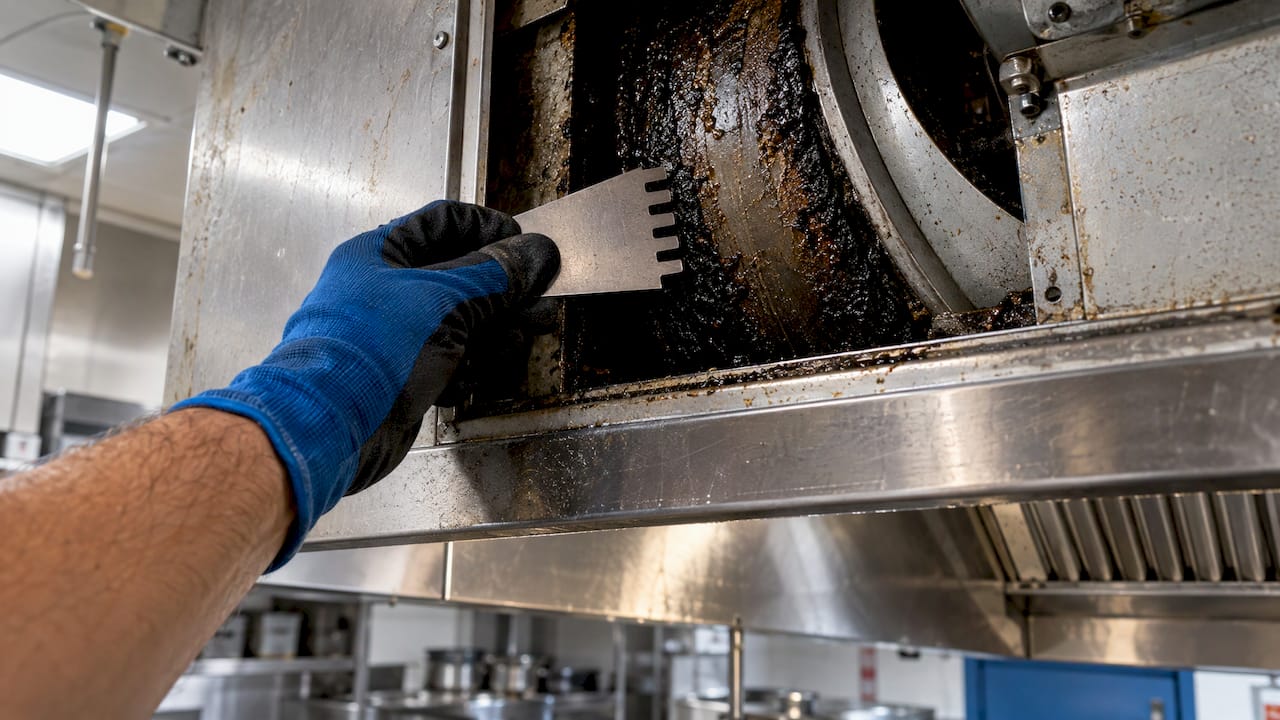
That has a practical meaning. The City of Calgary’s fire safety maintenance requirements state that only the qualified person who inspects the system can decide whether cleaning is required, using the depth gauge comb as the standard describes. Your staff spot the warning signs. A trained inspector makes the call.
How often the whole system needs professional cleaning
Frequency depends on what and how much you cook. The City of Regina’s facility inspections page lays out the NFPA 96 schedule:
| Cooking type | Inspection and cleaning interval |
|---|---|
| Solid fuel cooking | Monthly |
| High-volume (24-hour, charbroiling, wok) | Quarterly |
| Moderate-volume | Semi-annually |
| Low-volume (churches, day camps, seasonal businesses, senior centres) | Annually |
Provincial wording differs slightly:
- Alberta. An Alberta Fire Code interpretation sets the minimum for a qualified person to clean exhaust and hoods at annually, lets the authority having jurisdiction require more, and says deep fat cooking and char broiling systems should be cleaned at intervals of no more than 3 months.
- Calgary. The city requires conformance with NFPA 96-2017 and lists monthly, three-month, six-month and annual tasks in its owner responsibilities document.
- Edmonton. Fire Rescue Services points owners to the NFPA 96 schedule, including semi-annual cleaning for moderate-volume cooking, in its owner responsibilities sheet.
- Saskatchewan. Weyburn’s document calls for a semi-annual inspection and cleaning by an authorized person, in addition to the weekly checks.
If you cannot tell which category you fall in, ask your local fire department and your insurer. Our page on kitchen hood cleaning requirements explains how the 3 to 12 month intervals play out for Canadian operators.
Before the crew arrives
A clean job starts with a prepared kitchen. Use this list the day before:
- Confirm the appointment is after close, so cooking equipment is off and the hood, duct and fan are cool to the touch. Floaire’s deep cleaning instructions require both before any washing starts.
- Clear the cook line, and cover or move food, small wares and anything that cannot get wet.
- Make sure every access panel, rooftop hatch and fan access point can be reached. Inspection under the Regina program also determines whether adequate access exists, and a duct that cannot be reached cannot be cleaned.
- Tell the crew where the hood control panel and breaker are.
- Pull your previous service report and your log so the crew can compare against last time.
- Check that your ABC and Class K extinguishers are mounted, visible and have current inspection tags. Weyburn requires this, along with posted signage for the Class K extinguisher and a visible, accessible manual pull station.
If you are replacing filters at the same time, read our note on baffle versus mesh filters first, because a swap should match the hood’s listing.
What a professional should clean and inspect
A proper job covers the whole path from the cooking surface to the roof. The City of Regina describes cleaning as removing combustible contaminants from hoods, grease removal devices, fans, ducts and other appurtenances, down to a minimum of 50 microns (0.002 in.). The North Bay (Ontario) fire department describes the goal as cleaning to bare metal at the NFPA 96 intervals.
Your checklist for the service itself:
Hood
- Baffle filters removed, soaked, scrubbed, rinsed and dried, then inspected for damage.
- Interior canopy surfaces degreased, including troughs and channels.
- Lighting covers and lenses cleaned and checked.
Ductwork
- All access doors opened, so every section can be reached.
- Horizontal and vertical runs cleaned, joints checked for grease seepage or leaks.
- Before and after photos taken of each section.
Fan
- Fan housing, blades and the rooftop grease containment cleaned.
- Belt checked for wear, cracking or looseness.
Fire protection
- Nozzles and fusible links left intact and protected from cleaning chemicals.
- Appliances aligned with the nozzles after cleaning, with blow-off caps intact, as Weyburn requires.
Ask for a cleaner who can show credentials. The City of Regina notes that operators have the right to ask for qualification credentials. Alberta’s interpretation document says only two organizations are approved by the Provincial Fire Administrator to train people for commercial cooking equipment cleaning, and that a certified person may supervise up to two people while a trainee completes practicum hours. Our NFPA 96 compliance guide covers what to look for when hiring.
Safety steps during the cleaning
These are the rules your crew and your manager should both know:
- Lock out the power. NFPA 96 requires electrical switches that could be activated accidentally to be locked out at the start of cleaning, which is why the hood control panel breaker is switched off so the fan is not signalled to start mid-wash.
- Keep the fire suppression system working. Components must not be rendered inoperable during cleaning.
- No flammable solvents. The BC Fire Code (Section 2.6.1.9) prohibits flammable cleaning materials or solvents on exhaust systems.
- Avoid caustic or chlorine-based chemicals. Floaire warns they can corrode metal surfaces.
- Wash gently near controls. Floaire says not to pressure wash hood controls, fire systems or electrical cabinets, and to hand-wash exterior hood surfaces with mild soap and water.
- Post operating instructions. The BC Fire Code requires instructions for manually operating the fire protection systems to be posted conspicuously in the kitchen. Clear wet chemical extinguisher signs at the cook line help staff find the right equipment fast.
- Reset after cleaning. Floaire notes the system may need a gas reset and pilot lights relit before gas is enabled. Make sure someone qualified does this before service.
After the cleaning: records to keep
The paperwork is what an inspector or insurer asks to see. A complete service report should show:
- The contractor’s name, address and phone number.
- The printed name and signature of the qualified on-site supervisor.
- The date of cleaning or inspection.
- The next due date and recommended frequency.
- Areas cleaned, and any areas omitted with the reason.
- The recognized training organization.
That list comes from Alberta’s fire code interpretation, which also requires records to be retained so at least the current and the immediately preceding ones are available. In Weyburn, inspection reports for the previous two years must be kept on site, along with a drawing of the exhaust installation and operating instructions for components, including electrical schematics.
Post-service checklist for the manager:
- [ ] Service report received, signed and filed.
- [ ] Date label applied to each access door.
- [ ] Before and after photos reviewed.
- [ ] Filters back in place, seated correctly.
- [ ] Suppression gauge in range, nozzle caps intact.
- [ ] Gas and pilot lights confirmed working.
- [ ] Next cleaning date entered in the calendar and the weekly log.
Our perspective
Most grease fires we hear about did not start with a dramatic failure. They started with a duct that nobody could reach, or a log that nobody filled in. That is why we treat the checklist as part of the job, not an add-on.
Our technicians work to NFPA 96 and we plan each visit around access, protecting the suppression system, and documenting what was cleaned. We think a kitchen should leave a visit with photos, a report and a next due date it can trust.
We also offer unlimited hood cleaning packages for kitchens that need frequent visits, and round-the-clock support including emergencies, because a grease problem rarely waits for business hours.
Jayce
Book a hood and exhaust cleaning
We clean commercial kitchen hoods, grease ducts and exhaust fans to NFPA 96 standards across BC, Alberta and Saskatchewan. Our grease exhaust and hood systems service is published at $400 to $800 CAD per job, with clear pricing and no hidden fees. The final amount depends on the size and layout of your system.
We also serve specific communities, including Vancouver, Delta and Maple Ridge. Request a quote and we will confirm the schedule that fits your cooking volume.
FAQ
Can kitchen staff clean the grease duct themselves?
Staff can clean what they can reach safely, such as baffle filters and accessible hood surfaces, and they can check for warning signs weekly. The duct, fan and the decision on whether cleaning is due belong to a qualified person. Calgary’s requirements say that determination can only be made by the qualified person who inspects the system.
How often does a restaurant need its grease duct cleaned in Alberta?
The Alberta interpretation sets annual cleaning by a qualified person as the minimum. The authority having jurisdiction can require more, and deep fat or char broiling systems should be cleaned at intervals of no more than 3 months. Check with your local fire department for your own requirement.
What should I get in writing after a cleaning?
A service report with the contractor’s details, the supervisor’s name and signature, the date, the next due date, areas cleaned and any omitted areas with reasons. Keep it on site with your previous report.
Does the NFPA 96 schedule apply in Canada?
Yes, through the fire codes. The BC Fire Code requires use, inspection and maintenance of commercial cooking exhaust systems to conform with NFPA 96, subject to listed exceptions. Cities such as Regina and Calgary reference the standard in their own requirements.
Sources
- BC Fire Code 2018, Division B, Section 2.6 Service Equipment
- Weyburn: Restaurant Exhaust and Fire Suppression System Requirements
- RBQ weekly verification form for hoods, filters and ducts
- NFPA 96-2024 First Revision No. 52
- City of Calgary: Fire Safety Maintenance Requirements
- City of Regina: Facility Inspections
- Alberta Fire Code interpretation 19-FCI-002/19-BCI-017
- Edmonton Fire Rescue Services: Building Owner Responsibilities
- North Bay Fire and Emergency Services: Commercial Cooking Equipment
- Floaire: Hood, Duct, and Grease Fan Deep Cleaning Instructions