Construction dust gets into your HVAC system even when the furnace is off, and drywall dust is the worst offender because it is so fine. Once it settles in ducts, on the blower and on coils, it can restrict airflow, strain motors and recirculate through your home. The fix is to shut down and seal the system during the work, then have the ducts and equipment professionally cleaned once the dusty work is finished and before you settle back in.
This guide explains what the dust does, how to spot it, how to protect your system during a renovation and how a proper cleanup works.
TL;DR
- Sanding, sawing and drywall work release fine particles that can be drawn into ducts and equipment even when the system is not running.
- Drywall dust can coat motors and bearings and shorten their life, so never run the furnace or air handler during dusty work.
- Prevention is simple: switch the system off, cover every register and return, and keep duct openings covered until the work is done.
- After the work, have qualified technicians clean the ducts and the air handler, then replace the filter before you move back in.
- Skip wet solutions and broadcast biocide spraying. A proper duct cleaning does not need them.
Table of Contents
- Why construction dust ends up in your HVAC system
- What construction dust does to the system
- Signs that construction dust has reached your ducts
- Is breathing construction dust safe?
- How to keep dust out of your HVAC during a renovation
- Cleaning construction dust out of ducts and vents
- Perspective: what we see after renovations
- What post-renovation cleaning costs
- Book a post-renovation cleaning
- FAQ
- Sources
Why construction dust ends up in your HVAC system
Your ducts are a network of open pipes connected to every room. When a renovation fills a room with sanding dust, the system does not need to be running to collect it. Air moves through the house as doors open, as people walk through and as dust drifts, and the open registers and returns are an easy way in.
The U.S. Department of Energy’s Building America Solution Center, drawing on guidance from the Air Conditioning Contractors of America, says sawing, sanding and drywalling produce large amounts of dust that can be pulled into ducts and mechanical equipment even if the system is idle. The U.S. EPA’s Indoor airPLUS bulletin on duct protection says the same thing about airborne particulates and adds that running the system during dust-producing work should be avoided.
If the system does run, the problem multiplies. The return side pulls dusty air through the filter, the blower and the heat exchanger, then pushes whatever got past the filter into every supply duct.
Why drywall dust is a special problem
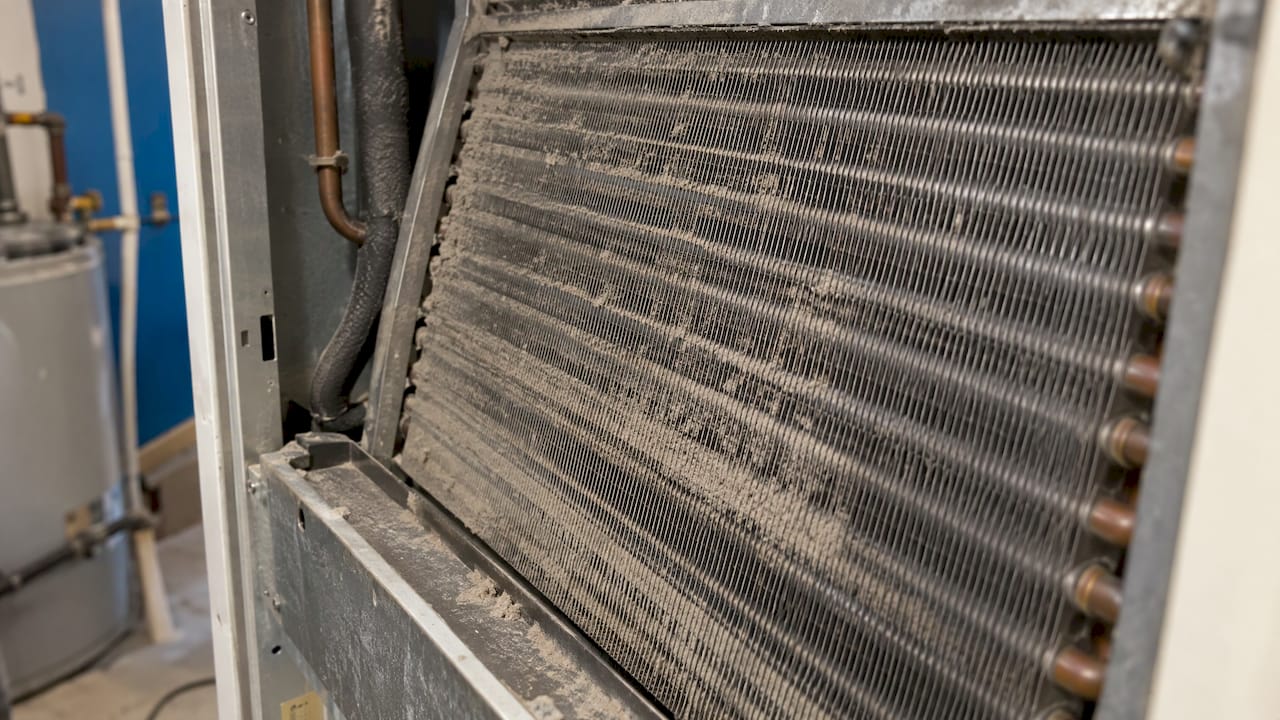
Drywall joint compound sands into a very fine powder that stays airborne for a long time. Ordinary furnace filters are not built to stop it. The Building America guidance notes that a basic fibreglass filter keeps large debris out but does not stop fine dust from reaching the equipment and ducts. Because the powder is so light, it travels to places you would not expect: the far ends of long duct runs, the bottom of the furnace cabinet and the fins of the evaporator coil.
What construction dust does to the system
Motors and bearings
This is where the damage is most concrete. A technical bulletin from an HVAC parts distributor reports that drywall and construction dust accounted for 40% of failed blower and inducer motors returned through one warranty return programme. The document explains two mechanisms. A layer of dust insulates the motor, so heat cannot escape and internal parts are damaged. The dust can also wick lubricating grease out of bearings, and because it is abrasive, bearings that keep running in that state wear out early.
That is a U.S. document from 2013, but the physics does not change at the border. A furnace blower in Calgary or Regina is the same kind of machine.
Airflow and efficiency
A coat of dust on coils, in the blower wheel and on the duct walls adds resistance. The system works harder to move the same air. The Building America guide says these particulates can reduce efficiency and equipment life and block airflow. In a Canadian winter, a furnace that has to push against extra resistance runs longer to hold the temperature you set. We cover the heating side in more depth in our article on how clean ducts improve furnace efficiency in winter.
Odours and microbial growth
The same guide notes that settled debris can become a reservoir for microbial growth and odours, which matters most for anyone in the household with allergies, asthma, COPD or heart conditions. Dust that sits in a damp spot, such as an air conditioning coil that sweats in summer, is more likely to cause trouble than dust in a dry supply run.
Signs that construction dust has reached your ducts
There is no single test, but these are the signs we most often see homeowners describe after a renovation:
- Fine pale film on surfaces that returns within a day or two of dusting. If you clean a room thoroughly and the grey or white powder is back quickly, the system is probably redistributing it.
- Dust or powder visible just inside registers. Remove a supply grille and look in with a flashlight. A layer of fine powder, drywall flecks or sawdust on the duct floor is a clear sign.
- Dark or dusty marks around vents and returns. Streaking on the wall or ceiling near a register can mean fine particles are being pushed out with the air.
- A dusty or musty smell when the furnace or air conditioner starts. Dust burning off hot components, or damp dust on a coil, gives off a noticeable odour.
- Filters that clog far faster than normal. If a new filter looks grey after a week or two, there is a lot of dust in the system.
- Weaker airflow from some rooms, or a blower that sounds laboured.
- Sneezing, coughing or itchy eyes that ease when you leave the house. These are not diagnostic on their own, but they are a reason to look at the system.
If you did major work and see even a couple of these, the ducts are worth inspecting. We go through the checks in more detail in our guide to post-renovation duct cleaning, and if your main complaint is dust coming from the registers, this walkthrough of what you can try yourself and when to call a professional will help you decide.
Is breathing construction dust safe?
The air quality question matters as much as the equipment question. Construction dust is a mix. Depending on the materials, it can include gypsum, wood dust, fibreglass fragments, paint particles and, when concrete, brick, tile or stone are cut, crystalline silica.
The UK Health and Safety Executive says that regular breathing of construction dust is linked to lung cancer, asthma, COPD and silicosis, and that most of these diseases develop over years because small exposures add up. It also says short-term exposure can trigger a reaction in someone who already has asthma or another breathing problem. Cancer Council Australia notes that there is no evidence of a safe level of silica dust exposure, and describes silica particles as about 100 times smaller than a grain of sand.
Those findings are about workers with long, repeated exposure. A family living through one renovation is in a different position, but the practical lessons carry over: keep dust contained, do not let it circulate through the house and clean it up properly rather than leaving it in the ducts. The Canadian Asthma Society’s household guide says dust, debris and fumes from building or remodelling can be hard on eyes, nose and skin, especially for people with asthma. It recommends planning the work step by step, hanging plastic sheeting over doorways and airing out the area for at least three weeks afterwards. For DIY work it advises a facemask approved by the Canadian Standards Association.
If your home is older, find out what is in the walls before anyone sands, cuts or demolishes. A short read on why an asbestos inspection before renovation matters explains the principle, though the rules and licensed providers differ by province, so ask your contractor or your provincial workplace safety body what applies where you live.
How to keep dust out of your HVAC during a renovation
The cheapest cleaning is the cleaning you never need. These steps come from the Building America guide and the EPA bulletin, and a good contractor will already follow most of them.
- Turn the system off before dusty work starts. Do not run the furnace, air handler or air conditioner while anyone is sanding, sawing or mudding. Set the thermostat to off so it cannot start itself.
- Close and cover supply and return registers. Seal them with plastic and painter’s tape. The EPA bulletin says duct openings can be covered with a commercial product or clear plastic wrap secured with painter’s tape, and that the covers should stay on until finishes such as flooring, cabinetry and trim are complete.
- Cover the furnace or air handler. Equipment that is installed during the job needs covering too, and the return opening is the one people forget.
- Seal the work zone. Hang plastic sheeting over doorways, as the Canadian Asthma Society suggests, and keep doors to the work area shut. A negative-pressure setup with a fan exhausting to the outside is common on larger jobs.
- Sweep and vacuum as the work goes on. Dust that is allowed to pile up gets kicked into the air again. Use a vacuum with a HEPA filter where you can.
- Ask your HVAC contractor for a duct and equipment protection plan. The Building America guide recommends exactly this on remodels. It is a short conversation before work starts.
- Store new ductwork away from dusty processes. On larger or commercial jobs, SMACNA’s duct cleanliness guidelines say duct material should be kept away from tile cutters, cutoff saws and drywall sanding.
Our own take on the same problem, with a timing rule that fits Canadian homes, is in the 30 to 60 minute rule for renovation dust control.
A note on filters
A filter alone will not save the system. A cheap fibreglass filter stops large debris but not fine drywall powder, and a high-efficiency filter can clog quickly and restrict airflow, so do not rely on filters as your protection plan. Seal the registers instead, and put in a fresh filter when the work is done.
Cleaning construction dust out of ducts and vents
Once the dusty work is finished, the sequence matters. Cleaning ducts while sanding is still going on only moves the dust around.
When cleaning is warranted
Canada Mortgage and Housing Corporation (CMHC) says drywall dust, fibreglass pieces and sawdust have no place in a duct system, and that duct cleaning can be useful for older houses after major renovations or when moving into a new house and you have doubts about how careful the crew was. That is a good rule of thumb. A small paint job rarely needs it. Opening walls, sanding drywall, removing flooring or a kitchen or basement overhaul usually does, especially if the system was running, or the registers were not covered, while the dust was being made.
What a proper cleanup involves
The Building America guide describes the approach for after construction and before the HVAC is operated: qualified HVAC professionals clean the ducts with a vacuum and duct-cleaning brushes or a pneumatic brushing system. The same guide says not to use wet solutions or ultraviolet light, and that the air-handling unit should be cleaned at the same time. It also says these methods can be used after a major home renovation.
In practice, a thorough job covers:
- Negative pressure on the duct system, so loosened dust is pulled into a HEPA-filtered collection unit instead of back into the house.
- Agitating the duct walls with brushes or air so settled powder lifts and is captured.
- Cleaning the registers, returns and the furnace or air handler cabinet, including the blower.
- Checking the evaporator coil if you have central air conditioning, since dust that collects there affects both airflow and cooling.
- Replacing the filter once the cleaning is done.
No biocide needed
CMHC points out that no products are registered under the Pest Control Products Act for residential duct cleaning, that a proper job does not require a biocide, and that broadcast spraying of biocides through a house is inappropriate if you want to maintain good indoor air quality. If a company proposes spraying your ducts after a renovation, ask why.
Filters before you move back in
The Building America guide says to run the central furnace or air handler with a filter installed after cleaning, and to replace the existing filters before occupancy. Keep a spare on hand, because a system that has just been through a renovation may load its first filter quickly. Check it after a week.
Perspective: what we see after renovations
Most of the post-renovation calls we get follow the same pattern. The homeowner finishes a basement, a kitchen or a new floor, the contractor leaves, and a few weeks later the house is dusty again no matter how often it is wiped down. The system was either running during the work or the registers were open, and fine powder has settled throughout the ducts.
Our view is that the best time to deal with this is right after the dusty work ends and before the family is back to normal life, because every hour the furnace runs on a contaminated system spreads more of it. We clean ducts together with the furnace, coils or HRV when they are affected, so the dust is not simply moved from one component to the next. Our technicians are certified and use advanced equipment, and we price openly with no hidden fees, so you know what the job will cost before it starts.
If you are still planning your renovation, call us before it starts. Covering the registers and shutting the system down costs almost nothing, and it can save you a big cleanup later. If the work is already done, we can inspect the system and tell you what needs attention.
Jayce
What post-renovation cleaning costs
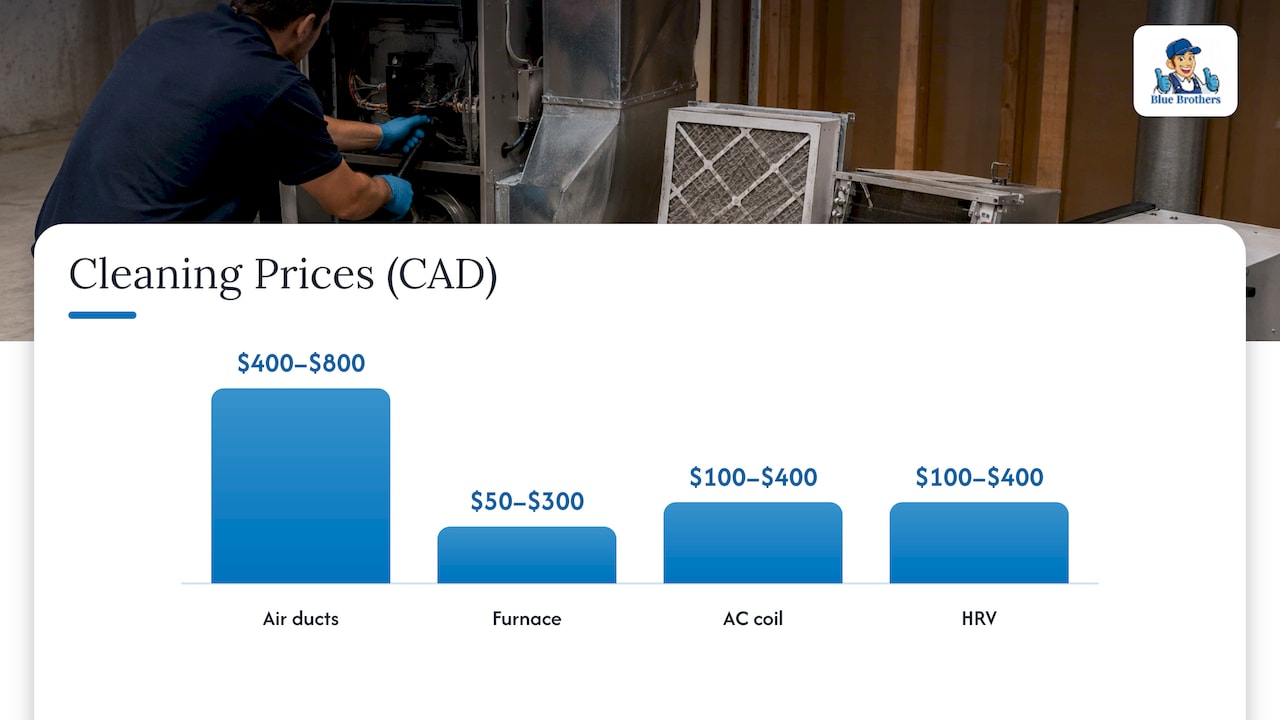
The scope depends on how many components were exposed. These are our published price ranges, which cover the usual jobs after a renovation:
| Service | Published price range |
|---|---|
| Air duct cleaning | $400 to $800 |
| Furnace cleaning | $50 to $300 |
| Air conditioning coil cleaning | $100 to $400 |
| HRV cleaning | $100 to $400 |
All prices are in Canadian dollars. The final figure depends on the size of the home, the number of vents and returns and the condition of the equipment. A larger house with a finished basement and two returns sits at a different point in the range than a small townhouse.
If you own a strata or manage a building, the principles are the same, and the equipment is usually larger. Our strata furnace cleaning and commercial furnace cleaning pages describe how we handle multi-unit and commercial sites.
Book a post-renovation cleaning
If your renovation is done and the dust is still showing up, we clean residential and commercial duct systems across British Columbia, Alberta and Saskatchewan. Our technicians remove the dust from ducts, registers and the furnace, and we can add coil or HRV cleaning in the same visit when the dust has reached them. Start with our residential duct cleaning service or request a quote at bluebrothers.ca.
If you want to understand the cleaning schedule beyond renovations, read how often air duct cleaning is really needed in Canadian homes.
FAQ
Will drywall dust ruin my HVAC system?
It can shorten the life of parts, especially if the system runs while dust is in the air. A U.S. technical bulletin found that drywall and construction dust was behind 40% of failed blower and inducer motors in one return programme, because it insulates motors and pulls grease out of bearings. Keeping the system off and sealed during the work, then cleaning afterwards, protects it.
Do I have to clean my ducts after every renovation?
No. Cosmetic work with little dust usually does not need it. Major renovations, drywall sanding, flooring removal or any job where the system ran or the registers were open are the cases where cleaning is worth doing. CMHC says duct cleaning can be useful for older houses after major renovations.
How long should I wait before cleaning the ducts?
Wait until the dusty work is complete, including sanding and final cleanup, but clean before you start using the system normally. If you clean while work is still going on, new dust will settle in the freshly cleaned ducts.
Can I vacuum the vents myself?
You can vacuum registers and the first reach of the duct with a HEPA vacuum, and that helps with visible dust. It will not reach the full duct run, the blower or the coil, which is where most of the problem sits after drywall work.
How do I get rid of construction dust in the air?
Keep doors and plastic barriers closed, vacuum and damp-wipe hard surfaces, change the furnace filter and ventilate with outdoor air when weather allows. The Canadian Asthma Society recommends airing out the area for at least three weeks after work is complete if you are sensitive to dust.
Sources
- Removing Construction Debris from Ducts, Building America Solution Center
- Indoor airPLUS Technical Bulletin: Duct Protection During Construction, U.S. EPA
- Technical Information TIC2013-0003, Sigler NorCal
- Dust, Health and Safety Executive (UK)
- Silica dust, Cancer Council Australia
- Guide for Reducing Allergens and Irritants in the Home, Canadian Asthma Society
- About Your House, Canada Mortgage and Housing Corporation
- Duct Cleanliness for New Construction Guidelines, SMACNA
- Asbestos inspection before renovation