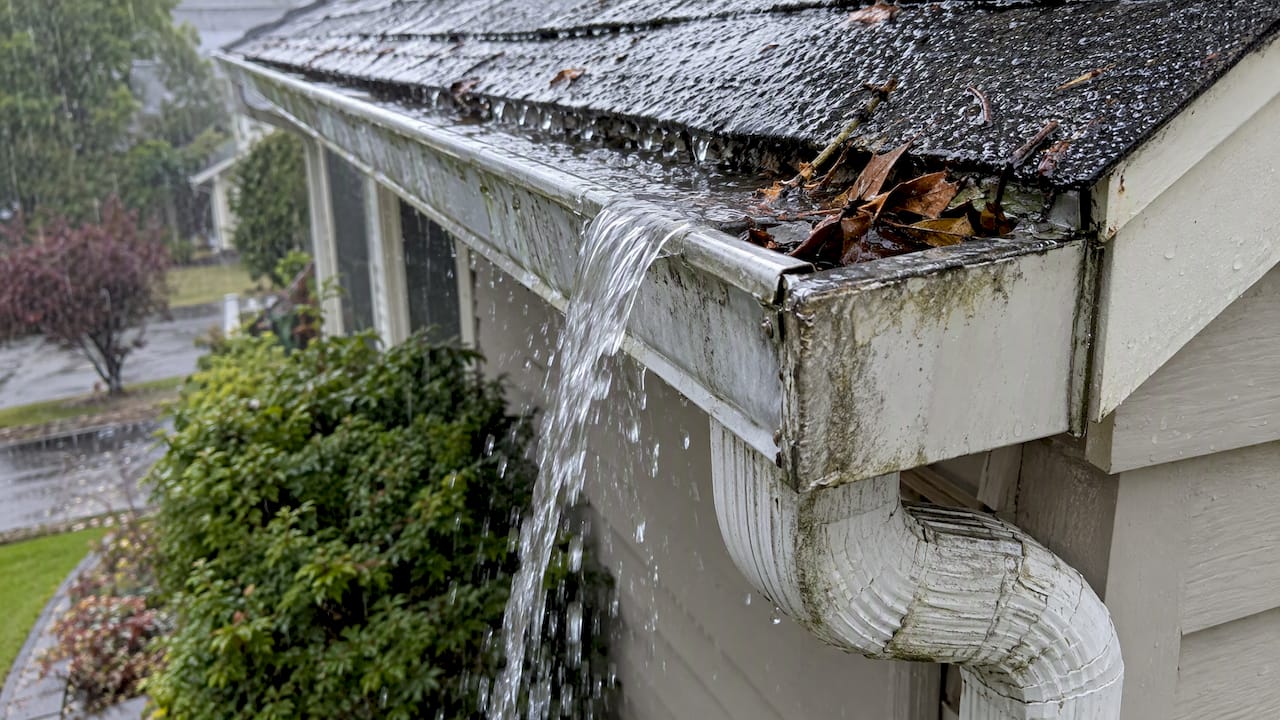
A clogged downspout shows itself in the rain. Water spills over the gutter edge instead of draining, only a trickle comes out of the bottom, or water pools beside the foundation after a storm. You can confirm it from the ground with a garden hose, and you can usually do it in ten minutes.
Below are the signs, what each one tells you, how to test safely, and when to hand the job to a professional.
TL;DR
- The clearest signs are water overflowing the gutter, a weak or dry flow at the downspout outlet during heavy rain, and water pooling near the foundation.
- Where the water first appears tells you where the problem is: gutter edge, downspout joint or ground connection.
- Flush the downspout with a garden hose. If water backs up, the blockage is deeper in the pipe.
- Check eavestroughs and downspouts at least twice a year, in fall and spring, according to Canada.ca.
- Never climb a wet ladder in the rain. Observe from the ground and call a professional if you cannot do the job safely.
Table of Contents
- The signs of a clogged downspout
- Where the water appears tells you what’s wrong
- How to test a downspout safely from the ground
- Why downspouts clog
- What clogged downspouts can do to your home
- What to do when you find a clog
- Preventing the next clog
- Our perspective
- Let us take care of it
- FAQ
- Sources
The signs of a clogged downspout
Most blockages announce themselves long before they cause damage. Walk around your house during a steady rain, ideally with a coat and a flashlight if it’s dark, and look for these.
Water spilling over the gutter edge
This is the most common sign. When the downspout can’t carry water away, the gutter fills and runs over the front lip, often in a sheet right above the downspout. If the overflow is worst near the downspout and the rest of the gutter looks fine, the clog is probably in the downspout itself rather than the gutter trough.
A weak trickle (or nothing) at the bottom
During heavy rain, a healthy downspout discharges a steady, strong stream. A thin trickle, or no flow at all while the gutter above is full, means something is restricting the pipe. Leaves and the fine grit shed by asphalt shingles tend to settle in the top opening, at elbows where the pipe changes direction, and at the bottom outlet where it meets an extension or a buried drain.
Plant growth or debris poking out of the top
Look at the top opening. Tufts of grass, small seedlings, matted leaves or a bird’s nest sticking out of the outlet mean debris has been collecting for a while. Seeds sprout in the damp muck that builds up in gutters and drain openings.

Leaks at the seams and joints
When a pipe is blocked, water has to go somewhere. It can push out at a seam or elbow and run down the wall. A clog also raises pressure on ageing joints, so a loose connection becomes more likely to separate.
Pooling near the foundation
Puddles beside the house after a storm are a warning. According to Canada.ca, water pooling around the foundation can be caused by clogged eavestroughs or downspouts, and it can leak into the basement.
Sagging gutters and stained siding
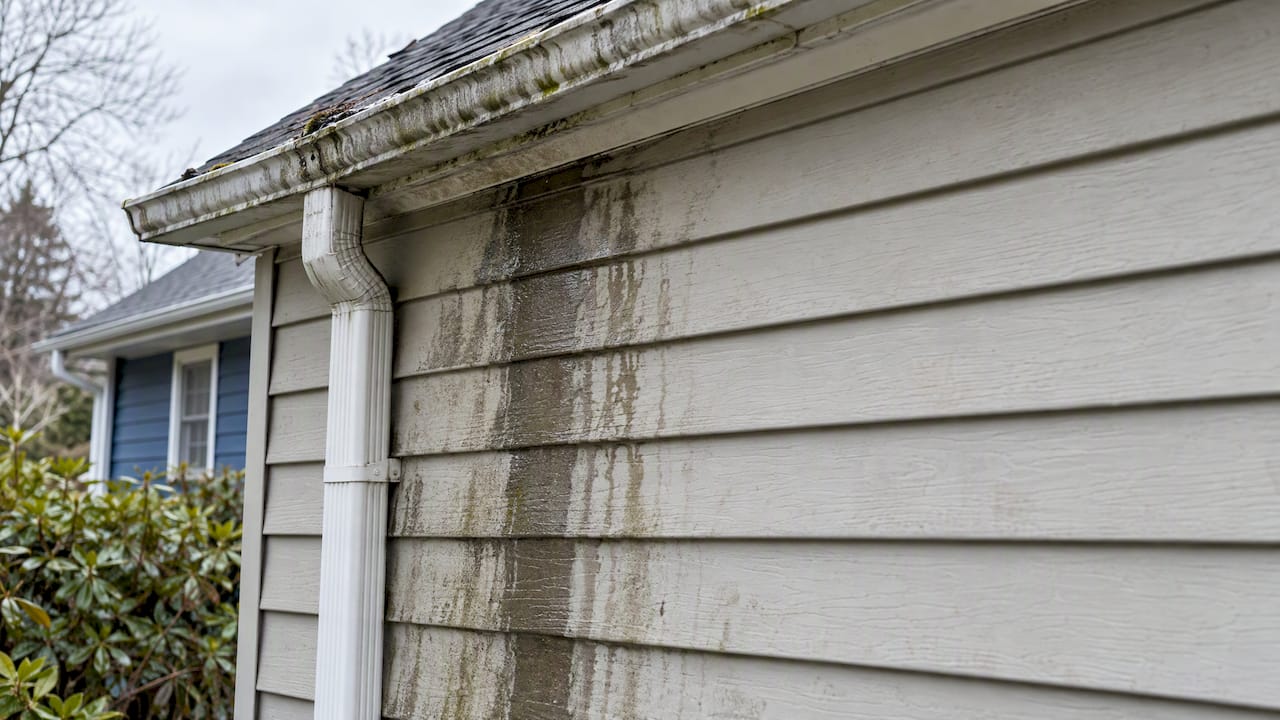
Standing water is heavy. A gutter that has started to pull away from the fascia, or dark streaks on the siding beneath a downspout, point to water that has been sitting or overflowing for some time. If you see these, read our guide on clogged gutters and water damage to see what can follow and how to stop it.
Where the water appears tells you what’s wrong
Don’t treat every wet spot as “a clogged downspout”. The location of the first sign is a useful clue, and different symptoms can call for different fixes.
| What you see | Where the water appears | Likely cause | First step |
|---|---|---|---|
| Water pours over the gutter lip | Along the gutter, often above the downspout | Blocked gutter trough or blocked top opening | Check the gutter and the downspout inlet |
| Water leaks from a seam or elbow | Mid-height on the downspout | Blockage below the joint, or a loose connection | Flush with a hose and check the joint |
| Weak trickle at the outlet | Bottom of the downspout | Debris lodged inside the pipe | Flush from the top |
| Water bubbles up at ground level | Where the downspout meets an underground pipe | Blocked underground drain or outlet | Disconnect the extension and test |
| Puddle right under the downspout | Below the discharge point | Splash pad sunk, or extension too short | Re-set the pad, lengthen the extension |
| Pooling along the wall | Along the foundation | Clog, or ground sloping toward the house | Clear the downspout, then check the grading |
If the water is going over the gutter edge because of a roof problem, such as a damaged edge or a poorly pitched section, clearing the downspout won’t solve it. That is a job for a roofing or gutter contractor.
How to test a downspout safely from the ground
You don’t need to go on the roof to find out whether a downspout is blocked.
- Watch it in the rain. Stand somewhere dry and safe and look at the outlet while rain is heavy. Compare the flow with the volume of water you see coming off the roof.
- Look at the openings. Check the bottom outlet and any joint you can reach at ground level for packed leaves, grit or roots.
- Use a garden hose. Put the hose in the top of the downspout (or in the gutter trough near the inlet) on a moderate flow. If the water runs freely out the bottom, the pipe is clear. If it fills, backs up or runs dry, there is a blockage. Canada.ca recommends using a garden hose to loosen debris in a downspout that isn’t draining properly.
- Disconnect and isolate. If the downspout empties into an underground pipe, detach the extension and run water through the above-ground section. If it flows freely, the problem is likely in the underground pipe or its outlet.
If the water backs up even after a good flush, the blockage is lodged deeper, and you may need an auger or a professional.
Staying safe
The official federal guidance is clear: when inspecting eavestroughs, don’t work alone. Have someone on the ground as a spotter, or hire a professional if you can’t complete the task safely (Canada.ca). A few practical rules:
- Don’t climb a wet ladder or a wet roof during or just after rain. Observe from the ground, then do the hands-on check when it’s dry.
- Set the ladder base about one foot out for every four feet of height, keep three points of contact, and never overreach. Move the ladder instead.
- Ground-level tools, such as a leaf blower with an extension or a telescopic wand, can clear a gutter without a ladder.
- Metal roofs are slick and need their own care. If yours is metal, read up on cleaning a metal roof safely before anyone steps on it.
Why downspouts clog
The causes are usually ordinary:
- Leaves and needles that wash into the gutter and pack into the inlet.
- Roof grit. Asphalt shingles shed fine mineral granules that settle in elbows and at the bottom outlet.
- Elbows and transitions. Every change of direction is a spot where debris catches.
- Underground connections. Where a downspout feeds a buried drain, roots, silt and compacted debris can block the pipe out of sight.
- Ice. In cold climates, standing water in a downspout can freeze and form ice dams that block the flow and cause overflow, and Angi notes that insulation and heat cables can help prevent it. That matters across the Prairies and the BC interior, where a mild afternoon followed by a hard freeze is routine.
Trees close to the house make everything worse. If you have heavy tree cover, you’ll see clogs sooner. Our page on how often to clean gutters covers the schedule for different yards.
What clogged downspouts can do to your home
A blocked downspout isn’t a cosmetic problem. When roof water can’t leave, it overflows beside the house and soaks the ground by the foundation. Canada.ca links pooling around the foundation to clogged eavestroughs or downspouts, with possible leaks into the basement. Over time you can also get stained or rotting fascia, damaged siding and, in winter, heavy ice build-up at the eaves.
Where the water lands after it leaves the downspout matters too. A common guideline is to direct downspouts at least 2 metres (6 feet) away from foundations where possible, and the City of Mississauga advises directing downspouts onto lawns or gardens away from the house and making sure the ground slopes away from it. If water pools directly below the downspout, check whether the extension is too short, the splash pad has sunk, or the ground slopes toward the wall.
What to do when you find a clog
- Flush it. Start with the garden hose from the top. Many soft blockages of leaves and grit wash out.
- Clear the inlet and the gutter. Remove debris near the top opening before you flush again, otherwise it just washes back in.
- Try an auger if water still backs up. A handheld drum auger can work up or down through the downspout, but only use it where you can reach safely.
- Check the bottom. Make sure the extension is attached, pointing away from the house and not crushed or buried.
- Test again with the hose until the flow is strong and steady.
For a stubborn or underground blockage, a ladder job on a two-storey house, or any situation where you aren’t comfortable, bring in a professional. Hiring help is also a sound choice for older homeowners: cost is modest compared with a fall injury or a serious water-damage repair, a point the US-based Senior List makes about ladder work.
Preventing the next clog
Prevention beats repair. Here’s what actually reduces the odds.
- Inspect twice a year. Canada.ca recommends checking eavestroughs and downspouts at least twice yearly, in fall and spring, to remove debris and prevent flood damage. After the leaves drop in October is the key window, before freeze-up.
- Add extra checks after a major windstorm, or if you have conifers or large maples overhead.
- Consider gutter guards. They keep most debris out of the system. See our overview of gutter guard types, and whether gutter guards are worth it for the number of cleanings you do now.
- Keep outlets clear in winter. Knock back ice and snow from the discharge point so meltwater has somewhere to go.
- Lengthen extensions so water lands well away from the foundation.
Our perspective
We get more calls about overflowing gutters in late fall than for almost anything else outdoors, and the story is nearly always the same: the homeowner saw water coming over the edge, assumed the gutter was full, and only later learned the downspout was packed solid.
Our view is simple. Don’t guess. Watch where the water goes, test with a hose, and if the answer isn’t obvious in a few minutes, get someone who works at height every day to take a proper look. A trained crew carries the right equipment, works to safety protocols and can see problems you can’t from the ground, such as a failing joint or a sagging section.
Blocked drainage and indoor air problems share one thing: the damage builds quietly, out of sight, until it’s expensive. That’s why we put so much weight on routine maintenance, whether it’s an eavestrough, a dryer vent or an air duct. A scheduled visit is almost always cheaper than an emergency one.
Jayce
Let us take care of it
If you’ve found a clogged downspout and don’t want to wrestle with ladders and augers, our team can clear it. We offer gutter cleaning across BC, Alberta and Saskatchewan, done by trained technicians with the right equipment and safety protocols.

While we’re at your property, it’s a good moment to think about the other places where debris quietly builds up. A blocked dryer vent is a fire risk, and our dryer vent cleaning is published at $99 to $225 CAD per visit. Our prices are clear, with no hidden fees. You can reach us any time through Blue Brothers, including for emergencies.
FAQ
How can I tell if my downspout is clogged without climbing a ladder?
Watch it during a heavy rain. If water spills over the gutter edge, or only a trickle leaves the bottom of the downspout while the gutter above is full, it’s probably blocked. For a firmer answer, run a garden hose into the top opening from a safe position and see whether the water flows out the bottom or backs up.
Can a clogged downspout cause water in the basement?
Yes. Water that can’t leave through the downspout overflows and pools beside the house, and Canada.ca notes this pooling can leak into the basement. Clearing the downspout, extending the discharge at least 2 metres (6 feet) from the foundation where possible, and keeping the ground sloped away from the house all lower the risk.
How often should I check my downspouts?
At least twice a year, in fall and spring, according to Canada.ca. If you have large trees close to the roof, add a check after storms and after leaf drop. Wet, windy weeks can fill a gutter faster than you’d expect.
When is it time to call a professional?
Call one when a hose flush doesn’t clear the blockage, when you suspect the underground pipe, when the gutter is on a second storey or a metal roof, or whenever you can’t do the job safely. Federal guidance says to hire a professional if you can’t complete the task safely.
Sources
- Eavestroughs and downspouts, Canada.ca
- Damaged Downspout: Common Causes and Solutions, Angi
- Reduce the risk of flooding on your property, City of Mississauga
- Gutter Cleaning for Seniors, The Senior List