Indoor air can make asthma better or worse, and you control more of it than you might think. The biggest levers are cutting the sources of irritants (smoke, mould, dampness, dust mites, strong scents), keeping humidity in a sensible range, and getting fresh air into the house without bringing in outdoor pollution. Ventilation matters, but it works best after you have dealt with the sources.
This guide covers what the research says, what Canadian health authorities recommend, and where clean ducts and ventilation equipment fit in. It is general information, not a treatment plan. Your asthma action plan and your doctor come first.
TL;DR
- Mould and dampness are the best-supported indoor risks. Health Canada links damp, mouldy homes to more wheezing, shortness of breath and worse asthma.
- Start with the source: no smoking indoors, fix leaks, keep humidity in range, limit candles, incense and strong scents.
- Ventilation dilutes what is left. Use bathroom and kitchen fans, keep vents clear and maintain filters and ventilation equipment.
- Evidence for many individual pollutants is uncertain, so tailor changes to your own triggers and talk to your doctor.
- Dirty ducts, HRVs and furnace components are one part of the picture, not a cure on their own.
Table of Contents
- Does poor indoor air quality affect asthma?
- The indoor triggers to look for
- Humidity: the range to aim for
- How ventilation affects asthma and air quality
- A practical order of operations
- Where duct, HRV and furnace cleaning fit
- Perspective
- Our services for healthier home air
- FAQ
- Sources
Does poor indoor air quality affect asthma?
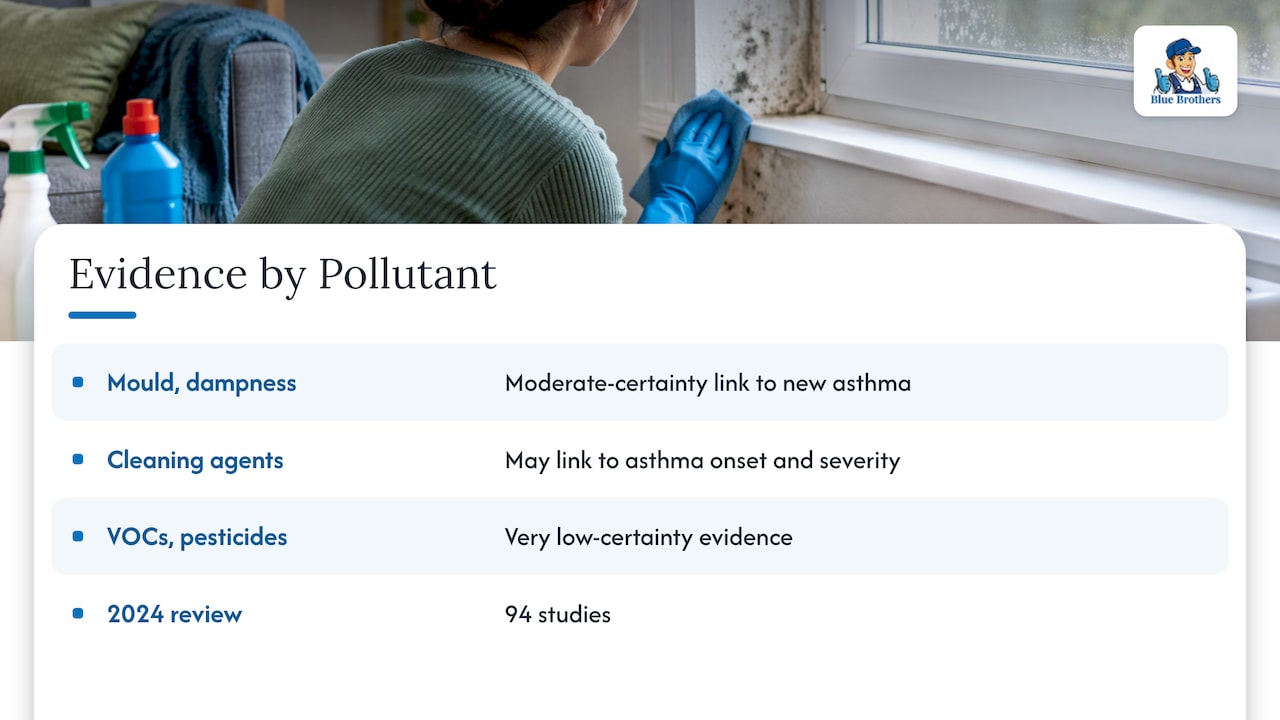
Yes, though the strength of the evidence differs by pollutant. Health Canada says people living in homes with mould and damp conditions are more likely to have wheezing, shortness of breath and worsening asthma symptoms.
A 2025 European guideline from allergy specialists found moderate-certainty evidence that mould exposure is linked to new-onset asthma. For most other indoor pollutants and asthma worsening, the evidence was low or very low certainty. A 2024 systematic review of 94 studies reached a similar picture: dampness or mould raised the risk of new-onset wheeze, cleaning agents may be associated with asthma onset and severity, and evidence on VOCs and pesticides was very low certainty.
What that means in practice: the experts say measures should be individualized and sit alongside clinical asthma management, not replace it. Fixing a damp basement is a well-supported move. Buying a gadget and expecting asthma to disappear is not.
The indoor triggers to look for
Asthma Canada lists dust mites, cockroaches, mould, chemicals and fragrances, smoke and pet allergens as common indoor triggers. Here is where they tend to hide:
| Trigger | Where it lives | First move |
|---|---|---|
| Dust mites | Bedding, carpets, soft furnishings | Hot-water washing, mattress and pillow covers, HEPA vacuum |
| Mould | Damp basements, bathrooms, leaky walls | Fix the water source, dry quickly, control humidity |
| Smoke | Tobacco or marijuana smoke, candles, incense | No smoking in the home or car, limit burning |
| Chemicals and scents | Cleaners, air fresheners, perfumes | Choose low-emitting, fragrance-free products |
| Pet allergens | Fur, dander on fabrics and in dust | Keep pets out of the bedroom, clean fabrics often |
Not everyone with asthma reacts to all of these. Your doctor or an allergist can help you work out which ones matter for you.
Humidity: the range to aim for
Humidity is the lever that links dust mites and mould. Both thrive when the air is too damp, and Canadian winters add a twist: dry heated air tempts people to over-humidify.
- Health Canada recommends indoor relative humidity between 30% and 50%, with a dehumidifier if needed and exhaust fans to remove moisture.
- Asthma Canada suggests keeping humidity below 50% for dust mites, and between 40% and 45% to reduce mould, checked with a hygrometer.
A hygrometer costs little and tells you more than guessing. Check it in the basement and bathrooms, where trouble starts.
Health Canada also advises repairing leaks, drying wet materials promptly, using moisture-resistant materials in wet areas, and making sure rain, irrigation water and snowmelt drain away from the building. Small amounts of mould can be cleaned with soap and water; larger problems need a qualified remediation professional.
How ventilation affects asthma and air quality
Ventilation removes pollutants, limits moisture buildup, clears stale air and brings outdoor air in, according to Health Canada. Its framework puts source control first and ventilation second: outdoor air dilutes or removes indoor pollutants, but more ventilation will not help if the outdoor air is itself polluted.
How much is enough? Canadian codes generally call for about 5 to 10 litres per second of outdoor air per occupant, roughly one whole-house air change every three hours, though the right rate varies with the house, the number of people and the sources inside.
Many homes fall short. In a Quebec public health study, 70% of participating homes ventilated below 0.30 air changes per hour, the nominal rate in the National Building Code. The same randomized study found that professionally installed mechanical ventilation, including heat- and energy-recovery ventilators, significantly improved ventilation and air quality. For children with asthma, it did not significantly cut the number of symptom days. It did lower the share who had at least one wheezing episode by 22% over 12 months, and the share with four or more episodes by 20%.
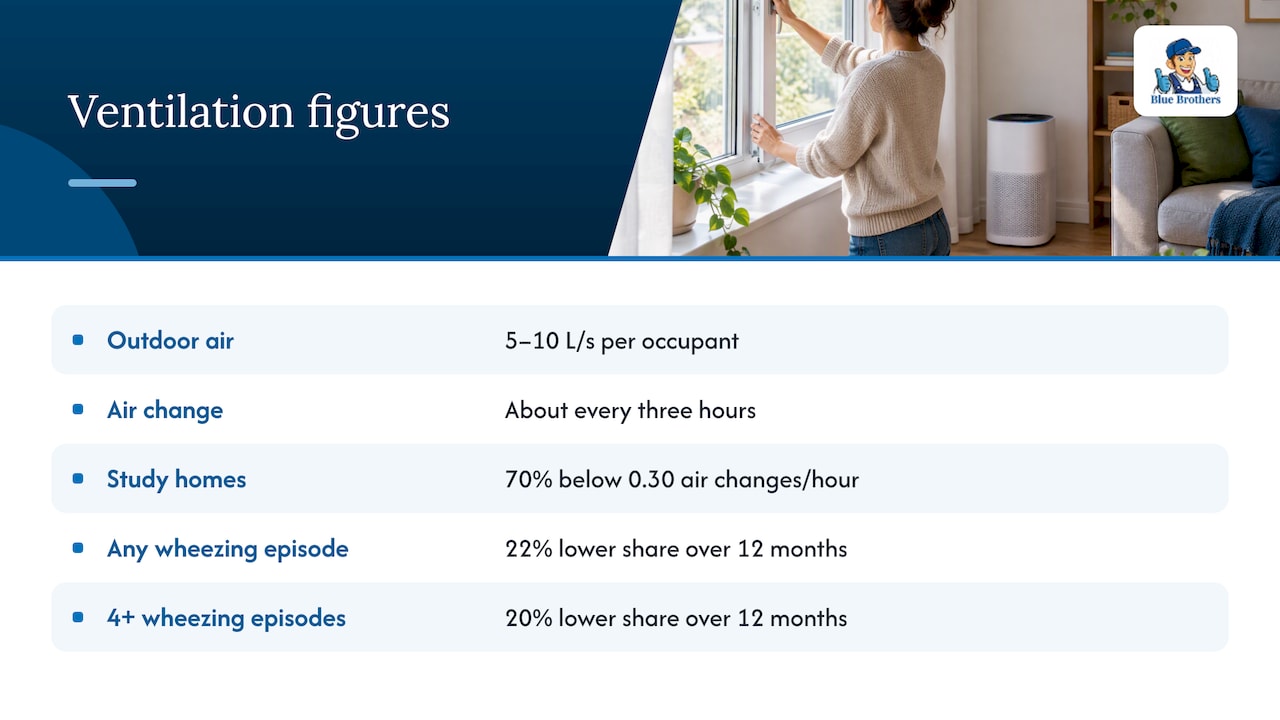
Those are meaningful results, and they are also modest. Treat ventilation as one supportive step.
When to open windows, and when to keep them shut
Open windows and doors when outdoor conditions allow. During high outdoor pollution, such as wildfire smoke or smog, Health Canada advises closing windows and using air conditioning to limit outdoor air coming in. If outdoor air is poor, ventilate at lower-pollution times such as outside rush hour or when smog is low.
Bathroom and kitchen fans in a damp climate
Exhaust fans are the cheapest ventilation upgrade. Run the bathroom fan during and after showers, and use the kitchen fan while cooking. Poorly ventilated attics can also feed moisture problems, which is why attic ventilation and moisture control matter for mould risk in wetter climates.
A practical order of operations
- Stop the sources. No smoking indoors, maintain fuel-burning appliances, keep vehicles and generators away from openings and air intakes, and limit candles, incense and deodorizers.
- Control moisture. Repair leaks, keep humidity in range, use fans.
- Reduce dust-mite habitat. Wash bedding in very hot water, use impermeable mattress and pillow encasements, reduce bedroom carpet, vacuum with a HEPA-filter vacuum.
- Ventilate. Keep interior doors open so air moves, keep heating vents clear, open windows when outdoor air is good.
- Maintain the system. Clean or replace filters as the manufacturer directs, and keep ventilation equipment in working order.
Steps 1 to 4 follow guidance from Health Canada and Asthma Canada. Step 5 is where a professional can help.
Where duct, HRV and furnace cleaning fit
Ducts, furnaces and ventilators move all the air in your home. When they are loaded with dust, they can recirculate it. Health Canada’s advice to keep filters maintained and vents clear points to the same idea: the air handling system should not be a source of its own.
A few situations where cleaning is worth considering:
- After renovation. Drywall and sanding dust travels through the ductwork. See our notes on post-renovation duct cleaning.
- If your home has an HRV. It is your main source of fresh air, so a clogged core or filters undermine the very ventilation described above. Here is what HRV cleaning involves.
- Visible dust from vents. Try the basics first with our guide to fixing dust from vents, then call a pro if it keeps coming back.
- Heavy winter use. Furnaces run for months here; see how dirty ducts affect your health in winter.
Filtration is also worth a look. Our comparison of MERV 13 and portable HEPA explains what suits most homes without upgrading the HVAC system.
To be straight about the evidence: studies on duct cleaning alone and asthma outcomes are thin, and the research above supports ventilation and moisture control more strongly. Cleaning is a sound maintenance step that supports those measures. It is not a replacement for medical care.
Perspective
We see the inside of Canadian ductwork every week, and the pattern is consistent: homes with asthma sufferers are rarely troubled by one big thing. It is a stack of small ones. A bathroom fan that never runs, a furnace filter nobody has changed, an HRV that has not been opened in years, dust left behind by a renovation.
That is why we treat air quality as a system, not a single job. Source control and moisture come first, and we say so. Once those are handled, clean ducts, a clean HRV and a clean furnace let the air in your home move the way it was designed to.
Our technicians are certified and use professional equipment, and our pricing is clear, with no hidden fees. If someone in your home has asthma, tell us when you book. We will focus on the parts of the system that matter most for you.
Jayce
Our services for healthier home air
Blue Brothers cleans homes and businesses across British Columbia, Alberta and Saskatchewan. These are the services most relevant to indoor air quality, with our published price ranges:
- Air duct cleaning: $400 to $800
- HRV cleaning: $100 to $400
- Furnace cleaning: $50 to $300
- Air conditioning coil cleaning: $100 to $400
- Dryer vent cleaning: $99 to $225
We offer round-the-clock support, and you can start with residential duct cleaning to request a quote.
FAQ
What does IAQ stand for?
IAQ stands for indoor air quality: the condition of the air inside buildings, including dust, moisture, mould, smoke, chemicals and how much fresh air circulates. For people with asthma, it matters because many triggers are found indoors.
Can ventilation really help with asthma?
It can help, as one part of a plan. Ventilation removes pollutants and moisture and brings in outdoor air, but Health Canada ranks source control first. In the Quebec study, mechanical ventilation reduced wheezing episodes in children without significantly cutting symptom days.
What humidity level is best for someone with asthma?
Health Canada recommends 30% to 50% relative humidity. Asthma Canada suggests staying below 50% for dust mites and between 40% and 45% to reduce mould. A hygrometer lets you check.
Should I keep windows open if I have asthma?
Open them when the outdoor air is good. When smog or wildfire smoke is high, close them and use air conditioning, as Health Canada advises. If you have a ventilator, keep it maintained so you still get fresh air.
Will duct cleaning cure my asthma?
No. Asthma needs medical management, and the best-supported home steps are controlling mould, dampness and smoke. Clean ducts and ventilation equipment support better air movement and reduce dust circulating through the home.
Sources
- Guide to addressing moisture and mould indoors, Health Canada
- Improve indoor air quality in your home, Health Canada
- Ventilation and the indoor environment, Health Canada
- Indoor Asthma Triggers, Asthma Canada
- IVAIRE Project, INSPQ
- EAACI Guidelines on Environmental Science for Allergy and Asthma
- The impact of indoor pollution on asthma-related outcomes, systematic review
- Attic Insulation & Ventilation in Vancouver