A clogged gutter stops carrying roof runoff away from your house, so the water goes somewhere else: over the edge, behind the fascia, down the siding and toward the foundation. Left alone, that can mean rotted trim, stained ceilings, a wet basement and mould. The fix starts with a clear drainage path and a twice-a-year habit, and if water has already got in, you need to find and stop the source before anything else.
TL;DR
- Clogged eavestroughs can contribute to basement flooding by pushing water toward the foundation, but they are only one of several causes.
- Check and clean eavestroughs and downspouts at least twice a year, in spring and fall, and again after severe storms, heavy rain, high winds or ice buildup.
- Look at the whole drainage path, not just the trough: downspout outlets, splash area, grading and the roof edge.
- If water is already inside, keep away from live electrical equipment, photograph everything, call your insurer, and dry and fix the source. Repainting or cleaning is not enough.
- Skip the ladder when there is ice, wind, damaged roofing or you are alone. That is the point where a professional earns the fee.
Table of Contents
- How a small blockage becomes a big repair
- Where the damage shows up
- Will clogged gutters cause water in the basement?
- Signs the water has already got in
- Our view: the gutter is part of the air you breathe
- What to do if water is already inside
- How to unblock a gutter drain safely
- How often to clean your eavestroughs
- What gutter cleaning costs
- Book the work with Blue Brothers
- Build a simple prevention routine
- FAQ
- Sources
How a small blockage becomes a big repair
The Government of Canada describes eavestroughs and downspouts as part of your flood-risk defences: their job is to collect roof runoff and move it away from your walls and foundation. When leaves, shingle grit, seeds and needles pack the trough or plug the downspout, that job stops.
Here is the usual sequence in a Canadian rainstorm or spring melt:
- Water fills the trough faster than it can drain.
- It spills over the front edge, or backs up behind the trough and wets the fascia and soffit.
- Overflow runs down the siding and lands next to the foundation, soaking the soil exactly where you want it dry.
- In cold weather, standing water in the trough freezes. The ice adds weight, can pull sections away from the house, and holds meltwater against the roof edge.
- Repeated wetting keeps wood, drywall and insulation damp, and damp materials are where mould starts.
None of these steps is dramatic on its own. The damage comes from repetition: the same overflow point soaking the same board every storm for several seasons.
Where the damage shows up
| Part of the house | What clogged gutters do | What you might notice |
|---|---|---|
| Fascia and soffit | Water backs up behind the trough and soaks the wood | Peeling paint, soft or dark boards, sagging trim |
| Roof edge | Water pools at the lower shingle edge | Curling shingles, stains in the attic near the eaves |
| Siding and walls | Overflow streams down the exterior | Streaks, bulging or rotting siding, wet masonry, chalky deposits |
| Foundation and soil | Water lands at the base of the wall | Pooling beside the house, soil washing away, damp basement walls |
| Landscaping | Concentrated overflow carves out beds | Bare patches, eroded soil under the drip line |
| The gutters themselves | Weight of debris and ice | Sagging, pulled-away sections, loose fasteners, rust |
A useful habit: look at your house during a real rainstorm, from a dry spot at the door. Water falling in sheets over the front of a trough, or a downspout that trickles when its neighbour pours, tells you more than any dry-weather inspection.
Will clogged gutters cause water in the basement?
They can. Guidance from the City of Toronto on basement flooding lists overflowing eavestroughs and leaking or plugged downspouts among the reasons basements flood, and notes that every home is at some risk, especially in heavy rain or when snow and ice are melting.
The same guidance is just as clear that gutters are only one suspect. Poor grading, foundation cracks, failed weeping tiles, sump-pump failure and sewer backup can produce the same wet floor. That matters for two reasons.
First, cleaning your gutters will not cure a wet basement caused by a cracked foundation or a failing weeping tile. Second, a clean gutter can still deliver water to the foundation if the downspout is plugged, ends right at the wall, or the lot slopes toward the house.
The Government of Canada recommends directing downspout discharge at least 2 m (6 ft.) from the foundation where possible. The City of Brantford gives a similar figure of 1.5 to 2 metres (5 to 6 feet) away from the basement wall. If yours dumps at the corner of the house, a downspout extension is one of the cheapest upgrades you can make.
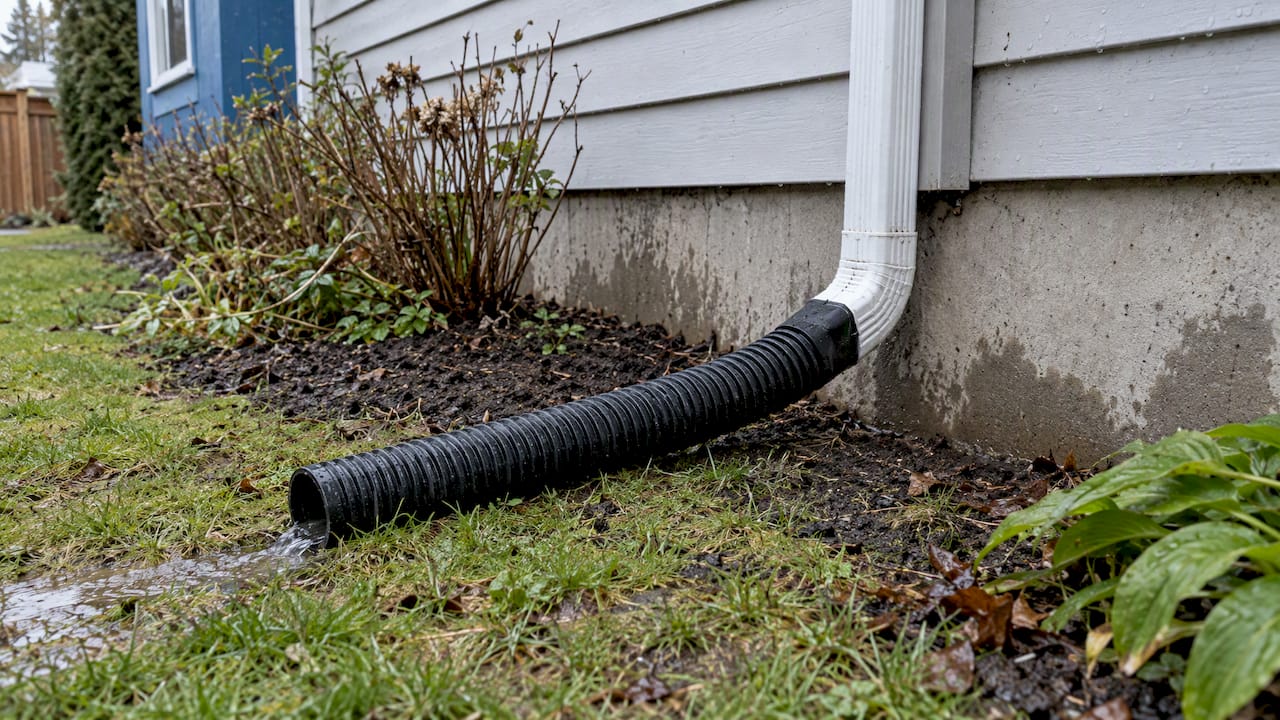
To tell which cause you have, watch where the water appears during or just after rain. Wet only below a downspout, or only after heavy rain? Look at drainage outside first. Water rising through the floor, or coming with a sewage smell? That points elsewhere, and a plumber or drainage professional should look at it.
Signs the water has already got in
The quickest way to tell whether roof-edge or wall water has been getting in is to check the usual places. Public health guidance and the research behind this article point to these signs:
- Ceiling or wall stains, especially near exterior walls
- Peeling or blistering paint
- Damp drywall or flooring beside exterior walls
- Musty odours
- Bulging or rotting siding
- Wet masonry or chalky white deposits
- Dampness in the attic near the eaves
- Visible mould
Ottawa Public Health notes that mould can grow behind walls or above ceiling tiles, and that growth can start within 48 hours once materials get wet and stay wet. Health Canada’s advice is to control dampness, clean visible mould, and keep indoor relative humidity between 30% and 50%.
The key point from that guidance: these signs mean you have to find and correct the moisture source. Painting over a stain while the gutter keeps overflowing just hides the next round of damage. If anyone in the home has symptoms you suspect are linked to mould or poor air, Health Canada’s guide to moisture and mould says to discuss health concerns with a health professional rather than guess.
Our view: the gutter is part of the air you breathe
We clean ducts, vents and exhaust systems for homes and businesses in Saskatchewan, British Columbia and Alberta, so we spend a lot of time thinking about what moisture does to indoor air. A damp wall cavity or wet insulation does not stay outside. It becomes the musty smell people notice in a basement or on the top floor, and that is often when homeowners call us.
Here is what we tell people:
- Sequence matters. Stop the leak, dry the wet materials, inspect the hidden areas, then clean or remove what is damaged. Duct cleaning cannot stand in for fixing the gutter, roof or foundation that let the water in.
- Check the whole path. A trough that looks clean from the ground may have a packed outlet, a plugged downspout or a splash zone aimed at the foundation.
- Gutter guards are not a pass. They cut down the debris but can hide packed organic material, and outlets, downspouts and roof valleys still need a look.
- Do not make it a one-person ladder job. Government guidance says not to check eavestroughs alone, and we agree. Heights, ice and wet surfaces are a bad mix.
We would rather you fix the water problem first and call us for the air side afterwards, if it is needed. A clean system and a dry house work together.
— Jayce
What to do if water is already inside
This is the order we would follow, based on Toronto’s advice on basement flooding and Health Canada’s moisture guidance.
- Make it safe. If water is near outlets or the electrical panel, keep away and shut off power only if you can do so safely. Otherwise contact your utility or a qualified electrician. If you suspect sewage backup, Toronto advises avoiding toilets and sinks until it is sorted out.
- Document. Photograph the damage before you move anything and keep receipts for emergency cleanup.
- Call your insurer promptly. Toronto specifically advises reporting damage and keeping photos and receipts. Ask what your policy covers for water entering from the roof, from sewer backup and from overland flooding, because these are often treated differently.
- Stop the source. Clear the overflowing gutter or plugged downspout, or have it done, and tarp or repair any roofing you cannot safely reach.
- Dry quickly. Remember the 48-hour window for mould growth. Remove soaked carpet and porous materials that cannot be dried, and run fans or dehumidifiers.
- Inspect hidden spots. Look in the attic, behind baseboards and above ceiling tiles.
If the stain is on a ceiling and you are not sure whether the water is coming from the roof edge or from plumbing, finding the source of a ceiling leak is a good first step before you decide who to call. A leak that continues in dry weather is not a gutter problem.
How to unblock a gutter drain safely
If the conditions are good and the work is low, this is how to do it, following Canada.ca guidance on eavestroughs and downspouts:
- Choose a dry, calm day. Do not climb during ice, high wind or an active storm.
- Work with a partner who can steady the ladder and call for help.
- Remove the debris you can reach from the trough by hand or with a scoop, and bag it.
- Run a garden hose into the trough toward the downspout. If water backs up or drains slowly, the downspout is partly blocked. Flush it from the top, using the hose to loosen the plug.
- Confirm that water leaves the bottom of the downspout and travels away from the foundation.
- Note any sagging, loose fasteners, holes or sections that hold water, because those need repair, not just cleaning.
The same guidance suggests roughly one downspout per 6 to 12 m (20 to 40 ft.) of eavestrough as a common guideline. If gutters overflow even when clean, Canada.ca suggests considering larger eavestroughs or downspouts and checking that discharge drains away from the building.
When to hire someone instead
Call a professional when the roof is steep or high, when there is ice, when roofing is damaged, when you see signs of concealed water damage, or when you simply have no one to spot the ladder. A cleaner can also clear downspouts and flag sagging runs you would not see from the ground.
How often to clean your eavestroughs
The baseline for Canadian homes is at least twice a year, usually spring and fall, with extra checks after severe storms, heavy rain, high winds or ice buildup. Heavy tree cover pushes you toward more frequent cleaning; we explain how to judge that in our guide on how often to clean gutters.
The fall visit matters most in much of Canada, because you want the trough clear before freeze-up. Debris frozen in place all winter is how a small problem turns into a spring melt problem.
What gutter cleaning costs
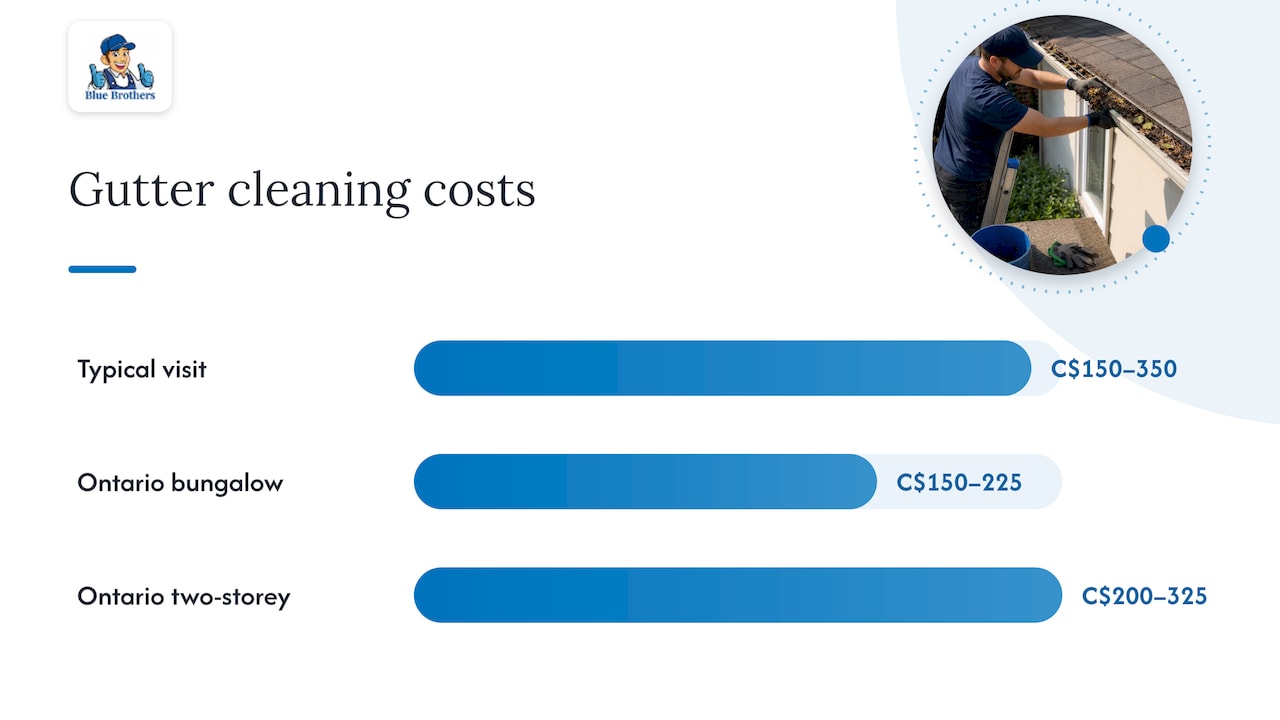
We do not publish a gutter-cleaning price on this page, so for context here is what a 2026 Canadian pricing guide reports: a typical professional residential visit around C$150 to C$350, with Ontario examples of C$150 to C$225 for a one-storey bungalow and C$200 to C$325 for a two-storey home. These are not government-set prices.
What moves the number:
- Height and number of storeys
- Linear footage of eavestrough
- Access, such as steep lots or fences
- How much debris has built up
- Gutter guards, which can add to the job
- Whether downspouts are flushed, and how bad the clogs are
Compared with the cost of replacing rotted fascia or drying a flooded basement, a routine cleaning is cheap protection. Whoever you hire, get the scope in writing, because what is included differs from company to company.
Book the work with Blue Brothers
We offer gutter cleaning in British Columbia, Alberta and Saskatchewan. If your wet-weather trouble has left you with a musty smell, we also clean the other side of your home’s air system: air ducts ($400 to $800 CAD), furnaces ($50 to $300 CAD) and HRV units ($100 to $400 CAD). Our pricing is clear, with no hidden fees, and we offer round-the-clock support including emergencies. Once the water source is fixed and the house is dry, contact us through our site and we will tell you whether cleaning is worth it.
Build a simple prevention routine
Gutters are one part of a bigger picture. The Government of Canada’s flood-prevention checklist also names foundation maintenance, grading, sump-pump testing and water alarms. Gutter cleaning alone cannot close every pathway for water.
A practical yearly routine:
- Spring: clean troughs and downspouts, check for winter damage, confirm extensions are in place and the ground slopes away from the house.
- Fall: clear leaves once most have dropped, flush downspouts, test the sump pump if you have one.
- After big storms: a quick look from the ground, then up close if something looks off.
- Any time: check ceilings, attic and basement corners for stains or odours, and act on them early.
FAQ
Will clogged gutters cause water in the basement?
They can, by sending water toward the foundation, and municipal guidance lists them among several causes. Grading, cracks, weeping tiles, sump pumps and sewer backup can cause the same symptoms. Watch where the water appears during rain before you decide.
How do I unblock a gutter drain?
On a dry, calm day and with a partner, remove the debris you can reach, then flush the downspout with a garden hose. Check that water exits away from the foundation. Avoid ladders in ice, wind or storms.
How much does it cost to unblock a gutter?
Canadian pricing guides for 2026 report roughly C$150 to C$350 for a typical residential visit, depending on height, length, access and debris. Severe downspout clogs or gutter guards can add to that. Ask for a written scope.
How can I tell if my roof has water damage?
Look for ceiling or wall stains, peeling paint, damp drywall near exterior walls, musty smells, rotting siding and dampness in the attic. Mould is another sign. These all mean you have to find the moisture source, not just clean the surface.
Sources
- Eavestroughs and downspouts, Canada.ca
- Actions to reduce flood damage, Canada.ca
- Basement Flooding, City of Toronto
- Basement Flooding Prevention, City of Brantford
- Mould, Ottawa Public Health
- Guide to addressing moisture and mould indoors, Health Canada
- Gutter Cleaning Cost in 2026, Masters’ Guild Insights