HEPA vacuum duct cleaning means a contractor pulls dust out of your ducts with a powerful, sealed vacuum whose final filter is HEPA, so the dust that comes out of the ducts is captured rather than blown back into your rooms. A true HEPA machine traps at least 99.97% of particles down to 0.3 microns, and it only works if all the air passes through that filter. Many “HEPA” claims fall short of that. This guide explains what the term should mean, what the equipment does during a job, when duct cleaning is worth paying for in Canada, and how to tell a proper job from a rushed one.
TL;DR
- A real HEPA vacuum captures at least 99.97% of 0.3-micron particles and sends every bit of air through the HEPA filter as the last stage. A “HEPA-rated” machine with leaks does not qualify.
- The vacuum has to run the whole time brushes or air whips are agitating the ducts. Dust that is loosened without being captured is only moved around your home.
- Canadian guidance says duct cleaning is not a routine need. It makes sense after water damage, visible mould, debris blocking airflow, or dust coming out of the registers.
- A good quote covers the furnace blower, the coil and the drain pan, not just the duct runs.
- Ask how the contractor keeps the system under negative pressure and what the vacuum is, before you agree to a price.
Table of Contents
- What “HEPA” actually means
- Why duct cleaners use a vacuum at all
- What a proper HEPA duct cleaning looks like
- Do you actually need your ducts cleaned?
- HEPA vacuum, MERV filter or air purifier?
- Seven questions to ask before you book
- What the system around your ducts has to do with it
- Our perspective
- What it costs with Blue Brothers
- When the HEPA machine is not the whole story
- FAQ
- Sources
What “HEPA” actually means
HEPA stands for high-efficiency particulate air. The U.S. EPA, in its guidance on HEPA vacuums, describes a HEPA vacuum as one built with a HEPA filter as the last filtration stage, where the filter captures at least 99.97% of particles 0.3 microns across. That is far finer than a human hair, and fine enough to include much of the dust, pollen and pet dander that people worry about.
Two details matter more than the number on the box.
- The filter must be last. Air should pass through coarser stages first (a bag or cyclone, then a pre-filter) and finish at the HEPA element.
- The machine must be sealed. If air can slip around the filter through a bad gasket, a cracked housing or a loose hose coupling, the filter’s rating is irrelevant. A machine that carries a HEPA filter but leaks will still push fine particles back into the room.
That is the real difference between a professional duct vacuum and the shop vacuum in your garage. A shop vacuum, even with a HEPA-style cartridge fitted, is rarely designed for sealed, continuous, high-volume airflow. A purpose-built duct machine is.
Why duct cleaners use a vacuum at all
The industry method is called source removal. The idea is simple: you cannot clean a duct system by loosening dust and hoping it goes away. You have to capture it.
In practice, the technician connects a high-volume vacuum to the duct system so that air is drawn through the ducts continuously. This creates negative pressure, meaning air is pulled toward the machine rather than pushed out into the house. While that suction runs, rotating brushes, compressed-air whips or similar tools dislodge debris from the duct walls, and the airflow carries it into the collector.
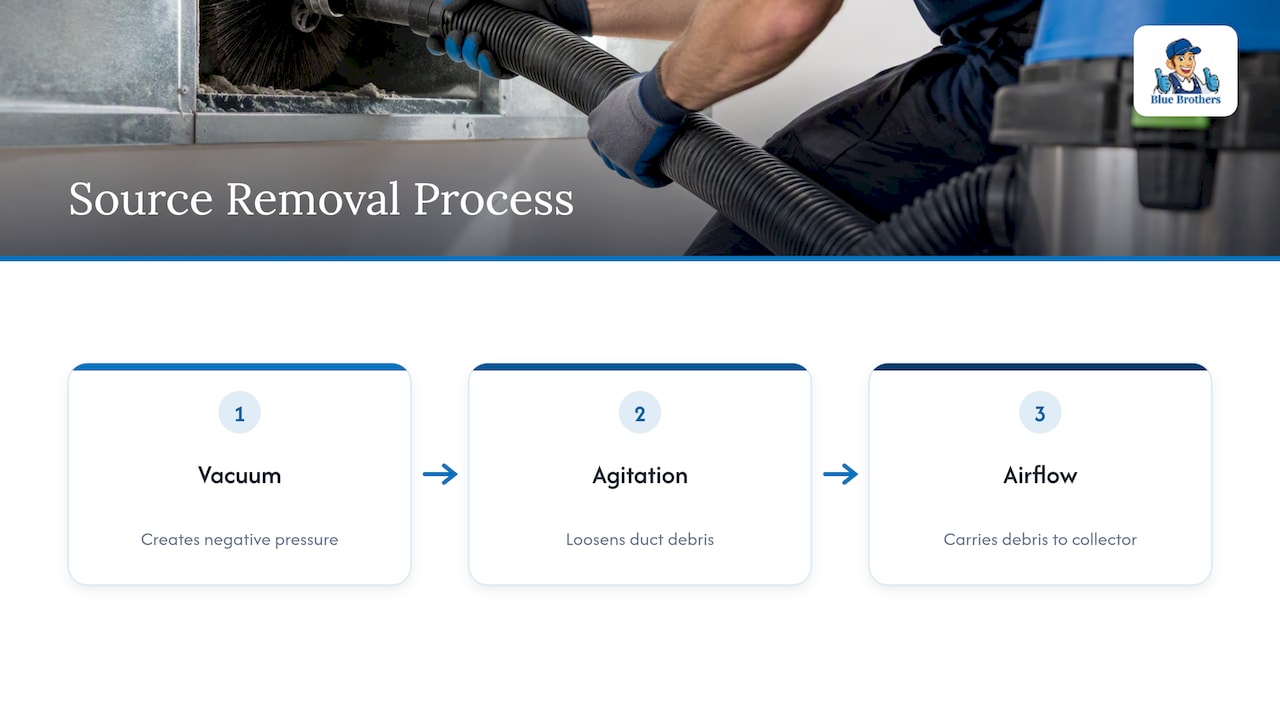
If the vacuum is off, undersized or poorly connected while the agitation tools work, the dust goes wherever the air goes: out of registers and into your living room. This is also why a flat-rate “blow it through and be done” service is not source removal.
On the equipment side, manufacturers state the requirement plainly. One Canadian duct-cleaning equipment maker notes in its catalogue.pdf) that industry practice requires any vacuum collection device exhausting indoors to be HEPA filtered. If the machine sits outside, for instance in a truck, the exhaust is not entering your home, but the same sealed-system thinking still applies to the hoses and connections inside.
What a proper HEPA duct cleaning looks like
The sequence varies by contractor and by house, but a job done to a professional standard follows roughly this order.
- Inspection. The technician looks at accessible duct sections, the furnace or air handler, and the coil, and notes visible debris, moisture or microbial growth.
- Containment. Registers and returns are sealed or fitted with controlled access points so suction acts on the whole system, not on the room.
- Vacuum connection. The HEPA collector is attached to the main trunk line, and negative pressure is established before any agitation starts.
- Agitation, section by section. Brushes or air tools work each branch while the vacuum keeps running.
- Components. The blower, the coil and the drain pan are cleaned too. The EPA warns that leaving these parts dirty can quickly re-contaminate a freshly cleaned system once the fan restarts.
- Check and close-up. The technician re-inspects, reseats registers and access panels, and shows you what was removed.
Notice that the vacuum is involved in every step after the connection. That is the point of the HEPA collector: it is not a finishing touch, it is the thing that makes the agitation safe.
Do you actually need your ducts cleaned?
Before you pay for any of it, the honest answer for most Canadian homes is: not on a schedule.
Guidance published on Canada.ca in a Department of National Defence occupant handbook refers to Canada Mortgage and Housing Corporation studies showing that duct cleaning will not usually change the quality of the air in a home. A review of the scientific evidence in the National Research Council’s publications repository examined the claims made for duct cleaning (health benefits, energy savings, better ventilation performance) and is worth reading if you want the detail. The EPA is similarly cautious: it says knowledge about duct cleaning is still early and does not offer a blanket recommendation either way.
That is useful context, and we would rather you hear it from us than discover it later. Cleaning is generally justified in specific situations:
- Water damage to ducts or the equipment connected to them
- Visible mould or other microbial growth
- Heavy debris that restricts airflow, or pests in the system
- Dust or debris visibly discharging from supply registers
- Construction or renovation that left drywall and sawdust in the system (see our notes on post-renovation duct cleaning)
If none of those apply, the cheaper and better-supported steps come first: change the furnace filter regularly (the Canadian guidance above suggests about every three months), control dust at its source, and vacuum weekly. Health Canada’s healthy home guide recommends vacuuming weekly with a HEPA-filtered vacuum where possible. For a closer look at timing, see how often Canadian homes need duct cleaning, and for a way to spot trouble yourself, our five checks before calling a pro.
There is one more caution worth knowing. The same Canadian guidance notes that in some documented cases, particle levels were higher after cleaning than before. A poorly contained job can stir up the very dust it claims to remove. That is exactly the failure a sealed HEPA system and continuous negative pressure are meant to prevent.
HEPA vacuum, MERV filter or air purifier?
These three get mixed up constantly, and they do different jobs.
| Tool | What it does | Where it works | Limit |
|---|---|---|---|
| HEPA duct vacuum | Captures dust dislodged from duct surfaces during a cleaning | Inside the duct system, during the job | A one-time removal, not ongoing air filtration |
| Furnace filter (MERV-rated) | Catches particles as air passes the furnace | Continuously, at the filter slot | Must be changed regularly and fit your system’s airflow |
| Portable HEPA air purifier | Filters room air | One room at a time | Does not clean the ducts |
A HEPA vacuum removes what has accumulated. A filter and a purifier deal with what is circulating now. If you are weighing a duct cleaning against buying a purifier, our comparison of duct cleaning versus air purifiers walks through odour, dust and smoke scenarios, and our piece on MERV 13 plus a portable HEPA unit covers when that combination is enough on its own.
Seven questions to ask before you book
You do not need to be an expert to screen a contractor. These questions take two minutes on the phone and tell you a great deal.
- “What vacuum do you use, and is it HEPA-filtered?” A confident answer names the type of machine and says it is a true HEPA collector, not just a filter fitted to a general-purpose vacuum.
- “Can you show me the manufacturer’s efficiency documentation?” You are looking for 99.97% at 0.3 microns.
- “Do you hold the system under negative pressure the whole time you agitate?” The answer should be yes, with a description of how the vacuum connects to the trunk line.
- “Do you monitor the pressure?” Contractors who work to the NADCA standard measure it rather than assume it. Our page on requiring NADCA checks explains what to ask for in homes and facilities.
- “Does the price include the blower, coil and drain pan?” If not, the dirtiest parts stay dirty.
- “Will you show me before and after?” Photos or a camera inspection are reasonable to request.
- “Is the quote fixed, and what could change it?” Ask about long runs, extra returns, or access problems up front.
Be wary of a one-price, one-hour “whole house” special that cannot answer questions 1, 3 and 5. Those are the jobs most likely to move dust around instead of removing it.
What the system around your ducts has to do with it
Duct cleaning is only one piece of a heating and cooling system, and what you do about the rest affects how long a clean lasts. Leaky joints, undersized returns and old equipment all change how much dust the system draws in. If you are deciding between keeping a ducted setup or changing it, this look at ducted systems in cold climates is a good way to understand what the ducts you have are asked to do through a Canadian winter.
It also explains why a cleaning quote should cover the air-side components such as the furnace blower and coil: they are part of the same airflow path, and they re-contaminate clean ducts if they are skipped. If you want us to look at those parts specifically, we offer furnace cleaning, air conditioning coil cleaning and HRV cleaning as separate services.
Our perspective
We get asked about HEPA vacuums more than almost any other piece of equipment, and the honest answer is that the label on the machine is the least interesting part. What matters is the sealed path: every bit of air that leaves a home’s duct system goes through the filter, and the suction never stops while the brushes are working. If either of those fails, the job turns into a dust-redistribution exercise no matter what the brochure says.
We also think homeowners deserve to hear that duct cleaning is not a monthly or yearly ritual. Canadian guidance is clear that it is situational. When we are called to a home where nothing suggests a problem, we would rather explain filter changes and source control than sell a job that will not change much. When there is water damage, visible growth, heavy debris, or a renovation has filled the system with drywall dust, a careful source-removal cleaning is the right call, and that is where we put our effort: containment first, continuous suction, then the blower, coil and drain pan along with the ducts.
Our technicians are certified, and our kitchen exhaust work follows NFPA 96 for fire safety. We publish our price ranges and we do not add hidden fees, so you can compare us on the same terms as anyone else. If a contractor, including us, cannot explain how the dust is captured, do not book them.
— Jayce
What it costs with Blue Brothers
Our published price ranges are:
| Service | Price range (one-off) |
|---|---|
| Air duct cleaning | $400-$800 |
| Dryer vent cleaning | $99-$225 |
| Furnace cleaning | $50-$300 |
| Air conditioning coil cleaning | $100-$400 |
| HRV cleaning | $100-$400 |
| Grease exhaust and hood systems | $400-$800 |
Prices are in Canadian dollars. The final figure within a range depends on the size of the system and how accessible it is, which is why we want to see or hear about the home before quoting.
If you have a reason to clean your ducts and want a team that works with sealed, HEPA-filtered equipment and tells you straight what is needed, start with our air duct cleaning service. We serve British Columbia, Alberta and Saskatchewan, and you can see how we handle homes on our residential duct cleaning page or offices and shops on our commercial duct cleaning page. We also have round-the-clock support, including for emergencies.
Dryer lines are a separate and often more urgent matter, because lint buildup is a fire risk. Our dryer vent cleaning is priced separately from duct work.
When the HEPA machine is not the whole story
A few situations need more than a vacuum.
- Suspected mould. If you can see growth, the cause is moisture. Cleaning without fixing the leak or humidity problem only buys time. Start with our safe checks for mould in air ducts.
- Renovation dust. Drywall dust is extremely fine and clogs filters quickly. Controlling it during the work is far cheaper than cleaning afterwards, and our renovation dust rule explains how.
- Commercial kitchens. Grease in exhaust systems is a fire hazard, not an air-quality question, and it needs its own method under NFPA 96. See our grease exhaust and hood cleaning.
- Winter symptoms. If stuffy air and dust spike in the heating season, our notes on winter air problems you cannot see help you sort out what is a duct problem and what is not.
FAQ
Can you vacuum your air ducts yourself?
You can vacuum visible registers and the first stretch of duct with a household vacuum, ideally one with a HEPA filter. You cannot reach the full system, and you cannot create the sealed negative pressure that makes agitation safe. For anything beyond surface dust, a purpose-built duct machine is the right tool.
Is a HEPA vacuum better than a regular one for duct cleaning?
Yes, if it is a sealed, true HEPA system. It captures at least 99.97% of 0.3-micron particles, so fine dust stays out of your rooms. A regular vacuum, or a leaky one labelled HEPA, can exhaust fine particles straight back into the air.
Does HEPA filtration make duct cleaning worth it?
It makes a necessary cleaning safer and more effective, but it does not make an unnecessary one necessary. Canadian guidance says cleaning usually does not change air quality, so reserve it for water damage, mould, debris or visible dust at the registers.
What should I look for in a contractor’s equipment?
Ask for a true HEPA collector with manufacturer documentation of 99.97% efficiency at 0.3 microns, a sealed hose and connection system, and a method that keeps negative pressure while agitating. Also confirm the blower, coil and drain pan are in the quote.
How is the dust kept from spreading during the job?
The vacuum draws air through the ducts continuously, so loosened debris travels to the collector instead of out of the registers. Registers are sealed or controlled, and the machine runs the entire time tools are in the ducts.
Sources
- EPA: HEPA vacuum definition and what to look for
- EPA: Should you have the air ducts in your home cleaned?
- Canada.ca: Occupant Handbook, indoor air quality and duct cleaning
- NRC: Is ventilation duct cleaning useful? A review of the scientific evidence
- Health Canada: Healthy home guide
- Duct cleaning equipment catalogue (Canada, 2024).pdf)