A cigarette-like smell coming from vents most often means residue built up inside the ducts, or a nearby smoke source getting pulled into the system. Start by switching the HVAC fan off, checking or replacing the filter, and wiping down visible grilles. If the smell persists after these steps, or carries a burning or electrical edge, that is your signal to call a professional rather than keep masking it.
TL;DR:
- Cigarette odors in vents mainly result from third-hand smoke residue embedded in duct liners, which can persist for months or years after smoking stops.
- External sources such as shared ventilation or nearby outdoor smoking can pull smoke into your system, while dust, grease, and mold inside ducts can also produce similar smells.
- DIY solutions like replacing filters, wiping grilles, and ventilating outdoors can reduce the odor but often fail to eliminate deeply embedded residue.
- Professional cleaning that includes mechanical agitation and HEPA vacuuming is typically necessary for thorough removal of smoke residue from accessible ducts and components.
- Preventive measures such as sealing duct leaks, regular filter changes, and scheduled professional maintenance significantly reduce the chances of odour recurrence.
Table of Contents
- Where the smell is actually coming from
- How smoke odour travels through your ductwork
- Quick DIY checks and fixes to try now
- Deeper fixes and professional services that remove smoke residue
- Preventing the smell from coming back
- What homeowners consistently get wrong about smoke odour
- How Blue Brothers can help clear the smell for good
- Sources
- FAQ
Where the smell is actually coming from
Cigarette odour in vents rarely comes from one obvious place. It usually points to a mix of residue, airflow, and whatever is happening near the intakes right now.
Third-hand smoke is the biggest culprit in homes with a smoking history. Tobacco particles cling to fabric, drywall, and especially the metal and fibreglass liners inside ductwork, then slowly off-gas back into the air for months or years after the smoking stopped. This is why a house can smell like smoke even when nobody has lit a cigarette indoors recently: the residue is baked into the system itself.
External sources are common in apartments and town homes. Shared return air paths, a neighbour who smokes near a shared wall, or an outdoor intake positioned close to a patio or stairwell where people smoke can all pull odour straight into your unit.
Not every burning smell is tobacco, either. A few things get mistaken for cigarette smoke:
- Grease or charred food residue baked onto a range hood or nearby ductwork.
- An overheating blower motor or an electrical component with dust burning off it.
- Mould or mildew inside the ducts, which can carry a stale, smoky undertone.
- A saturated furnace filter that has absorbed odours over time and started releasing them back into the airflow.
That last point matters more than people expect. Filters are designed to trap particulate, not to hold onto odour indefinitely. Once a filter is loaded with dust, smoke residue, and cooking grease, it can become a slow-release odour source of its own rather than a barrier against one.
How smoke odour travels through your ductwork
HVAC systems have two air paths: the supply side pushes conditioned air into rooms, while the return side pulls room air back to the furnace or air handler. Odour usually enters through the return side, gets mixed at the blower, then gets redistributed through every supply vent in the house. That is why a smoke smell near one bedroom can end up smelling identical two rooms away.
Pressure differences drive a lot of this. A closed door, a running exhaust fan, or a leaky duct seam can shift air pressure enough to pull smoke from a neighbouring space or even from outside toward your intakes. Research on HVAC duct smoke movement shows that fans actively distribute smoke throughout the system, and that shutting a fan off measurably reduces how far and how fast that smoke travels.
A few other things explain why the smell shows up suddenly or changes character over time:
- Smoke dilutes and ages inside ducts, so the odour you notice today might be days old and already weakening.
- Particulate filters catch some smoke residue but do little against the gas-phase compounds that give tobacco smoke its sharp, sticky smell.
- Filter type and airflow speed both affect how much particulate actually gets removed before air reaches your rooms.
- Porous materials inside the ductwork, such as fibreglass liners or foam gaskets, absorb odour and release it slowly, which is why a smell can linger long after the source is gone.
Quick DIY checks and fixes to try now
Before assuming you need a professional, run through this sequence. Most of it takes under an hour and costs nothing beyond a filter and some cleaning supplies.
- Turn off the HVAC fan. This stops the system from actively spreading odour through every room. Skip this step and call for help immediately if the smell has a burning, plastic, or electrical quality, since that could indicate an overheating component rather than tobacco residue.
- Check and replace the filter. A filter that is grey, clogged, or older than three months is a likely odour source on its own. Note the filter type: basic fibreglass filters do little for odour, while pleated or higher-efficiency filters trap more particulate but still won’t stop gas-phase smells.
- Remove and wipe down vent grilles. A mild vinegar-and-water solution cuts through nicotine film effectively. Vacuum the visible dust inside the register opening while you’re at it.
- Set out temporary odour absorbers. Activated charcoal or an open box of baking soda near affected rooms can pull some odour out of the air. These help with light residue but only mask heavier, embedded smoke smell rather than removing it.
- Ventilate with outdoor air, but only if it’s clean. Opening windows dilutes indoor odour effectively when outside air quality is good. Skip this step during wildfire smoke events or high pollution days, since you’d be trading one smoke problem for another.
Pro Tip: Skip ozone generators, bleach poured into ducts, and any flammable solvent near ductwork. Ozone reacts with materials in ways that can create new problems, and bleach fumes mixing with residual dust are not worth the risk.
If you’ve worked through all five steps and the smell is still there after a day or two, the residue is likely deeper in the system than a filter change or a wipe-down can reach.
Deeper fixes and professional services that remove smoke residue
DIY steps handle surface-level odour. Deeply embedded tobacco residue usually needs mechanical cleaning that reaches parts of the system homeowners can’t access.
A proper professional duct cleaning typically includes:
- A camera inspection of accessible duct runs to locate visible deposits and residue buildup.
- Mechanical agitation to knock loose particulate and film clinging to duct walls.
- HEPA-filtered vacuuming that pulls the loosened debris out of the system instead of just stirring it around.
- Cleaning of the coil and return plenum, two spots where odour-holding dust tends to concentrate.
Dryer vent cleaning and furnace or coil cleaning serve a more targeted purpose. A dryer vent clogged with lint holds odour and, more urgently, is a known fire risk when airflow is restricted. Furnace and coil cleaning removes buildup directly at the source of heated or cooled air, which matters because a dirty coil can bake odour into the airstream every time the system runs.
For homes with HRV or ERV systems, regular servicing matters too. Health Canada’s ventilation guidance notes that HRV and ERV filters need washing or vacuuming roughly every second month, and that these units don’t remove very fine particles unless fitted with a higher-efficiency filter. Gas-phase sorbents like activated carbon can supplement this for lingering odour, though ASHRAE’s position on filtration and air cleaning is clear that their effectiveness depends heavily on correct sizing and maintenance.
Cleaning has limits worth knowing before you book anything. If duct liners, insulation, or other porous materials have absorbed tobacco residue over years, mechanical cleaning may reduce the smell without fully eliminating it, and in severe cases those components may need replacing rather than cleaning. Source control still matters most: Health Canada’s guidance on indoor ventilation points to combining source control, ventilation, and professional cleaning as the most reliable path to removing persistent odour, rather than relying on any single fix.
Preventing the smell from coming back
Cleaning solves the immediate problem. Keeping the smell from returning depends on a handful of habits that cost little but get skipped often.
Start with sealing and source control. Gaps around return grilles, unsealed duct seams, and shared-return paths in multi-unit buildings all give outside odour a way in. If you live in a building with shared ventilation, ask your property manager whether returns are isolated per unit, since that single detail explains a lot of persistent smoke complaints in apartments and condos.
Ventilation guidance backs this up structurally. Health Canada recommends ventilation rates equivalent to roughly one complete air change every three hours, or about 5 to 10 litres per second of outdoor air per occupant, and treats this as a baseline for diluting indoor pollutants when outdoor air quality allows it.
A short seasonal checklist keeps most of this on autopilot:
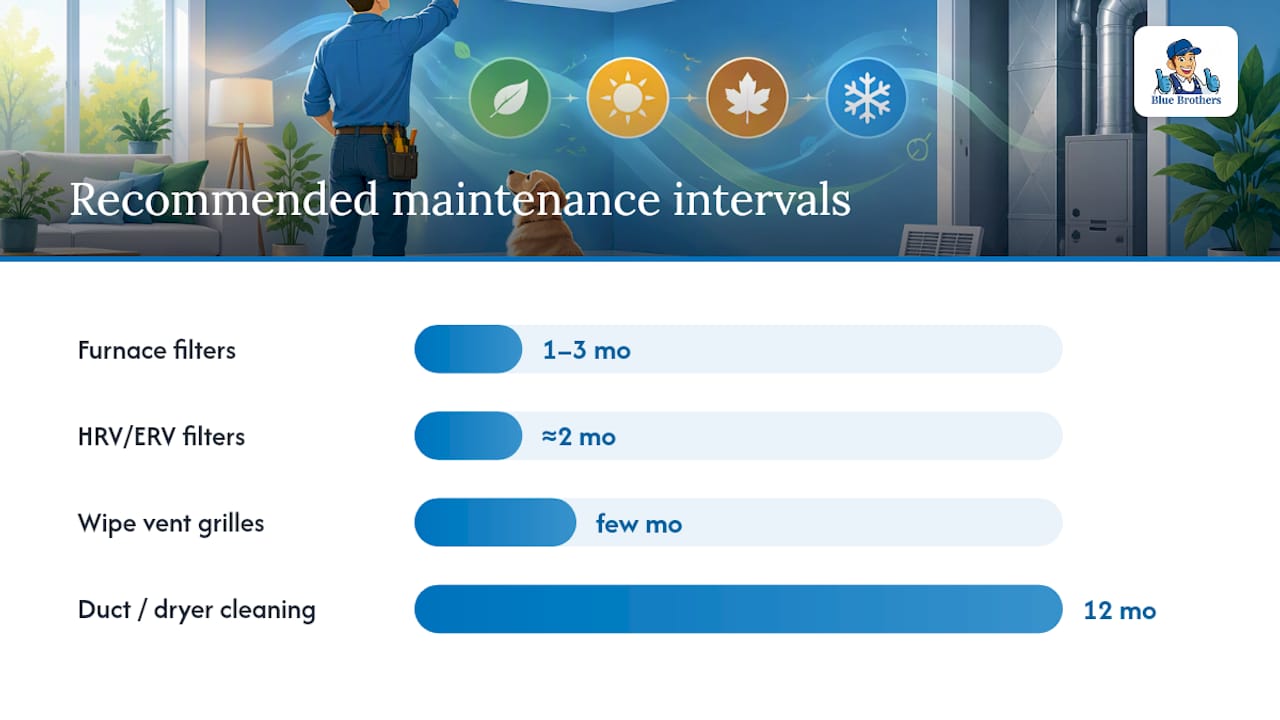
- Replace furnace filters every one to three months depending on filter type and household activity.
- Wipe down vent grilles and registers every few months to prevent residue buildup before it gets embedded.
- Have HRV or ERV filters cleaned roughly every second month if your home has one.
- Schedule professional duct or dryer vent cleaning annually, or sooner in a home with a smoking history.
Gas-phase sorbents like activated carbon can help manage ongoing low-level odour between cleanings, but they’re a maintenance step, not a substitute for one.
What homeowners consistently get wrong about smoke odour
Most people reach for a scented plug-in or an air freshener spray the moment they notice smoke smell, and it never actually works because those products cover odour rather than remove it. Ozone generators are worse: they’re marketed as a stronger fix, but they generate a gas that can be harmful to breathe and can degrade rubber, plastic, and other materials inside your HVAC system.
The other mistake I see constantly is waiting. Someone notices the smell, tries an air freshener, decides it’s “manageable,” and lives with it for a year before calling anyone. By then, residue that could have been cleaned out has had months longer to soak into porous materials.
Before calling a technician, run through three questions: Have you already replaced the filter and cleaned the visible grilles? Does the smell persist after ventilating with clean outdoor air? Is there any chance the smell is coming from a shared return or a neighbouring unit rather than your own system? If you’ve answered honestly and the smell is still there, you’re past the point where DIY fixes will finish the job.
— Jayce
How Blue Brothers can help clear the smell for good
Once you’ve run through the filter checks, wiped the grilles, and the smell is still hanging around, the fastest way to actually resolve it is a targeted cleaning rather than another round of air fresheners. Professional duct cleaning services address this kind of problem across residential and commercial systems, focusing on the specific sources smoke odour tends to hide in.
Depending on where the smell traces back to, the relevant service is usually one of these:
- Air duct cleaning to remove embedded residue from supply and return runs, priced from $400 to $800 CAD depending on the home.
- Dryer vent cleaning when lint buildup is holding odour and creating a fire risk, priced from $99 to $225 $CAD.
- Furnace cleaning to clear residue baked onto the heat exchanger and blower, priced from $50 to $300 $CAD.
- HRV cleaning for homes with balanced ventilation systems, priced from $100 to $400 $CAD.
A typical appointment starts with an inspection of accessible ductwork and components to confirm where the residue actually sits, followed by the agitation and HEPA vacuuming needed to pull it out, then a follow-up recommendation if something like a filter upgrade or a repeat visit makes sense. If the smell keeps returning after your own cleaning attempts, if it’s coming through a shared return in a multi-unit building, or if you’ve noticed any burning smell alongside it, that’s the point to book a visit rather than keep testing home remedies. Get a quote through Blue Brothers and get the source handled properly.
Sources
The guidance in this article draws on a few primary sources worth reading directly if you want the full detail. Health Canada’s ventilation guidance covers target ventilation rates and source control principles. The ASHRAE filtration and air cleaning position document explains gas-phase sorbents and the risks of ozone-based devices. NRC’s experimental research on duct smoke movement is the source behind the airflow and filter findings referenced above.
FAQ
Why do my vents smell like smoke?
Vents usually smell like smoke because tobacco residue has built up inside the ductwork over time, or because smoke from a neighbouring unit or outdoor source is being pulled into your system’s return air. A clogged filter that has absorbed odour can also release it back into the airflow. Running through a filter check and a grille cleaning is the fastest way to narrow down which one applies.
Why does my house smell like smoke even though there’s no smoke in it?
This is typically third-hand smoke: tobacco particles that clung to duct liners, insulation, and other surfaces months or years ago and are still slowly releasing odour. Health Canada notes that combining source control with proper ventilation and cleaning offers the best chance at removing this kind of lingering odour.
How can I remove smoke smell from my air ducts?
Start with a new filter, a vinegar wipe-down of vent grilles, and ventilation with clean outdoor air. If the smell persists, a professional duct cleaning that includes mechanical agitation and HEPA vacuuming reaches residue that DIY methods can’t, though heavily impregnated materials may need replacing rather than cleaning.
What smell can be mistaken for cigarette smoke?
Overheating electrical components, charred cooking grease, and mould growth inside ductwork can all produce a smoky or acrid smell similar to tobacco. A burning or electrical-sounding smell specifically points away from cigarette residue and toward a mechanical issue that needs prompt attention rather than an odour fix.