If wildfire smoke got into your home, have your HVAC system inspected before you restart it. Have the ducts professionally cleaned if you see soot or ash, smell smoke from the vents, or live in or near the fire zone. Canadian health authorities say the same: Alberta Health Services tells residents to consult a professional to clean, restore and restart HVAC systems after a wildfire. A few hazy days with the windows shut are a different case, and this guide helps you tell them apart.
TL;DR
- Keep the furnace and air conditioner off after heavy smoke or ash until the ducts, vents and filters have been inspected.
- Replace filters with new, properly rated ones (MERV 13 where your system can handle it). Never wash and reuse disposable filters.
- Heavy smoke, visible soot, a lingering smoke smell or a home near the fire zone all point to professional cleaning of the whole HVAC system, not just the vents.
- Clean surfaces wet and with HEPA vacuums while you wait. Dry sweeping and dusting put ash back in the air.
- Our air duct cleaning is priced at $400–$800 CAD, depending on the home.
Table of Contents
- When wildfire smoke means your ducts need attention
- What to do before the technician arrives
- Choosing the right filter and air cleaner meanwhile
- What a proper post-smoke cleaning covers
- Costs for homeowners
- How to choose a contractor after a smoke event
- Perspective: why we clean the whole system
- Can you stay home during duct cleaning?
- Book a post-smoke assessment
- After the clean: keeping the air fresh
- FAQ
- Sources
When wildfire smoke means your ducts need attention
Smoke does not stay in the room it enters. Your furnace fan pulls air through return vents and pushes it through every duct in the house, so fine particles can settle throughout the system. The Saskatchewan government notes that smoke and ash can clog ducts, damage filters and coat heat exchangers and fan systems.
The signals that matter most:
- Visible soot or ash around registers, on the filter, or blowing out of supply vents when the fan starts.
- A smoke smell that returns every time the system runs, even after you have cleaned the rooms.
- Heavy smoke infiltration, such as days of dense smoke with the furnace running, or a home in or near the fire zone.
- A fan or furnace that was running during the event with an old, low-grade filter.
The US EPA says you may consider having air ducts cleaned after a fire. It adds that cleaning fits best when ducts hold excessive dust and debris or particles are released from the supply registers. That is the practical test: look at what is actually in your system.
The industry standard agrees. The NADCA Standard ACR lists contamination from fire, smoke or water damage among the conditions that warrant HVAC cleaning, alongside visible debris and odours coming from components.
A short smoke event versus a heavy one
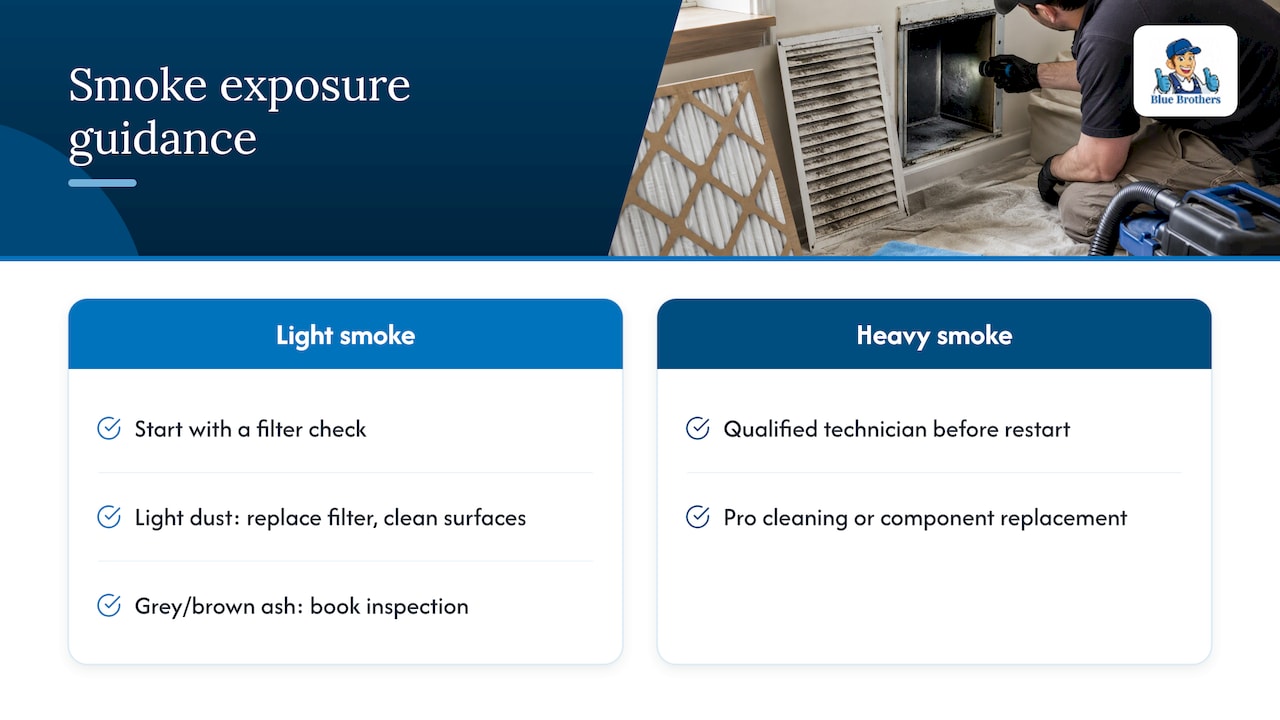
If smoke was light, the windows stayed closed and the system ran with a decent filter, start with the filter. Check it. If it is grey or brown with ash, the system has moved smoke around, and an inspection is worth booking. If the filter is only lightly dusty, replacing it and cleaning surfaces may be all you need for now.
If smoke was heavy, the Saskatchewan guidance is clear: where a home was in or near the fire zone or had heavy smoke infiltration, a qualified HVAC technician should inspect the system before it is restarted, and professional cleaning or component replacement may be required.
What to do before the technician arrives
The first 48 hours after smoke clears shape how much work is left. Follow this order.
- Leave the HVAC off if smoke was heavy. Saskatchewan advises keeping systems off until ducts, vents and filters have been inspected and cleaned or replaced as needed.
- Ventilate once outdoor air improves. Health Canada says to open doors and windows to replace indoor air with fresh outdoor air after the smoke event, then run the ventilation system and replace filters. Check the air quality index first so you do not pull more smoke in.
- Clean surfaces wet. Lightly mist ash, then use wet mops, damp cloths or a HEPA-filtered vacuum. Skip dry sweeping, dusting, leaf blowers and non-HEPA vacuums, and work from top to bottom.
- Replace the filter. Use a new filter rated at least MERV 13 where your system is compatible. Disposable filters should not be cleaned and reused.
- Test smoke and carbon monoxide alarms. Health Canada lists this among its post-event steps.
Laboratory work reviewed by the National Collaborating Centre for Environmental Health shows that wiping, laundering, vacuuming and mopping can reduce PAHs and VOCs on surfaces and in indoor air. Results vary by pollutant, surface and method. That is a good reason to clean thoroughly and keep at it rather than do one quick pass.
Choosing the right filter and air cleaner meanwhile
Filters do two jobs after an event: they catch what is already floating, and they protect a freshly cleaned system. The US EPA recommends an HVAC filter marked MERV 13 or higher and a portable air cleaner whose smoke CADR is at least two-thirds of the room’s floor area in square feet. Alberta Health Services asks residents to upgrade the furnace filter to the highest efficiency the ventilation system can handle and to check filters often, since they may need replacing more than usual.
Two cautions that keep you safe:
- Not every furnace blower copes with a dense filter. If you are unsure, our guide to choosing MERV 13 or 11 without straining your HVAC walks through it.
- Ozone generators are not air cleaners. Alberta Health Services warns that they do not work as air cleaners despite advertising claims.
For many homes, a good filter plus a portable HEPA unit covers the air in the room while duct work deals with the system itself. Our comparison of MERV 13 with a portable HEPA explains how the two fit together, and duct cleaning versus air purifiers shows which problem each one solves for smoke and odour.
What a proper post-smoke cleaning covers
“Air duct cleaning” is shorthand. Smoke settles in the whole air path, so a thorough job covers:
- Supply and return ducts, registers and grilles
- The plenums and the furnace cabinet
- The blower and heat exchanger area
- Air conditioning coils, if you have central air
- The HRV or ERV core, if your home has one
We clean each of these. Our furnace cleaning, air conditioning coil cleaning and HRV cleaning services pair with duct work so that smoke residue is not left in one component to be pushed back through the rest.
Metal ducts, flex duct and insulation
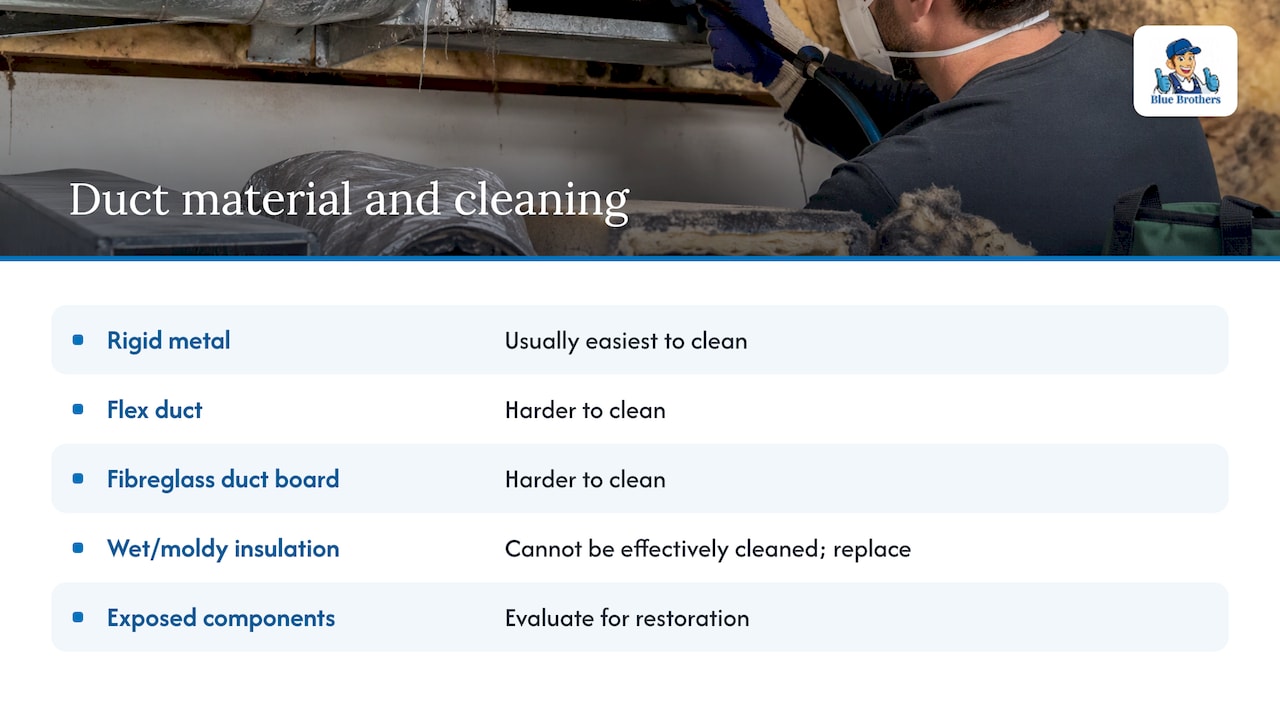
Material matters. The NADCA standard says components exposed to heat and smoke must be evaluated for restoration, and anything that cannot withstand mechanical cleaning must be replaced. Porous surfaces are checked for friability and odour retention after cleaning, and resurfaced or replaced if they fail. In practice, rigid metal ducts are usually the easiest to clean. Flexible duct and fibreglass duct board are harder, and a technician will tell you if a section should be swapped.
The EPA makes a similar point about insulated ducts: if the insulation gets wet or moldy, it cannot be effectively cleaned and should be replaced.
Confirming whether smoke is actually in the system
If you are unsure whether components hold soot, NADCA recommends sampling to the ANSI/IESO/RIA 6001-2011 method for fire-related particulate. Insurers may ask for this on a claim, so mention it when you book.
Costs for homeowners
Our published ranges, one-off per service:
| Service | Price range (CAD) |
|---|---|
| Air duct cleaning | $400–$800 |
| Furnace cleaning | $50–$300 |
| Air conditioning coil cleaning | $100–$400 |
| HRV cleaning | $100–$400 |
| Dryer vent cleaning | $99–$225 |
Where you land in the range depends on the size of the home and the condition of the system. We publish clear pricing with no hidden fees. If your insurer is covering smoke damage, ask them early what documentation they want for the claim.
How to choose a contractor after a smoke event
Look for these before you book:
- Whole-system scope. The quote should name the furnace, plenums and coils, not only vents.
- Certified technicians who work to recognized industry standards.
- Clear written pricing, so you know what is included.
- Insurance awareness. LA County Public Health advises confirming that a contractor is licensed and, on a claim, checking whether your insurer has firms it recommends. The same sense applies in Canada: ask your insurer and your provincial licensing requirements before work starts.
- Documentation of what was found and what was cleaned.
Property managers carry extra weight here because tenants breathe the result. When a building has had heavy smoke, a condition check before restart helps, and independent property inspections can add a second view of what needs attention in older systems. Health Canada’s office guidance recommends upgrading recirculation filters to MERV 13 once the system is confirmed able to handle them, and expecting more frequent changes during smoke.
Perspective: why we clean the whole system
We see the same pattern after smoke seasons in British Columbia, Alberta and Saskatchewan. Homeowners wipe the surfaces they can see and replace a filter, but the smell returns the first cold morning the furnace runs. That is the system telling you something is left inside.
Our approach is to treat the ducts, furnace, coils and HRV as one air path. Cleaning the vents alone leaves residue upstream that the fan will carry back into the rooms. A meticulous job means opening the system up, cleaning each component, and telling you plainly what we found.
We would rather you call us after a heavy smoke event and hear “your system is fine, change the filter” than guess. When the system does need work, our certified technicians use professional equipment and safety protocols, and we are reachable around the clock if something cannot wait.
Jayce
Can you stay home during duct cleaning?
Generally yes. Work happens at the registers, the furnace and the access points, not in every room. Your technician will tell you what to expect for your home, and it is wise to keep pets and anyone with breathing sensitivities in a room away from the work area. After heavy smoke, many people choose to be elsewhere for the day, which is also a good time to ventilate once the air outside is clear.
Book a post-smoke assessment
If your filter is full of ash, the vents smell of smoke or your home sat in the fire zone, we can inspect and clean the whole air path. We serve homes and businesses in British Columbia, Alberta and Saskatchewan, and our residential duct cleaning service runs $400–$800 CAD.
Tell us when smoke came through and what you have noticed, and we will recommend the scope. Start at bluebrothers.ca. If you only want to check the vents yourself first, our 5 checks for smoke smell in vents and signs of dirty air ducts show what to look for.
After the clean: keeping the air fresh
- Run the fan on its normal schedule and swap the filter earlier than usual for the first few weeks. Health Canada notes that high-efficiency filters retain more particulate, so they need more frequent changes during smoke seasons.
- Keep windows and doors closed during future smoke events and limit exhaust fan use, as Health Canada advises.
- Set the system to recirculate if it has that option, as Peel Region’s public health team suggests, and wipe and wet-mop dust on indoor surfaces during smoke.
- Check that your dryer vent is clear too. Lint builds up and is a fire risk, and our dryer vent cleaning is $99–$225 CAD.
- Plan winter ahead. Smoke residue and a heating system working hard are a poor mix, so see how dirty ducts affect winter air.
FAQ
Does air duct cleaning help after wildfire smoke?
It can, when smoke or ash has entered the system. The Government of Northwest Territories advises considering professional cleaning of HVAC units and ductwork to remove soot, ash and smoke residue after you return. The EPA suggests cleaning as needed, such as when ducts are clogged or particles come out of the registers.
How do I know if my ducts have smoke in them?
Check the filter, look inside registers with a flashlight, and notice whether a smoke smell appears when the fan starts. If you are unsure, a technician can inspect the system, and sampling to the ANSI/IESO/RIA 6001-2011 method can confirm fire-related particulate.
Can I use the furnace right after the smoke clears?
After heavy smoke, wait. Saskatchewan advises keeping the system off until ducts, vents and filters have been inspected and cleaned or replaced as needed. Fit a new filter before restarting.
Should I clean the ash myself first?
You can clean surfaces safely if you do it wet. Mist the ash, use damp cloths, wet mops or a HEPA vacuum, and avoid dry sweeping or blowers. Leave the inside of the furnace and ducts to a technician.
Can I stay home during duct cleaning?
Usually, yes. The work is concentrated at the registers and furnace. After a heavy smoke event, some households prefer to be out for the day and to ventilate the home once the job is done.
Sources
- Reopening Buildings, Homes, and Businesses After a Wildfire (Alberta Health Services)
- Forest Fire Smoke and Your Health (Government of Saskatchewan)
- Wildfires and Indoor Air Quality (US EPA)
- Should You Have the Air Ducts in Your Home Cleaned? (US EPA)
- Indoor Air Filtration (US EPA)
- The NADCA Standard ACR, 2025 (conditions for cleaning)
- The NADCA Standard ACR, 2025 (smoke-damaged components and sampling)
- Wildfire smoke, air quality and your health (Health Canada)
- After the wildfire: Indoor smoke residues and cleaning considerations (NCCEH)
- Indoor Air Testing After a Wildfire (Alberta Health Services)
- Guidance on improving indoor air quality in office buildings (Health Canada)
- Wildfire smoke (Peel Region)
- Returning Home from a Wildfire (Government of Northwest Territories)
- Property Inspections