If your restaurant kitchen cooks with grease, fire code in British Columbia requires an exhaust hood and duct system built to NFPA 96, plus automatic fire suppression. It also requires you to keep that system clean, and the cleaning duty falls on you as owner or occupier. The Building Code covers design and installation. The Fire Code covers use, inspection and cleaning. Your city adds its own permits and bylaws on top. We clean kitchen exhaust systems in BC, so this guide sets out what each layer asks of you and what to do about it.
TL;DR
- BC’s Building Code governs how commercial cooking exhaust and fire protection are designed and installed. Use, inspection and maintenance generally follow NFPA 96, subject to the Fire Code’s stated exceptions.
- Any cooking that produces smoke or grease-laden vapour (fryers, griddles, woks, broilers) needs an NFPA 96 hood and duct system with automatic suppression.
- Hoods, filters, fans and ducts must be cleaned often enough that grease never builds up. Some municipalities, such as Saanich, set a floor of at least monthly.
- Changing your menu can change your requirements, so check before you add a fryer or wok.
- Fines can reach $50,000 in some bylaws, and each day of a continuing offence counts separately.
Table of Contents
- Which rules apply to a BC restaurant hood
- Does your kitchen need an NFPA 96 hood and suppression system?
- What the system must include
- Cleaning: how often, and who is responsible
- What non-compliance costs
- A practical compliance routine for owners
- Where we fit in
- Book your kitchen exhaust cleaning
- Our perspective
- FAQ
- Sources
Which rules apply to a BC restaurant hood
Three layers apply at once, and owners often only hear about one of them.
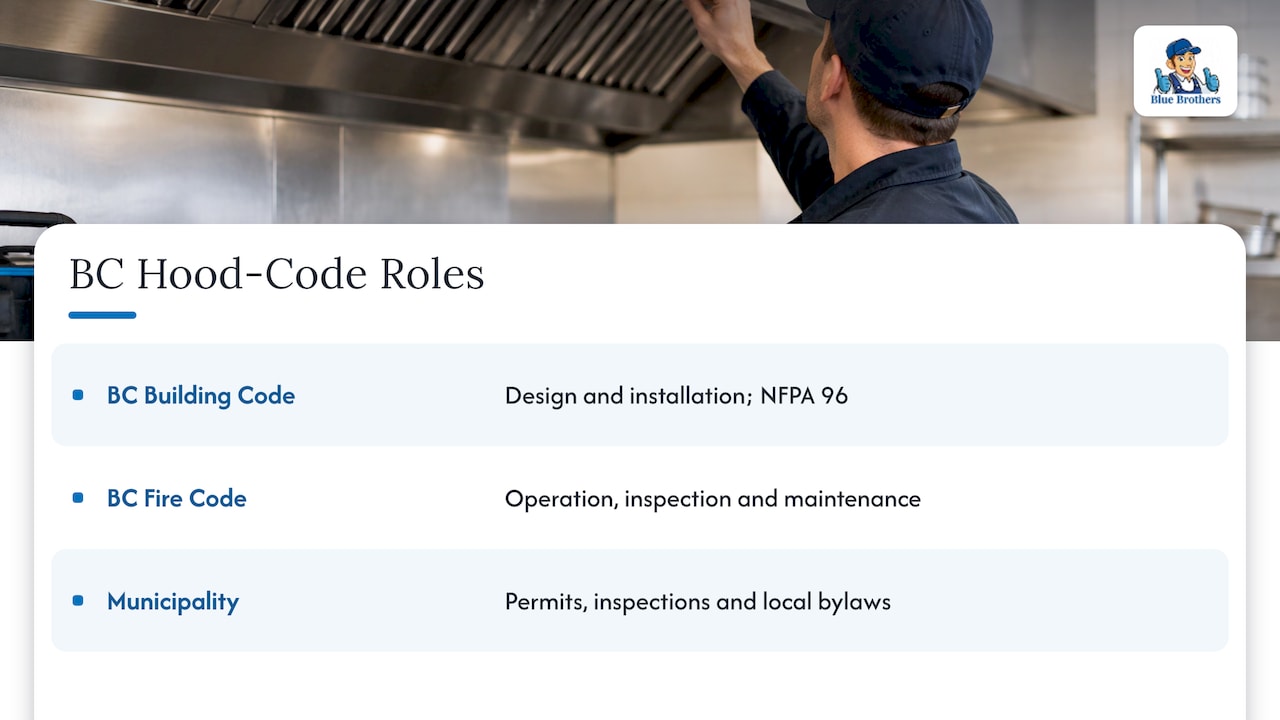
The BC Building Code sets how commercial cooking exhaust and fire-protection systems are designed and installed. The requirement for commercial cooking equipment to comply with NFPA 96 sits here. NFPA 96 is the “Standard for Ventilation Control and Fire Protection of Commercial Cooking Operations”, a U.S.-origin fire safety standard that BC adopts by reference. Its scope is the removal and control of grease-laden vapours, as the Province’s Building Code Appeal Board explained in decision BCAB #1540.
The BC Fire Code covers the system once it is operating. Under Division B, Section 2.6, use, inspection and maintenance of kitchen exhaust and fire-protection equipment generally conform to NFPA 96. Certified commercial cooking equipment must be installed and maintained in line with its certification. Uncertified equipment must be installed and maintained so that it does not create a fire hazard.
Your municipality issues the permits, does the inspections and may pass bylaws that tighten the rules. Saanich’s Fire Prevention and Life Safety Bylaw is one example. It requires use, inspection and maintenance to conform to the current NFPA 96 edition.
One administrative change is worth knowing. Effective August 1, 2024, BC repealed the Fire Code Administration Regulation and made the Fire Safety (Risk Analysis for Compliance Monitoring) Regulation. The technical kitchen requirements above still come from the codes and NFPA 96. Confirm the current edition and local amendments with your city’s fire department or building department.
Does your kitchen need an NFPA 96 hood and suppression system?
It depends on what you cook, not on whether you call yourself a restaurant.
The BCAB #1540 decision held that an NFPA 96 ventilation system is required unless the authority having jurisdiction is satisfied that grease-laden vapours are not produced. The “authority having jurisdiction” is the local official who enforces the code, usually your building or fire department.
Municipal guides sort cooking into types:
| Cooking type | What it produces | What is typically required |
|---|---|---|
| Type I (Class 1) | Significant smoke or grease-laden vapours | NFPA 96 hood and duct system with automatic fire suppression, per Nanaimo’s guide |
| Class 2 | Significant steam or heat, no grease-laden vapours | A Type II hood and exhaust with general HVAC ducting, per Peachland’s bulletin |
| Class 3 | Limited smoke and limited grease-laden vapour, typically single-family-style cooking | A domestic hood and grease filter as the minimum, per Peachland |
Nanaimo lists hot plates, meat-roasting ovens, woks, fry grills, griddles, vertical broilers, salamanders, deep-fat fryers and domestic ranges used commercially as Type I equipment. If you have any of these, plan for the full system.
Menu changes can change the requirement
The City of Vancouver notes that an existing kitchen may have been approved only for food that did not create greasy fumes. Changing the menu or cooking process can require upgraded ventilation and fire protection. A café that adds a fryer, or a bakery that starts grilling, should settle this with the city before buying equipment.
What the system must include
Design and approval are project-specific. The detail below comes from Nanaimo’s April 2026 guidance, and other cities follow similar lines. Your own city’s requirements govern.
- Permitted, engineered design. Where required, sealed drawings and assurances from a BC-registered professional engineer. For new or significantly altered food-service operations, Peachland asks for a building permit, an Interior Health-approved kitchen layout, and mechanical drawings showing compliance with the BC Building Code and NFPA 96, sealed by an engineer entitled to practise in BC.
- NFPA 96-compliant hood and duct construction, with required clearances and protection where ducts pass combustible construction.
- Accessible duct-cleaning panels. Vancouver requires access panels and related clearances so systems can be cleaned. If a technician cannot reach a section, it cannot be cleaned.
- Listed exhaust fans and electrical components, and make-up air that is mechanical, tempered and interlocked with the exhaust.
- Suppression equipment: nozzles, fusible links and manual pull stations, with alarm, fuel and electrical shutoff and control interlocks.
- Acceptance testing. Nanaimo’s guidance includes duct-leakage testing and a suppression dry-trip test before final acceptance.
For fire suppression, New Westminster’s November 2025 kitchen-ventilation guideline says the system must comply with NFPA 96, the manufacturer’s specifications and one of UL 300, ULC/ORD 1254.6 or UL 197. Those are product test standards. Your installer should confirm which one your system meets.
Cleaning: how often, and who is responsible
This is the part that affects you every month, and where most restaurants fall short.
The BC Fire Code requires hoods, grease-removal devices, fans, ducts and other exhaust-system parts to be cleaned at frequent intervals so surfaces do not become heavily contaminated with grease or other residues. The code gives you a test rather than a single number. How often you need cleaning depends on how much you cook and what you cook. A high-volume fryer line builds grease far faster than a kitchen that serves a few steamed dishes.
Some municipalities set a number. Saanich’s bylaw requires hoods, grease-removal devices, fans, ducts and other parts to be cleaned at least monthly, or more often when required. The same bylaw makes the owner or occupier responsible for preventing grease or combustible residue from accumulating in any part of the system. Hiring a cleaner does not hand over that duty. It is how you meet it.
Two more rules in the Fire Code shape how cleaning is done:
- Flammable cleaning materials or solvents are prohibited for exhaust-system cleaning.
- Kitchens must display conspicuous instructions for manually operating the fire-protection system, as part of the fire-safety plan.
What a good service record looks like
The Applied Science Technologists and Technicians of BC (ASTTBC) sets the standard of practice for Registered Fire Protection Technicians. It requires the next service date to be recorded after kitchen-exhaust cleaning or inspection and testing. Areas that were inaccessible or not inspected, and any missing access panels, are described in the report.
Keep those reports. They show an inspector, and your insurer, that the system is maintained on a schedule. They also show you which panels to add before the next visit.
Suppression testing is a separate job
Cleaning the hood and testing the suppression system are different tasks. ASTTBC states that kitchen-exhaust fire-suppression inspection and testing must be done by a Registered Fire Protection Technician endorsed for the relevant system, following manufacturer specifications and applicable codes. Book both, and keep the paperwork for each.
What non-compliance costs
The penalty depends on your municipality, but Saanich shows the scale. Under its bylaw, contravening the bylaw or a related permit or order is an offence with a fine of up to $50,000 on conviction, and each day of a continuing offence is a separate offence. The Fire Chief can also order compliance where the code is contravened or a condition is a fire or life-safety hazard.
The larger cost is a grease fire that reaches the ductwork. Duct fires travel through the building, away from the cooking line where your suppression nozzles are. Regular cleaning removes the fuel.
A practical compliance routine for owners
- Identify your cooking type. List every appliance and decide whether it produces grease-laden vapour. If you are unsure, ask your building or fire department.
- Confirm your approvals. Your permits and drawings should match what you cook today. If the menu has changed, ask the city whether the system needs an upgrade.
- Check access. Make sure duct access panels exist and are not blocked by shelving, ceiling tile or storage.
- Set a cleaning schedule based on volume. Fryer and wok kitchens usually need it more often than light-use kitchens. Where your bylaw sets a minimum, treat it as the floor.
- Book suppression inspection and testing separately with a technician endorsed for your system.
- File every report. Keep the service date, the next-service date and any notes on inaccessible areas.
- Post the manual-activation instructions where staff can see them, and train new hires on them.
Where we fit in
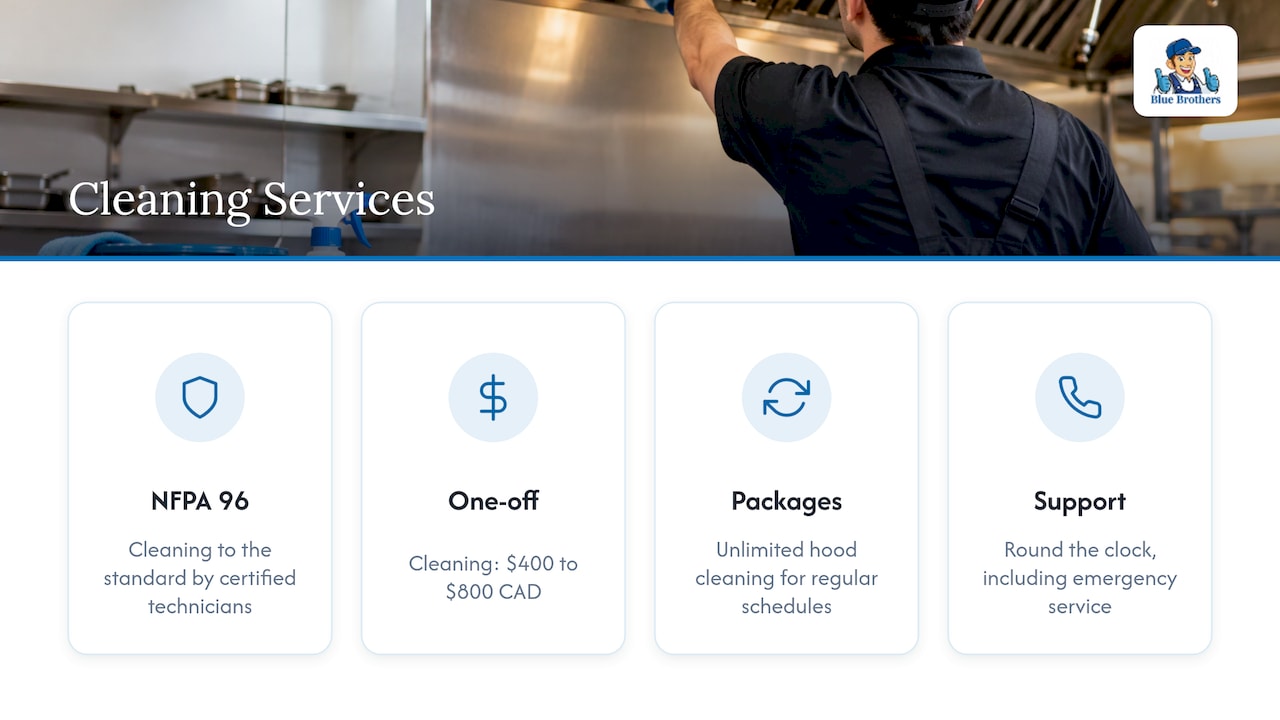
Steps 3, 4 and 6 are where we work with BC kitchens. Our grease exhaust and hood cleaning is delivered to NFPA 96 standards by certified technicians. Pricing is published at $400 to $800 CAD per one-off cleaning, with no hidden fees. We also offer unlimited hood cleaning packages for kitchens that need a regular schedule, and our support runs round the clock, including emergency service.
We serve kitchens across the province, including Vancouver, Burnaby, Kelowna and Kamloops. See our kitchen exhaust cleaning in British Columbia page for the full list of locations.
Book your kitchen exhaust cleaning
If your hood, ducts or fan have not been cleaned to a schedule, start with our grease exhaust and hood cleaning service. Our certified technicians clean to NFPA 96 standards, and you can book a routine visit or call us for an emergency.
Booking a recurring schedule means the cleaning dates are set before an inspector or insurer asks about them.
Our perspective
Most restaurant fires that reach the ductwork start the same way: a little grease on every surface, month after month, until one flare-up gives it somewhere to go. The code describes this plainly. Keep the system from becoming heavily contaminated, and keep it accessible.
We built our hood cleaning around that idea. Every job is meticulous and tailored to the kitchen in front of us, to NFPA 96 standards, by certified technicians. The goal is a system you can show to an inspector without worry.
What we ask owners is simple: know what you cook, keep your access panels clear and put the cleaning dates in the calendar. We handle the rest, day or night if something goes wrong.
Jayce
FAQ
Does every BC restaurant need a commercial exhaust hood?
Not necessarily. The requirement follows the cooking. Where the kitchen produces smoke or grease-laden vapours, an NFPA 96 system is required unless the authority having jurisdiction is satisfied that none are produced. Kitchens that only steam or heat food may need a lighter Type II system, so confirm with your city.
Who is responsible for keeping the hood clean, the landlord or the tenant?
Saanich’s bylaw places responsibility on the owner or occupier of the commercial kitchen. In a leased space, your lease sets who pays, but a bylaw can still hold the occupier responsible. Settle the arrangement in writing and keep the service reports.
Is cleaning the hood the same as testing the fire suppression system?
No. Cleaning removes grease from hoods, filters, fans and ducts. Suppression inspection and testing must be done by a Registered Fire Protection Technician endorsed for your type of system. Both belong on your maintenance calendar.
Do I need new approvals if I change my menu?
Possibly. Vancouver warns that a kitchen may have been approved only for food that did not make greasy fumes, and that a new menu or cooking process can require upgraded ventilation and fire protection. Ask your building department before adding fryers, woks or grills.
What can I be fined?
It varies by municipality. In Saanich, an offence under the fire bylaw carries a fine of up to $50,000, and each day of a continuing offence is separate. Check your own city’s bylaw for its figures.
Sources
- BC Fire Code 2018, Division B, Section 2.6 Service Equipment
- City of Nanaimo, Commercial Cooking Equipment Exhaust & Air Systems
- District of Peachland, Commercial Kitchen Exhaust Requirements
- City of Vancouver, Building permit for restaurant kitchen ventilation
- City of New Westminster, Kitchen Ventilation Guidelines, November 2025
- District of Saanich, Fire Prevention and Life Safety Bylaw
- ASTTBC, Registered Fire Protection Technician Standard of Practice
- B.C. Reg. 249/2024, Fire Safety (Risk Analysis for Compliance Monitoring) Regulation