Most commercial kitchens in Canada need their exhaust system cleaned every three to six months. Solid-fuel cooking needs it monthly, and high-volume cooking such as 24-hour service, charbroiling or wok cooking needs it quarterly. Moderate-volume kitchens are usually on a six-month cycle. The exact interval depends on what you cook, how much you cook, and what your local fire authority requires, so this guide walks through the national pattern, the provincial differences and the records you need to keep.
TL;DR
- NFPA 96 intervals used by Canadian fire departments: monthly for solid fuel, quarterly for high-volume cooking, semiannually for moderate-volume cooking.
- British Columbia’s fire code calls for hoods, ducts and filters to be inspected at least every 7 days, with cleaning when deposits create a fire hazard.
- Alberta sets annual cleaning by a qualified person as the minimum, and the local authority can ask for more.
- Keep dated cleaning records on site. Alberta expects them kept for at least five years.
- Our published range for grease exhaust and hood cleaning is $400 to $800 CAD per job, and we can set up a recurring schedule that matches your cooking volume.
Table of Contents
- Why there is no single national number
- The NFPA 96 cleaning tiers
- What the rules say in British Columbia
- What the rules say in Alberta
- What the rules say in Saskatchewan
- Factors that push you toward a shorter interval
- Perspective from our team
- Records: what to keep after every cleaning
- Related inspections that run on a different clock
- Who is allowed to clean your system
- How much does a cleaning cost?
- Setting your schedule: a worked example
- Why delay costs more than cleaning
- Book your next hood cleaning with us
- FAQ
- Sources
Why there is no single national number
Canada does not have one federal rule for hood cleaning. Provinces adopt their own fire codes, and cities and fire departments interpret them. Most of them point to the same reference: NFPA 96, the standard for ventilation control and fire protection of commercial cooking operations.
That is why you see the same three tiers on fire department pages from Saskatchewan to British Columbia. It is also why the same restaurant can be told “quarterly” in one city and “at least annually” in another. The code sets a floor. Your cooking sets the real schedule.
The NFPA 96 cleaning tiers
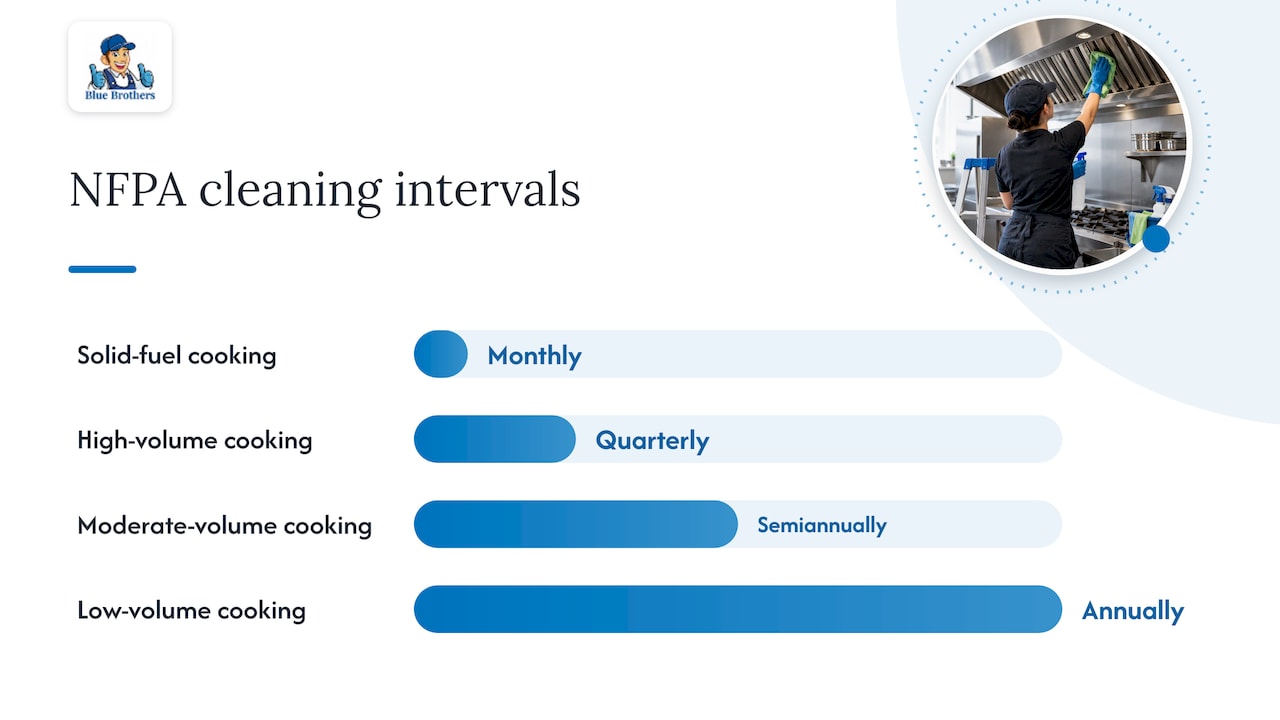
The fire department in North Bay, Ontario, lists the NFPA 96-2011 intervals for cleaning the entire system to bare metal:
| Type of cooking | Cleaning interval |
|---|---|
| Solid-fuel cooking (wood, charcoal) | Monthly |
| High-volume cooking (24-hour cooking, charbroiling, wok cooking) | Quarterly |
| Moderate-volume cooking | Semiannually |
| Low-volume cooking (churches, day camps, seasonal businesses, senior centres) | Annually |
The first three rows come from North Bay. The low-volume row comes from the City of Dawson Creek, BC, whose 2024 fire inspection handout uses the same four tiers.
The City of Weyburn, Saskatchewan, applies the same tiers. It adds a weekly routine: hoods, grease removal devices, fans and ducts should be checked weekly and cleaned regularly, before surfaces become heavily contaminated.
Which tier is your kitchen?
The tier follows what is on the cook line, not the type of business.
- Solid fuel. A wood-fired oven or charcoal grill puts you on the monthly tier.
- High volume. A kitchen open around the clock, a charbroiler running through every service, or a wok station running hot most of the day belongs in the quarterly tier.
- Moderate volume. A typical full-service restaurant with standard fryers, griddles and ranges, and regular but not constant service, usually lands here.
- Low volume. A church hall kitchen, a seasonal operation or a small senior centre cooks too little for grease to build quickly.
If you sit between tiers, go to the shorter interval. Cleaning a little early costs less than cleaning after grease has built up.
What the rules say in British Columbia
British Columbia has the most detailed wording of the three provinces we serve. The BC Fire Code 2018 requires hoods, ducts and filters subject to combustible deposits to be inspected at intervals not greater than 7 days, and cleaned if the deposits create a fire hazard. The same section requires commercial cooking exhaust and fire protection systems to be used, inspected and maintained in conformance with NFPA 96, subject to stated exceptions.
That 7-day inspection is a quick visual check by your own staff, such as looking at filters and the hood interior. It is separate from the professional cleaning. The professional cleaning follows the NFPA tier above.
The City of Vancouver’s kitchen ventilation guidelines, citing NFPA 96, set a range of 3 to 12 months for removing grease from exhaust ductwork, the hood and the ecology unit. They set 6 months for hood fire suppression and 1 month for solid-fuel exhaust systems. An appendix note says that in general, exhaust systems should be cleaned at intervals not greater than 3 months.
Practically, in the Lower Mainland most operators with real fryer and grill volume plan for quarterly cleaning. If you run a kitchen in Vancouver, Kelowna or elsewhere in the province, confirm the interval with your local fire department when you open or renew.
What the rules say in Alberta
Alberta works differently. The Government of Alberta’s fire code interpretation 23-FCI-004 states that the minimum for a qualified person to do exhaust and hood cleaning is annually. It also says the authority having jurisdiction (AHJ) may require more frequent cleaning based on the grease, dust or residue that has built up in the hood and duct system.
So an annual clean is the legal minimum for a low-use kitchen, but a busy restaurant that waits a year will almost certainly have heavy buildup. An inspector can then order a shorter cycle. Most busy Alberta kitchens end up on the NFPA tiers anyway.
Who does the work also matters. The same Alberta document says only qualified persons with a certificate for an approved course in duct-cleaning procedures may maintain commercial cooking exhaust systems. The City of Calgary repeats that requirement and lists approved training. If you cook in Calgary, ask any contractor for their certificate before booking.
What the rules say in Saskatchewan
In Saskatchewan, requirements are set by the city. The City of Weyburn, noted above, has the whole exhaust system inspected for grease buildup by an authorized person on the NFPA tiers: monthly for solid fuel, quarterly for high-volume cooking and semiannually for moderate-volume cooking. If you operate in or near Regina, check with your municipal fire prevention office for its current handout.
Factors that push you toward a shorter interval
The tier is a starting point. These factors tell you whether to clean sooner.
- Fuel type. Solid fuel produces residue that builds faster than gas or electric cooking.
- Hours of operation. A kitchen running 16 hours a day has twice the exposure of one running eight.
- Menu. Deep frying, charbroiling, wok cooking and anything with heavy smoke or oil vapour loads filters and ducts faster than baking or steaming.
- Duct layout. Long horizontal runs, many bends and rooftop fans give grease more places to settle.
- Filter upkeep. Filters that are cleaned or swapped on schedule hold back grease. Neglected filters let it pass into the duct.
- Seasonal peaks. If you run a patio season or a holiday rush, schedule a clean just before the peak, not just after.
The “look at it” test
One method for deciding when to call is to check the surfaces. Some guides use a grease depth of roughly 2 millimetres as the trigger. We would not wait for that. Whenever you see grease dripping from the hood, hear the fan labouring, or find a heavy film on the filter frames, book the clean.
Perspective from our team
In our experience, the kitchens that get into trouble are rarely the ones that ignore cleaning altogether. They are the ones that clean on a schedule that was right for the restaurant they used to be.
A place adds a wok station, extends its hours, or starts a late-night menu. The cleaning contract stays on the old semiannual cycle. Nothing looks wrong until the fire inspector arrives, or worse, a grease fire starts in the duct.
That is why we treat frequency as something to review, not set once. When we clean a hood system to NFPA 96 standards, we want to leave you with a clear next-due date based on what we saw in the duct, not just on the calendar. Our team is certified, our pricing is stated up front with no hidden fees, and we offer unlimited hood cleaning packages for kitchens that need a tighter cycle.
If your volume changes, call us. We are reachable round the clock, and we also handle emergency situations.
Jayce
Records: what to keep after every cleaning
A clean that is not documented will not satisfy an inspector. Requirements vary, but the strongest examples are consistent.
- Alberta. The interpretation 23-FCI-004 requires cleaning and maintenance records to be kept on the premises for the AHJ’s review. At least the current and the previous record must be available, and no record should be destroyed within five years of being prepared.
- What the certificate should show. Alberta’s document lists the date of cleaning or inspection, the next cleaning due date and recommended frequency, the areas cleaned, reasons any areas were left out, and the recognized training organization of the supervisor or crew.
- Saskatchewan. Weyburn requires inspection reports for the previous two years to be kept on site, along with drawings of the exhaust installation and operating instructions for its components.
- British Columbia. The ASTTBC Standard of Practice for registered fire protection technicians calls for a self-sticking label of at least 7.5 x 15.0 cm in a visible spot on the hood. The technician marks the results of cleaning, inspection and testing, notes areas not cleaned because of inaccessibility, records the next service date, then stamps and signs it.
That label system also rates the condition of the system. A pass means all components are accessible, cleaned and working as intended. A fail, shown by a large red X, means the equipment is not functioning as intended and urgent work or replacement is needed. The technician then advises the fire protection company and building owner.
Keep a simple binder or shared folder with every service report, the label photo and the next due date. Keep it for five years if you operate in Alberta, since that is the longest retention in these sources.
Related inspections that run on a different clock
Cleaning is one item on the kitchen fire safety list. Two others commonly arrive at the same inspection.
- Fire suppression system. North Bay requires the hood suppression system to be checked and tested by a qualified company every 6 months. Dawson Creek asks for service and tagging at least once every 6 months. Vancouver’s table also gives 6 months for hood fire suppression.
- Class K extinguisher. Dawson Creek requires one within 30 feet of cooking areas, visible, accessible, and serviced and tagged at least annually by a certified technician.
A sensible habit is to align your hood cleaning with the suppression service. You then have one visit window, and the suppression technician sees a clean system.
Who is allowed to clean your system
North Bay is explicit that the exhaust system must be cleaned by an approved company acceptable to the fire department, not by the owner. Alberta and Calgary require a certificate of approved duct-cleaning training. In British Columbia, the technician standard above sets how results are recorded.
Practically, before you hire anyone, ask for:
- Proof of training or certification accepted where you operate.
- A written scope showing the hood, filters, duct, fan and rooftop discharge.
- A sample of the report or label you will receive.
- Confirmation that they service to NFPA 96.
- Their approach to areas with no access panels, since those must be noted in the report.
How much does a cleaning cost?
Our published range for grease exhaust and hood systems cleaning is $400 to $800 CAD per job. Where you land depends on the size of the system, the number of hoods, the length of the duct run and access. A one-hood kitchen with direct roof access sits at the lower end. A multi-hood kitchen with long ducts sits higher.
For a kitchen on a quarterly cycle, that means budgeting for four cleans a year. If your kitchen needs a tight cycle, ask about our unlimited hood cleaning packages, which are built for that situation. Compare any quote against the written scope above, not the headline number alone.
Setting your schedule: a worked example
Here is how the reasoning goes for three typical kitchens. These are illustrations, not code citations.
- A neighbourhood pizzeria with a wood-fired oven. Solid fuel puts it on the monthly tier. Twelve cleans a year, and an unlimited package makes budgeting simple.
- A 60-seat family restaurant with fryers and a flat-top. Moderate volume suggests semiannual. If the fryer runs through lunch and dinner every day and filters are visibly greasy at three months, move to quarterly.
- A late-night noodle bar with wok stations. Wok cooking is in the quarterly tier. If it runs 24 hours, quarterly is the minimum.
In each case, write the interval and the next-due date in your records, then review whenever the menu or hours change.
Why delay costs more than cleaning
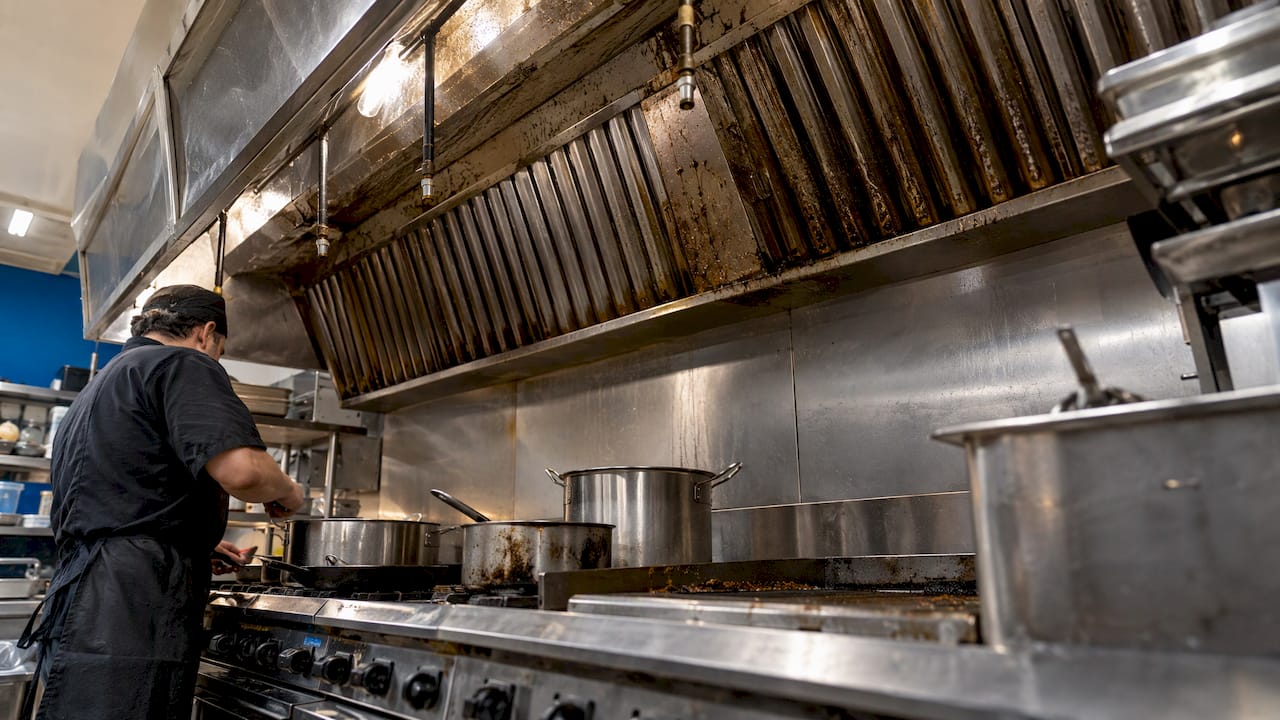
Grease in a hood, duct or fan is fuel. The point of the NFPA tiers is to remove it before it accumulates to a hazardous level. Beyond fire risk, heavy buildup can make the fan work harder and push odours back into the kitchen and dining room. Those are practical reasons to stay ahead of the schedule, in addition to meeting code. A missed interval can also put you on the wrong side of an inspection, where the AHJ can order cleaning, as Alberta’s wording makes clear.
Book your next hood cleaning with us
We clean grease exhaust and kitchen hood systems for restaurants, food plants and commercial kitchens across British Columbia, Alberta and Saskatchewan, to NFPA 96 standards and with certified technicians. Our published range is $400 to $800 CAD per job, and we can recommend an interval after seeing your system.
See our grease exhaust and hood cleaning service to request a quote, or browse our pages for British Columbia kitchens. Emergency calls are answered around the clock.
FAQ
How often should a restaurant hood be cleaned in Canada?
For most restaurants, every three to six months. NFPA 96 tiers used by Canadian fire departments call for monthly cleaning with solid fuel, quarterly for high-volume cooking and semiannually for moderate-volume cooking. Your local fire authority can require more.
Is there a Canada-wide law on hood cleaning frequency?
No. Provincial fire codes and municipal fire departments set the requirement, and many reference NFPA 96. BC’s fire code requires NFPA 96 conformance, while Alberta sets an annual minimum with room for the AHJ to require more.
Can I clean the hood and ducts myself?
You can wipe down hood surfaces and clean filters as part of daily and weekly upkeep. The exhaust system itself must be cleaned by an approved or qualified company in places like North Bay, and Alberta requires a certificate of approved training for anyone doing the maintenance.
How long should I keep cleaning records?
Alberta’s interpretation says records stay on the premises for the AHJ, with at least the current and previous ones available, and none destroyed within five years. Weyburn requires two years of inspection reports on site. Keeping five years covers both.
What if my kitchen use changes?
Reassess the interval. A new fryer, a wok station or longer hours can move you into a shorter tier. Ask your cleaner to note the recommended frequency on each report, as Alberta’s maintenance certificate requires.
Sources
- North Bay Fire and Emergency Services: Commercial Cooking Equipment
- City of Weyburn: Restaurant Exhaust and Fire Suppression System Requirements
- City of Dawson Creek: Retail / Commercial Occupancies fire inspection handout
- City of Vancouver: Kitchen ventilation systems for commercial-type cooking operations
- BC Fire Code 2018, Division B, Section 2.6 Service Equipment
- Government of Alberta: interpretation 23-FCI-004 on fixed fire suppression and exhaust systems
- City of Calgary: Life Safety Equipment, required qualifications
- ASTTBC: RFPT Standard of Practice