In Canada, commercial kitchen grease ducts must be inspected and cleaned to NFPA 96, which the provincial fire codes adopt. The schedule depends on how you cook: monthly for solid fuel, quarterly for high-volume cooking, semi-annually for moderate volume. The work must be done by a trained, certified person, and you must keep the records. Details vary by province and by city, so this guide walks through the national picture and then Alberta, British Columbia and Saskatchewan, where we work.
TL;DR
- Fire codes in BC and Alberta require use, inspection and maintenance of kitchen exhaust systems to follow NFPA 96.
- Cleaning frequency follows cooking type: monthly (solid fuel), every 3 months (high volume), every 6 months (moderate), yearly (low volume).
- Cleaning must be done by a certified, trained person. Owners cannot simply do it themselves in many jurisdictions.
- Keep written reports on site (Alberta cities ask for five years) and put a service label on the hood.
- Skipping the work can mean a re-clean at your cost, and a much higher fire risk.
Table of Contents
- Which rules apply to grease duct cleaning in Canada
- What has to be inspected and cleaned
- How often grease ducts must be cleaned
- Who is allowed to do the cleaning
- Records, labels and proof of service
- What happens if you fall behind
- A simple compliance routine
- Our perspective
- Book grease exhaust and hood cleaning
- FAQ
- Sources
Which rules apply to grease duct cleaning in Canada
There is no single federal law that tells a restaurant when to clean its ducts. The National Fire Code is adopted and amended by each province, and local fire departments enforce it. What matters is that the provincial codes point to the same standard: NFPA 96, Ventilation Control and Fire Protection of Commercial Cooking Operations.
British Columbia. The BC Fire Code 2018, Division B, Section 2.6.1.9 says commercial cooking exhaust and fire protection systems must be designed and installed to the BC Building Code, and that their use, inspection and maintenance must conform to NFPA 96.
Alberta. Article 2.6.1.9 of Division B of the National Fire Code, Alberta Edition, says the same thing, tying use, inspection and maintenance to NFPA 96-2017.
Saskatchewan. Local authorities set out the practical expectations. The Town of Weyburn and the City of Regina both publish requirements built on NFPA 96.
Ontario. The City of Oshawa also requires maintenance and periodic inspection to comply with NFPA standards, which shows how widely the standard is used across the country.
The practical rule: whatever your province, NFPA 96 is the yardstick, and your local fire department (the authority having jurisdiction, or AHJ) decides how it is enforced. If you are unsure which edition or local rule applies, ask your fire prevention office before you book.
What has to be inspected and cleaned
“Grease duct cleaning” is shorthand for the whole exhaust path. The City of Lethbridge lists hoods, grease removal devices, fans and ducts as the components that must be inspected at the applicable frequency and cleaned as required under NFPA 96.
The BC Fire Code adds a few points worth knowing:
- Hoods, grease removal devices, fans, ducts and other appurtenances must be cleaned at frequent intervals so surfaces do not become heavily contaminated with grease or residues.
- Flammable cleaning materials or solvents must not be used to clean exhaust systems.
- Instructions for manually operating the fire protection system must be posted conspicuously in the kitchen as part of the fire safety plan.
The standard is not satisfied by wiping the visible hood. IKECA’s guidance, citing NFPA 96 (2024 edition), says contaminated parts of the system must be cleaned by a properly trained, qualified and certified person acceptable to the authority having jurisdiction. The City of Regina goes further on the result: surfaces should be cleaned to a minimum of 50 microns (0.002 in.) of combustible contaminants.
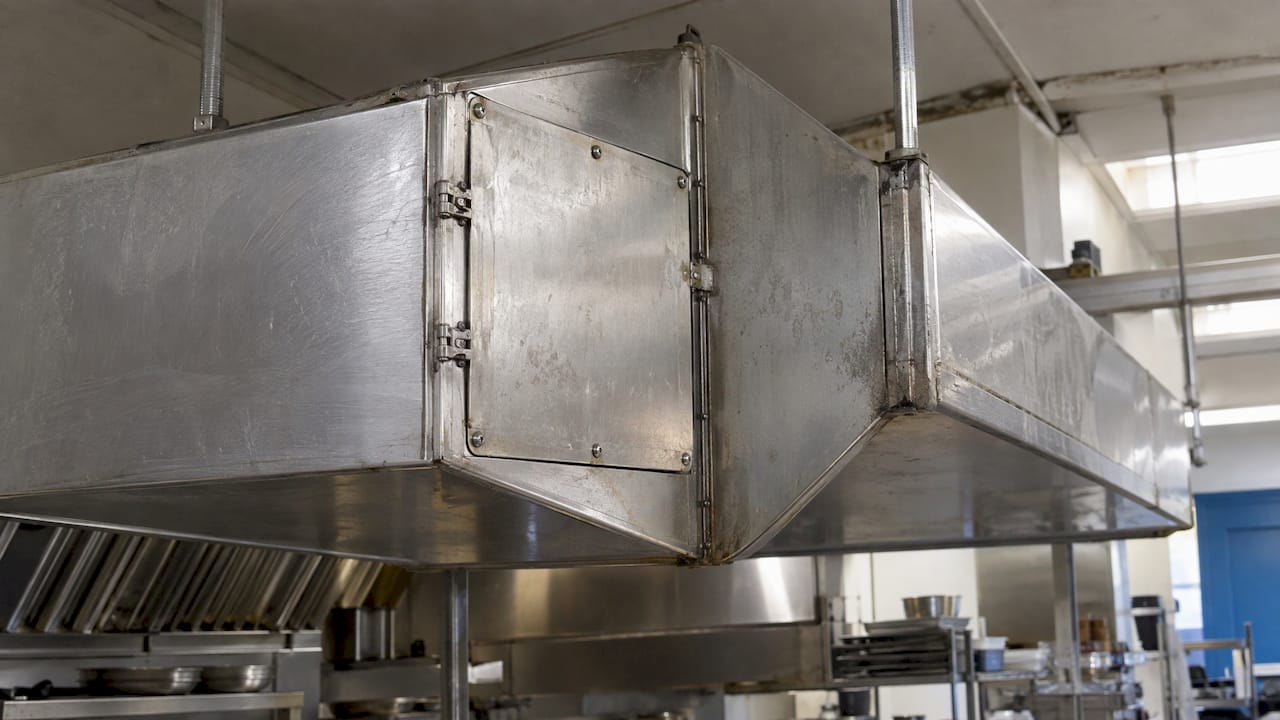
Access matters too. The City of Oshawa notes that ducts need openings for inspection and cleaning at any change of direction, with access panels of the same material and construction as the duct. If a section of your system cannot be reached, it cannot be cleaned, and that is a design problem to raise with your cleaner and your landlord early.
How often grease ducts must be cleaned
NFPA 96 ties frequency to the type and volume of cooking. Canadian municipal pages describe the inspection schedule consistently. The Town of Weyburn and the City of Regina give the following intervals, and North Bay Fire and Emergency Services adds the low-volume category.
| Type of cooking operation | Examples | Inspection and cleaning interval |
|---|---|---|
| Solid fuel | Wood or charcoal cooking | Monthly |
| High volume | 24-hour cooking, charbroiling, wok cooking | Quarterly (every 3 months) |
| Moderate volume | Typical full-service restaurants | Semi-annually (every 6 months) |
| Low volume | Churches, day camps, seasonal businesses, pizza ovens | Annually |
Two details trip people up.
Inspection is separate from cleaning. Weyburn’s document also says hoods, grease removal devices, fans and ducts should be checked weekly and cleaned before surfaces become heavily contaminated. Alberta’s 2024 fire code interpretation says that, depending on usage, the whole system including grease extractors should be inspected at intervals not greater than 7 days. The same interpretation says systems should generally be cleaned at intervals of no more than 12 months, and no more than 3 months for deep fat cooking, char broiling or similar operations.
The qualified inspector decides. The City of Calgary explains that whether cleaning is needed is determined under NFPA 96 section 11.6, using the depth gauge comb described in the standard, and that only the qualified person who inspects the system can make that call. The table is a floor for planning, not a guarantee that you are compliant between visits. A busy kitchen on a six-month plan may find its ducts need attention sooner.
The same logic of buildup applies elsewhere in the building. If the upstairs suites or offices share your property, this explainer on why dust builds up in air vents is a useful companion to the kitchen exhaust schedule, since ordinary ventilation needs its own cleaning rhythm.
Who is allowed to do the cleaning
This is where Canadian rules differ most from the “hire anyone with a brush” assumption.
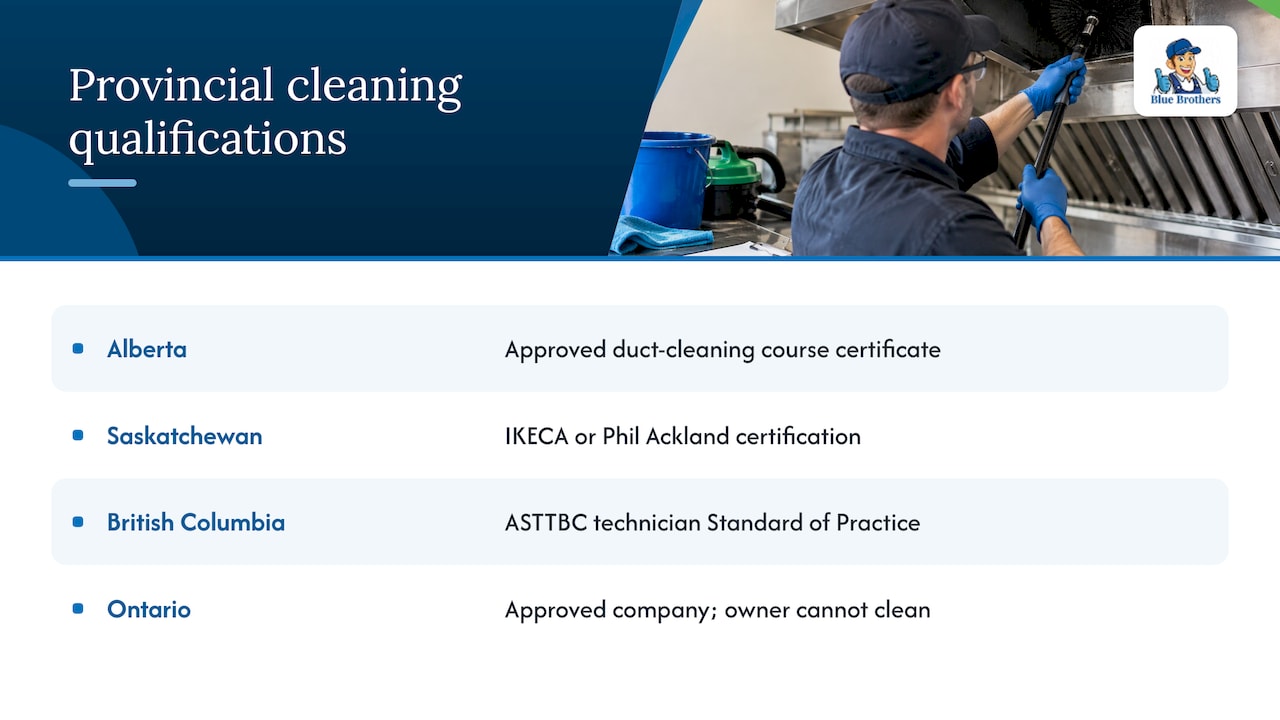
Alberta. Division C, Article 2.2.4.5 requires that only qualified persons maintain commercial cooking exhaust systems, meaning people who hold a certificate showing they completed an approved course in duct-cleaning procedures. The 2024 interpretation also allows a certified person to supervise up to two trainees who are registered students with a recognized training facility. An earlier 2019 interpretation named the two training organizations then recognized by the Provincial Fire Administrator, so ask any contractor which recognized program certified their crew.
Saskatchewan (Regina). The City of Regina says anyone inspecting or cleaning commercial cooking exhaust within city limits must hold an IKECA Certified Exhaust System Inspector certification or a Phil Ackland kitchen exhaust cleaning certification.
British Columbia. ASTTBC publishes a Standard of Practice for Registered Fire Protection Technicians, which sets out how cleaning, inspection and labelling are carried out by those technicians.
Ontario (North Bay). The fire department states that the exhaust system cannot be cleaned by the owner and must be cleaned by an approved company acceptable to the department.
The owner is still on the hook. Lethbridge says the owner or the owner’s authorized agent is responsible for carrying out the Code, including making sure the people hired are qualified. If you lease, check whether your lease puts exhaust cleaning on you or on the landlord, and make sure someone holds the paperwork.
Records, labels and proof of service
An inspector will ask for evidence, not just a clean hood. Expect three kinds.
Written maintenance records. Lethbridge and Calgary both require written records kept on site for examination by the AHJ. A qualified person completes a report for each maintenance frequency, and the report stays on site for five years. Weyburn asks that inspection reports for the previous two years be on site. Oshawa says certificates of inspection and maintenance are forwarded to the fire service when required.
A maintenance certificate. Alberta’s 2019 interpretation says the cleaning contractor provides a certificate that is attached to the hood or posted where the fire AHJ can see it. It should show:
- the cleaning company’s name, address and phone number
- the printed name and signature of the qualified on-site supervisor
- the date of cleaning or inspection, and the next cleaning due date with recommended frequency
- which areas were cleaned, and notes on any areas omitted and why
- the recognized training organization that qualified the supervisor or crew
A hood label. ASTTBC’s standard sets a minimum label size of 7.5 x 15.0 cm, with company name and contact details, a peel-off label placed visibly on the hood, and permanent ink. The technician punches the boxes for results, notes areas not cleaned because of inaccessibility, records the next service date, then stamps, signs and affixes the label.
The suppression system has its own schedule. Lethbridge lists inspection and maintenance of wet chemical systems every 6 months, and North Bay says a qualified company must check and test it on that cycle. Ask whether your provider coordinates this, or book it separately so the two certificates line up.
What happens if you fall behind
The consequence the regulators spell out is practical. Regina states that if a certified company was not used, a Fire Inspector will require the system to be cleaned again by a certified company at the restaurant owner’s cost. The same page warns that poorly maintained exhaust systems are a significant fire hazard, with grease fires that spread quickly through ductwork.
That is the real reason the rules exist. Grease collects inside ducts where you cannot see it, and a flare-up at the cooktop can travel through the duct into the ceiling space. A compliant cleaning is the cheapest part of that equation. Insurers and local fire departments also ask for the certificate, so a gap in your records can become a problem long before there is any fire.
A simple compliance routine
- Classify your cooking. Match your kitchen to solid fuel, high, moderate or low volume. When in doubt, take the shorter interval and ask your inspector.
- Hire a certified provider. Ask for the certification (a recognized Alberta program, IKECA or the Regina-accepted certification, ASTTBC registration in BC) and confirm it satisfies your local fire department.
- Set a recurring schedule. Book the next service at each visit, and have the next due date written on the label.
- Keep a binder. Reports, certificates and suppression system tests in one place, on site. Alberta cities ask for five years.
- Do the small checks yourself. Staff can watch for grease dripping from filters, weak airflow and smoke that lingers, and clean filters as your plan allows. Deep cleaning of ducts stays with the certified person.
- Fix access problems. If a duct section has no access panel, get one installed so the whole system can be cleaned.
Our perspective
Most kitchens that call us in a hurry are not careless. They simply assumed that a cleaned hood meant a compliant system, and then an inspector asked for a certificate, a label and a report.
We treat grease duct cleaning as a fire safety job first and a cleaning job second. That means certified technicians, work to NFPA 96, and a clear written record at the end of each visit, so you can show your fire department exactly what was done and when the next visit is due.
We also think the schedule should be set once and then run itself. Our unlimited hood cleaning packages and round-the-clock support, including emergencies, are designed so a busy chef or property manager does not have to chase the calendar.
Our NFPA 96 checklist for commercial kitchens is on our compliance page, and it is a good starting point if you are preparing for an inspection.
Jayce
Book grease exhaust and hood cleaning
Blue Brothers cleans commercial kitchen exhaust systems to NFPA 96 standards for restaurants, food plants and commercial kitchens in Saskatchewan, British Columbia and Alberta. Our published range for Grease Exhaust & Hood Systems is $400 to $800 CAD per one-off service, and pricing is clear with no hidden fees.
If you want a local team, we have hood cleaning pages for Calgary, Regina, Kelowna and Saskatchewan more broadly. Contact us through bluebrothers.ca to book a visit or ask about a recurring plan.
FAQ
How often does a restaurant need grease duct cleaning in Canada?
It depends on the cooking. Municipal guidance based on NFPA 96 sets monthly cleaning for solid fuel, quarterly for high-volume cooking such as charbroiling or wok cooking, semi-annually for moderate volume and annually for low volume. A qualified inspector makes the final decision on whether cleaning is due.
Can I clean my kitchen exhaust ducts myself?
In many places, no. North Bay says the owner cannot clean the system, and Regina requires cleaners to hold a recognized certification. Alberta requires a qualified, certified person. You can still handle day-to-day tasks such as filter care, as your plan allows.
What records do I need to keep?
Keep the cleaning and inspection reports, the maintenance certificate and your suppression system test records on site. Alberta cities such as Calgary and Lethbridge ask for reports to be kept for five years, while Weyburn asks for the previous two years. Your hood should also carry a current service label.
What happens if I use an uncertified cleaner?
In Regina, the Fire Inspector can require the system to be cleaned again by a certified company at your cost. Beyond that, uncertified work leaves you without valid paperwork if your insurer or fire department asks for it.
Sources
- BC Fire Code 2018, Division B, Section 2.6
- City of Lethbridge, Building Owner’s Responsibilities for Fire Safety
- City of Calgary, Fire Safety Maintenance Requirements
- City of Regina, Facility Inspections
- Town of Weyburn, Restaurant Exhaust and Fire Suppression System Requirements
- City of Oshawa, Requirements for Commercial Cooking Equipment
- North Bay Fire and Emergency Services, Commercial Cooking Equipment
- Alberta Fire Code Interpretation 23-FCI-004 (2024)
- Alberta Fire Code Interpretation 19-FCI-002 (2019)
- IKECA Frequently Asked Questions
- ASTTBC Registered Fire Protection Technician Standard of Practice V4
- Dust in Air Vents: Why It Builds Up and How to Clean It