A high-efficiency gas furnace turns more of the fuel you buy into heat for your house, so it usually means lower heating bills, steadier room temperatures and sealed combustion that does not draw on your indoor air. It costs more to buy than a standard unit, and it needs correct installation, a condensate drain and plastic venting to deliver what it promises. This guide covers what you gain, how much you can realistically save, what it costs to own, and how to look after it through a Canadian winter.
TL;DR
- Gas and propane furnaces in the high-efficiency class run at 90% to 98% AFUE, and ENERGY STAR gas models must reach at least 95%.
- Swapping a 20-year-old, 78% AFUE furnace for a 95% unit cuts annual energy costs by about 18%.
- Comfort improves too: more even temperatures, and sealed combustion that suits airtight homes.
- Expect a higher purchase price, a condensate drain and PVC or ABS vent pipes.
- Installation quality and sizing decide how much of the rated efficiency you actually get.
Table of Contents
- What “high efficiency” means in a furnace
- The main benefits
- High-efficiency vs standard furnace at a glance
- What the savings look like in a real house
- Upfront cost, rebates and payback
- Sizing and installation decide the result
- Living with a high-efficiency furnace
- Is a high-efficiency furnace right for you?
- Perspective
- Keep your new furnace performing
- FAQ
- Sources
What “high efficiency” means in a furnace
Furnace efficiency is measured as AFUE, annual fuel utilization efficiency. It is a seasonal figure for how much of the fuel energy becomes heat in your home. Natural Resources Canada notes that AFUE leaves out the electricity used by controls, fans and pumps, so it describes the fuel side of the picture.
In practice:
- High-efficiency (condensing) gas or propane furnaces range from 90% to 98% AFUE, according to EnerGuide.
- ENERGY STAR certified gas furnaces must have an AFUE of at least 95%.
- Older standard furnaces are often far lower. The NRCan example used for savings below assumes a 78% unit at 20 years old.
A higher AFUE means less of your gas bill leaves through the flue. Condensing furnaces pull so much heat out of the exhaust that the gases come out cool, which is why the venting and drainage differ from older units (more on that below).
The main benefits
Lower heating bills
This is the benefit most people buy for. Natural Resources Canada states that a new 95% AFUE furnace replacing a 20-year-old 78% unit reduces annual energy costs by 18%. Against an average new standard model the gap is smaller: ENERGY STAR certified gas forced-air furnaces use 6% less energy on average than standard models.
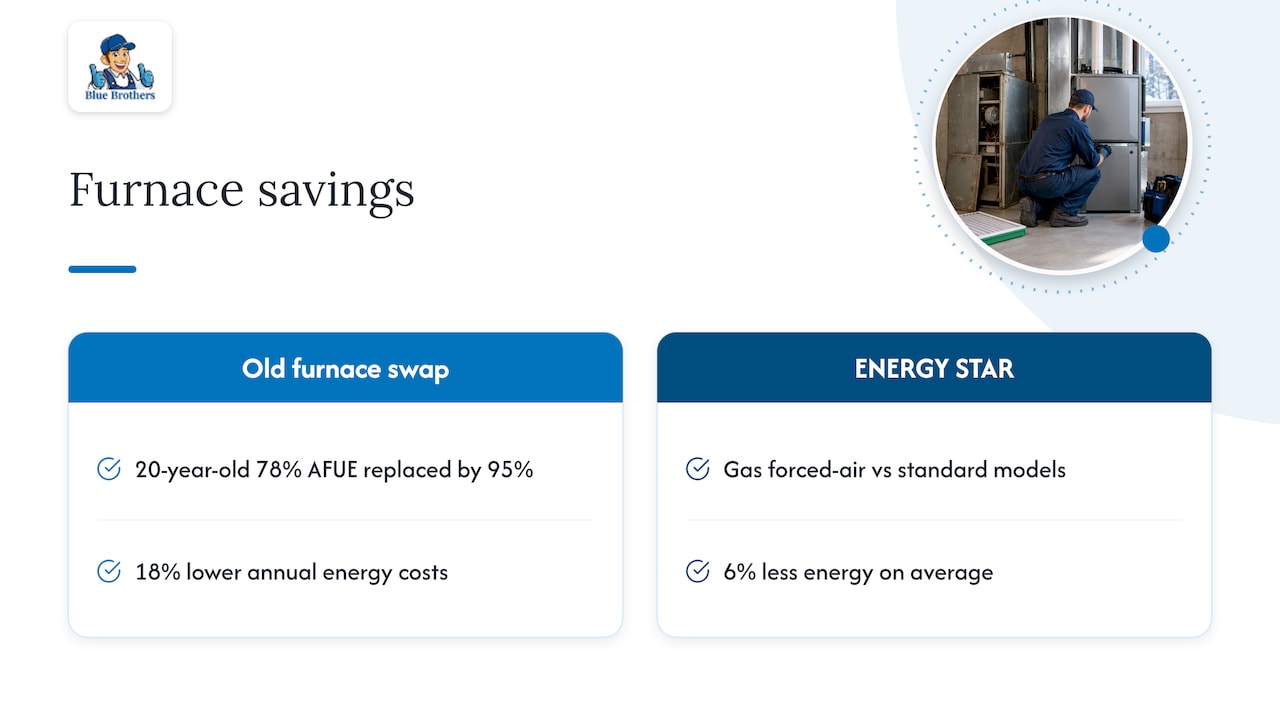
So your result depends on what you are replacing. The older and less efficient your current furnace, the bigger the jump.
More even comfort
Natural Resources Canada lists improved comfort among the advantages of ENERGY STAR furnaces, through more consistent temperatures and better air distribution. Models with two stages, three stages or modulating output go further. They run at lower output for longer periods instead of blasting on and off, which smooths out the hot-and-cold swings between rooms. If you are weighing that step, our guide to single versus two-stage furnaces explains how the choice plays out in Canadian homes.
Better filtration through longer run times
The same staged and modulating designs help your air. Because they deliver lower heat output over longer periods, more air passes through the filter, which supports better indoor air quality. That benefit depends on a clean, correctly rated filter. Our comparison of MERV 11 and MERV 13 filters helps you pick one your blower can handle.
Sealed combustion for airtight homes
High-efficiency units generally do not use room air for combustion. They bring outside air in through a pipe, which makes them safer in airtight houses than open-combustion furnaces, and it avoids pulling warm indoor air out of the house. Many can also be side-wall vented, so you may not need a chimney at all.
A smaller carbon footprint and resale appeal
Burning less gas for the same heat lowers your emissions. NRCan also lists increased resale value among the benefits of an ENERGY STAR furnace, which makes sense to buyers who read an energy label as lower running costs.
High-efficiency vs standard furnace at a glance
| Feature | High-efficiency (condensing) | Standard / older mid-efficiency |
|---|---|---|
| AFUE | 90% to 98% (ENERGY STAR: 95% or higher) | Lower; the NRCan example uses 78% |
| Combustion air | Typically from outside, sealed | Typically from the house |
| Venting | Plastic pipe (PVC or ABS), can be side-wall vented | Traditional chimney or metal flue |
| Condensate | Needs a drain | No condensate drain |
| Purchase price | Generally higher | Generally lower |
| Fuel savings | Greater, especially against old units | Baseline |
The facts in the table come from NRCan’s Heating with Gas guide and EnerGuide.
What the savings look like in a real house
Savings are a share of your own gas bill, so run your numbers rather than trusting a headline percentage. Here is a simple way to do it:
- Find your annual heating gas cost on last year’s bills. A rough way is to take the winter total and subtract the summer baseline.
- Check the AFUE on your current furnace’s rating plate or in its manual.
- Apply a realistic percentage. Moving from a 78% unit to a 95% unit is the 18% scenario NRCan describes. Moving from a newer standard furnace to ENERGY STAR is closer to 6% on average.
For example, a household spending $1,500 a year on heating gas that sees an 18% reduction would save about $270 a year. That is an illustration of the arithmetic, not a quote. Your result shifts with climate zone, house size, insulation and gas prices.
Some utilities add incentives on top. SaskEnergy has said participating customers with new high-efficiency furnaces can save up to $650 annually on natural gas and electricity costs under its heating affordability program. Programs change, so confirm current eligibility on the utility’s own page before you buy.
Upfront cost, rebates and payback
More efficient heating systems generally cost more to buy, though NRCan says the extra cost may be recouped quickly through fuel savings. How quickly depends on what you are replacing and what installing it involves. A high-efficiency unit needs a condensate drain and plastic venting, and swapping from a chimney-vented model can add work.
Rebates can narrow the gap. FortisBC, for example, offers rebates for eligible homes in Indigenous communities in climate zones 6, 7a, 7b and 8: $2,000 for gas furnaces at 95 to 96.9% AFUE and $3,000 for models at 97 to 99%. Check your own utility and provincial program pages before you sign a quote, because eligibility and amounts differ by province and change over time.
When you shop, NRCan recommends getting at least three quotes and asking each contractor to calculate your home’s heat requirements for proper sizing.
Sizing and installation decide the result
A furnace’s label efficiency is a best case. A professional guide for existing homes warns that improper installation can reduce performance by up to 30%, hitting savings, lifespan and comfort. The same guide cites a FortisBC study that found only 46% of important installation criteria met best practice. A great unit set up badly is a poor purchase.
What good installation looks like:
- A real heat-loss calculation. Do not accept “same size as the old one”. If you have added insulation, windows or air sealing since the last furnace went in, the old size may be too big.
- Correct venting and condensate drainage. Slopes, pipe runs and drain routing all matter on a condensing unit.
- Proper airflow. Ductwork and filter capacity have to match the new blower.
Oversizing is a common trap. NRCan notes that retrofits that cut heat loss can leave fuel-fired equipment oversized, causing short cycling. If short cycling cannot be controlled, it suggests considering a 2-stage, 3-stage or modulating furnace.
Living with a high-efficiency furnace
The day-to-day differences are small, and easy to manage once you know them.
Venting and condensate
Exhaust gases from a condensing furnace are too cool for a traditional chimney, so these units vent through PVC or ABS plastic pipe. They also produce condensate that has to drain away. Keep the intake and exhaust terminations clear of snow, ice and debris through winter, and have your technician check the drain line at each service.

Filters and airflow
Routine filter changes keep airflow steady and help avoid short cycling and comfort complaints. Federal housing guidance suggests checking furnace filters monthly and replacing them every three months, and keeping floor registers unobstructed. Our air filter replacement schedule walks through the monthly check.
Annual professional maintenance
NRCan advises regular professional maintenance, including yearly inspection of the heat exchanger and vent integrity. A clean burner, blower and cabinet help the furnace hold its rated performance. We explain how a clean furnace and duct system boost efficiency in a separate piece.
Ventilation still matters
A tighter, more efficient home needs a plan for fresh air. Health Canada ranks efficient ventilation as the second most important strategy for indoor air quality, after reducing pollution sources at the start. If your house has an HRV, keeping it clean is part of the same system.
Is a high-efficiency furnace right for you?
It tends to be an excellent fit when:
- your furnace is 15 to 20 years old or has an AFUE well below 90%;
- you heat with gas or propane through long, cold winters, where fuel savings add up;
- your home is airtight or recently upgraded and you want sealed combustion;
- you want steadier temperatures and are considering a staged or modulating model;
- you plan to stay in the home long enough to enjoy the savings.
If you are still deciding on fuel, our piece on when gas beats electric furnaces covers the Canadian trade-offs.
Perspective
We see furnaces from the inside every week, and the pattern is consistent: a high-efficiency unit earns its place when it is sized properly, installed carefully and kept clean.
The rating on the box is the starting point. What reaches your living room depends on the venting, the condensate drain, the filter and the duct system that carries the heat. A new furnace pushing air through clogged filters or neglected coils cannot deliver the comfort it was designed for.
That is why we treat the furnace, the ducts and the ventilation equipment as one system. We install furnaces, and we clean furnaces, ducts, HRVs and air conditioning coils, so the whole path from burner to register is ready for winter. If you are upgrading, plan the maintenance on day one. A new high-efficiency furnace is a strong investment, and it is worth protecting.
Jayce
Keep your new furnace performing
Whether you are installing a high-efficiency furnace or already have one, we can help it deliver. Our furnace cleaning service is published at $50 to $300 one-off, depending on the home and system. If your ducts are part of the picture, air duct cleaning runs $400 to $800 one-off. Our technicians serve homes in British Columbia, Alberta and Saskatchewan, with round-the-clock support and emergency service available.
To book a visit or ask about a furnace installation, start on our residential services page.
FAQ
What is the biggest benefit of a high-efficiency furnace?
Lower fuel use is the headline benefit. NRCan’s example of replacing a 20-year-old 78% furnace with a 95% unit shows an 18% cut in annual energy costs. Comfort and sealed combustion are strong secondary gains.
What size furnace does my house need?
Square footage alone does not decide it. Ask your contractor to calculate your home’s heat requirements, and get at least three quotes, as NRCan advises. Insulation, windows, air tightness and climate all change the answer, and past upgrades can mean you need less capacity than the old furnace had.
What do homeowners most often have to adjust to with a high-efficiency furnace?
Most adjustments are about setup and upkeep. These units vent through plastic pipe, need a condensate drain, and depend on regular filter changes and annual professional inspections. Once those are routine, day-to-day living with the furnace is simple.
Is a high-efficiency furnace worth the higher price?
For many homes it is, particularly when replacing an old unit and when rebates apply. NRCan notes the added cost may be quickly recouped through fuel savings. Compare quotes, check your utility’s incentives, and weigh how long you plan to stay in the home.
Sources
- Furnaces, EnerGuide (Natural Resources Canada)
- Heating with Gas (Natural Resources Canada)
- Residential furnaces, ENERGY STAR (Natural Resources Canada)
- SaskEnergy heating affordability program
- FortisBC energy-efficiency rebates for homes in Indigenous communities
- Installation guide for existing furnaces
- Keeping the Heat In, Section 9 (Natural Resources Canada)
- Occupant Handbook, Indoor air quality (Canada.ca)
- Ventilation and the indoor environment (Health Canada)