Most homes do fine with a MERV 11 filter, and upgrading to MERV 13 only pays off in specific situations like wildfire smoke season, severe allergies, or a household member with a compromised immune system. Before you buy a MERV 13, check your filter slot depth and confirm your blower can handle the added resistance. A quick static pressure check settles the question either way.
TL;DR:
- MERV 13 filters provide better capture of smoke, bacteria, and virus-sized particles but increase resistance, risking reduced airflow if the system isn’t compatible.
- Check if your filter slot is at least 4 inches deep and ensure your blower motor can handle higher resistance before installing MERV 13 to avoid damaging your system.
- Homeowners with older HVAC systems or 1-inch filter slots should stick with MERV 11 or upgrade to a deep-media filter cabinet to manage resistance safely.
- Replacing MERV 13 filters every 1 to 2 months can reduce the benefits of higher filtration due to clogging and increased pressure drop.
- A duct and coil cleaning service can improve airflow and system capacity, making higher-rated filters more effective and safer to use.
Table of Contents
- MERV 11 vs MERV 13 at a glance
- What does MERV actually measure?
- How do you know if your HVAC can handle MERV 13?
- How often do you need to replace each filter?
- Which rating fits your specific situation?
- Why duct and coil condition matters more than filter choice alone
- A practical next step before you upgrade your filter
- Where this guidance comes from
- Sources
- FAQ
MERV 11 vs MERV 13 at a glance
The two ratings sit close together on the MERV scale, but that gap matters more than the numbers suggest. MERV 13 catches finer particles. MERV 11 breathes easier through your ductwork. Here’s how they stack up:
| Factor | MERV 11 | MERV 13 |
|---|---|---|
| Particle capture | Pollen, dust mites, pet dander, mould spores | All of MERV 11, plus smoke, fine bacteria, some viral carriers |
| Airflow resistance | Low to moderate | Moderate to high (especially in 1" filters) |
| Replacement frequency | Every 2 to 3 months | Every 1 to 2 months |
| Cost range | Lower per filter | Higher per filter, more frequent swaps |
| Best for | Typical households, pets, seasonal allergies | Wildfire smoke, severe allergies, immunocompromised residents |
A few things jump out once you look past the chart. MERV 11 handles the everyday stuff, pet fur, pollen, the dust that collects on your windowsill, without taxing a standard residential blower. MERV 13 goes after particles small enough to carry smoke and some bacteria, but that extra capture comes from denser filter media, which is exactly what raises resistance. If your system wasn’t built for that resistance, you’ll feel it in weaker airflow at the vents long before you notice cleaner air.
What does MERV actually measure?
MERV stands for minimum efficiency reporting value, a rating scale that grades how well a filter captures particles across three size bands: 0.3 to 1 micron, 1 to 3 microns, and 3 to 10 microns. The scale runs from 1 to 20, and it was built to give homeowners and HVAC technicians a common language instead of vague marketing claims like “premium filtration.”
The size bands are where MERV 11 and MERV 13 actually diverge. In the middle and larger bands, both ratings perform similarly well against dust, pollen, and pet dander. The real split happens in the smallest band, 0.3 to 1 micron, where smoke particles, some bacteria, and viral carriers live.
MERV 13 improves minimum capture in that smallest band compared with MERV 11, which is why it’s the rating Carrier points to for households dealing with wildfire smoke or airborne illness concerns. MERV 11 still does solid work in the 1 to 10 micron range, catching most household allergens, but it wasn’t engineered to chase down the ultra-fine stuff the way MERV 13 was.
- Pet dander and pollen: both ratings perform well
- Mould spores and dust mite debris: both ratings perform well, MERV 13 slightly better
- Smoke particles and fine bacteria: MERV 13 has a clear advantage
How do you know if your HVAC can handle MERV 13?
This is the step most homeowners skip, and it’s the one that causes the most callbacks to HVAC companies. A filter that’s too restrictive for your system doesn’t just reduce airflow, it can freeze your evaporator coil or shorten the life of your blower motor.
- Check your filter slot depth. A 1-inch slot means any MERV 13 filter you install will likely run higher resistance than your system expects. A 4-inch slot has more surface area, which lowers resistance even at MERV 13.
- Find your owner’s manual and look for a maximum MERV rating. Manufacturers often list this, and ignoring it can void warranty coverage on some units.
- Note your blower motor type. A PSC (permanent split capacitor) motor runs at fixed speed and struggles with added resistance. An ECM (electronically commutated motor) automatically adjusts to maintain airflow, which makes it far more forgiving of denser filters.
- Watch for existing airflow symptoms. Weak airflow at distant vents or a furnace that runs longer than usual are signs your system is already working near its limit.
- Book a static pressure test if you’re not sure. A technician uses a manometer to measure total external static pressure against your equipment’s rated maximum, which settles the compatibility question with a number instead of a guess.
If you’ve got a 4-inch slot, an ECM blower, and static pressure comfortably below your system’s maximum, MERV 13 is generally feasible. If any of those are missing, stick with MERV 11 or ask about a deep-media filter cabinet retrofit.
Pro Tip: If a technician measures your static pressure, ask for the actual number in inches of water column, not just a pass or fail. That figure tells you how much headroom you have if you ever want to upgrade filtration later.
A 1-inch MERV 13 filter can push initial pressure drop high enough to stress a standard blower, which is why Bryant and other manufacturers often recommend a 4-inch media filter for anyone set on MERV 13 performance. More surface area does the same filtration job with less resistance per square inch.
How often do you need to replace each filter?
Replacement frequency is where the MERV 13 premium actually shows up in your budget, not just at checkout. Denser media captures more, but it also clogs faster, and a clogged filter restricts airflow regardless of its rating.
- MERV 11 filters typically last 2 to 3 months under normal household conditions
- MERV 13 filters usually need replacement every 1 to 2 months, faster if you have pets, smokers, or heavy dust
- Homes near wildfire-prone regions or construction zones should check monthly regardless of rating
Think about lifetime cost, not just the sticker price at the hardware store. A MERV 13 filter often costs more upfront, and if you’re replacing it twice as often as a MERV 11, that gap adds up over a year. Here’s the part that trips people up: a clean MERV 11 changed on schedule usually filters better than a MERV 13 that’s been sitting past its replacement date. A clogged high-MERV filter restricts airflow just as much as it filters particles, sometimes more.
Which rating fits your specific situation?
Your household’s actual needs matter more than chasing the highest number on the shelf. Match your situation to the guidance below before you commit to either rating.
- Pets or seasonal allergies: MERV 11 handles dander and pollen well without straining a standard system.
- Severe asthma, immunocompromised residents, or wildfire smoke exposure: MERV 13 is worth pursuing, but only after confirming system compatibility.
- Unsure about your system, or living in an older home with a 1-inch slot: Choose MERV 11 and add a standalone HEPA unit in bedrooms or high-use rooms for extra protection.
- Anyone considering an upgrade: Confirm slot depth, run a static pressure test, and make sure ducts and coils are clean before adding resistance.
| Scenario | Recommended filter | Why |
|---|---|---|
| Pets, mild allergies | MERV 11 | Balances filtration and airflow |
| Wildfire smoke, compatible system | MERV 13 | Better capture in the fine-particle range |
| Immunocompromised household, older HVAC | MERV 11 plus room HEPA | Avoids straining an incompatible system |
— Jayce
Why duct and coil condition matters more than filter choice alone
A filter only works as well as the system pushing air through it. Dirty ducts and a coated evaporator coil already increase pressure drop before you even add a higher-MERV filter, which means the resistance problems homeowners blame on MERV 13 sometimes started with a duct system that needed attention years earlier.
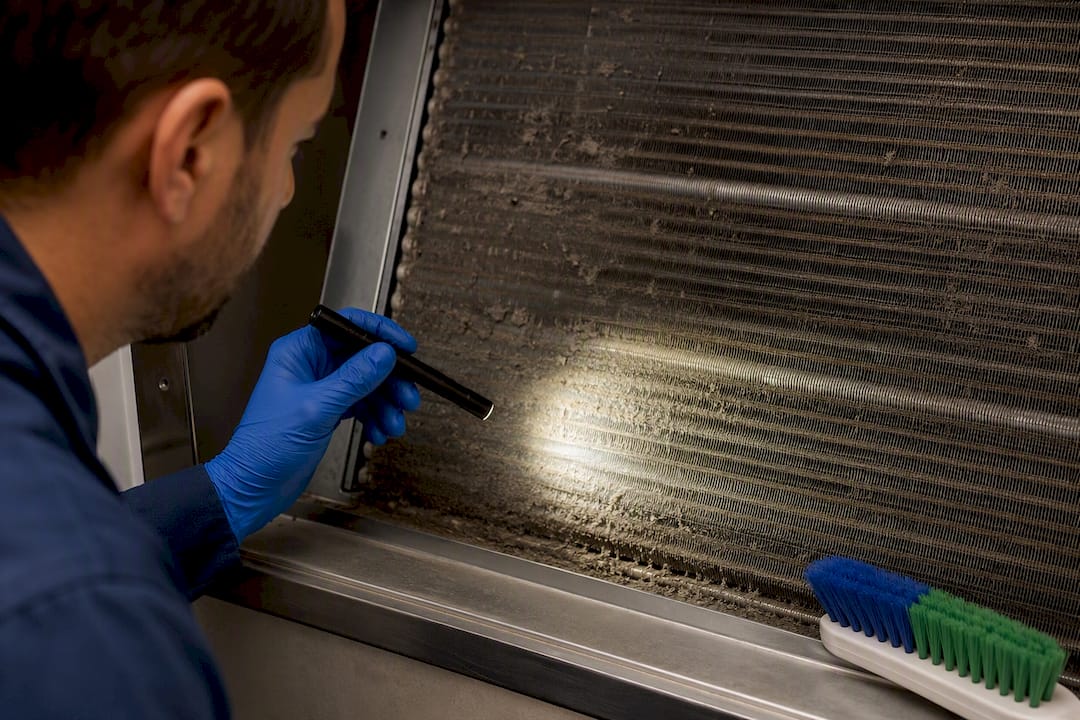
When our technicians inspect a system before a filter upgrade, we’re checking for exactly that: buildup on coils, restriction points in the ductwork, and airflow that’s already compromised. Clean ducts and a serviced coil give a higher-MERV filter room to work without pushing your blower past its limits. Skipping that step is how a reasonable filter upgrade turns into a service call three weeks later.
A practical next step before you upgrade your filter
If you’re leaning toward MERV 13 but aren’t sure your system can handle it, the smartest move is a diagnostic, not a guess at the hardware store. Bluebrothers offers the groundwork that makes a higher-efficiency filter actually work as intended: duct cleaning to clear existing restriction, furnace and coil cleaning to remove buildup that’s already adding to your static pressure, and HRV cleaning for homes running heat-recovery ventilation alongside their furnace.
Book a diagnostic visit if your filter slot is 1 inch, your system is older than ten years, or you’ve noticed weaker airflow since your last filter change. Ordering a new filter yourself makes sense once you know your system can take the added resistance. Bluebrothers technicians use industry-standard equipment to check your ducts and coils, so the filter you choose actually performs the way the rating promises instead of fighting a system that’s already restricted. Get a quote through Bluebrothers and find out what your system can safely handle before you spend money on the wrong filter.
Where this guidance comes from
- Carrier on how MERV ratings translate to particle capture
- Trane on why MERV 11 suits most residential systems
- Bryant on filter depth and pressure drop
- HVACDatabase on static pressure testing before upgrades
Sources
- What Is a MERV Rating? | Air filter ratings explained — Carrier
- HVAC Air Filters: MERV 8 vs MERV 11 vs MERV 13 — Trane
- MERV rating — Bryant
- MERV 11 vs MERV 13: Which filter protects your home best? — HVACDatabase
FAQ
Is MERV 13 too high for a home?
Not inherently, but it depends entirely on your system. A furnace with a 1-inch filter slot and a standard PSC blower motor can struggle with MERV 13’s added resistance, while a system with a 4-inch slot or an ECM blower typically handles it fine.
Is MERV 13 that much better than MERV 11?
MERV 13 offers a real advantage in the smallest particle band, 0.3 to 1 micron, where smoke and some bacteria-sized particles live. For everyday allergens like pollen and pet dander, the two ratings perform similarly, and MERV 11 remains the recommended balance for most households.
Is a MERV 11 filter too much for a typical home?
No, MERV 11 is generally considered the practical middle ground for residential use, filtering out common allergens without pushing airflow resistance too high for a standard system. It’s rarely “too much” and is the more common recommendation over lower ratings like MERV 8 for households with pets or allergies.
Can my HVAC handle a MERV 13 filter?
The only way to know for certain is to check your filter slot depth, blower motor type, and ideally have a technician run a static pressure test with a manometer. If your system lacks a 4-inch slot or an ECM blower, a deep-media filter cabinet retrofit is often a safer path to MERV 13 performance.
Does Bluebrothers help with filter upgrades?
Bluebrothers doesn’t sell filters, but its duct, furnace, and coil cleaning services address the airflow restriction that determines whether a MERV 13 upgrade will succeed. Pricing for duct cleaning and furnace cleaning is listed on each service page.