A commercial kitchen is out of balance when the air its exhaust fans remove is not matched by air coming back in. The kitchen then runs at negative pressure, the hood loses capture, smoke and odour spread, and doors fight you. The fix is to find where the air is short, restore make-up air and a clean exhaust path, and have the system measured by a qualified professional. We keep the exhaust side clean and NFPA 96 compliant, so the readings you take reflect the system as designed.
TL;DR
- Imbalance means exhaust volume exceeds replacement air. Building pressure goes too negative and the hood may fail to capture the cooking plume.
- Common signs: hard-to-open doors, smoke or odour lingering, cold drafts, backdrafting appliances and a hood that spills at the edges.
- Typical causes are exhaust fans added without matching supply, failed make-up air units, slipping belts, plugged filters and bypassed interlocks.
- In Canada, make-up air is a code matter. Rules and plan reviews differ by city, so design changes go through a registered engineer.
- A clean hood, filters and duct keep exhaust performance honest. Our hood cleaning follows NFPA 96.
Table of Contents
- What airflow imbalance actually is
- Signs your kitchen is out of balance
- What causes the imbalance
- How the effects show up in the kitchen
- How airflow is measured
- What Canadian codes require
- A practical sequence for restoring balance
- Why a clean hood and duct matter to balance
- Get the exhaust side ready
- FAQ
- Sources
What airflow imbalance actually is
The principle is simple: air out must equal air in. A design guide from the California Energy Wise programme gives an example. If the mechanical design calls for 8,000 cfm of exhaust but only 6,000 cfm of outdoor air can enter, the exhaust fan creates more suction in a failed attempt to pull more air through the hood. The fan cannot move its rated volume against that suction, so the hood captures less than it should.
The National Building Code of Canada recognizes the risk. The intent behind its make-up air requirement is to limit the chance that exhaust systems run without replacement air, which could depressurize occupied space, reduce exhaust air volume and allow combustion products from fuel-fired appliances to enter the building. That makes imbalance a health and fire-safety issue, not only a comfort one.
Imbalance has two directions:
- Too little supply. The common case. The kitchen goes strongly negative.
- Poorly placed supply. Enough air enters, but at high velocity near the cookline. The guide’s primary recommendation is to minimize air velocity as make-up air is introduced near the hood, because dumping a large volume in front of the cookline disturbs capture and makes staff uncomfortable.
Some negative pressure is intended. Kitchens are normally kept slightly negative to the dining room so odours stay contained. The goal is controlled, modest negative pressure, not strong suction.
Signs your kitchen is out of balance
The symptoms are consistent across Canadian and US guidance. Not all of them point to the same cause, so treat them as a prompt to test, not a diagnosis.
| What you notice | What it can mean |
|---|---|
| Exterior doors hard to open, or slamming shut | Exhaust is removing more air than the supply returns |
| Smoke or grease vapour escaping at the hood edges | Reduced exhaust flow, or drafts or supply air disturbing the capture zone |
| Kitchen odours in the dining room | Air being pulled the wrong way, or poor hood containment |
| Cold drafts at doors and windows in winter | Replacement air entering through leaks instead of a tempered supply |
| Gas appliances burning poorly, or flue spillage | Negative pressure interfering with combustion air |
| Whistling at doors or uneven air at diffusers | High velocity infiltration or unbalanced distribution |
One Canadian case reported by a mechanical firm involved a restaurant whose make-up air delivered roughly 40% of the exhaust airflow. The result was severe negative pressure, difficult doors, cold drafts, poor hood capture and smoke and odours drawn into dining areas. Not every kitchen shows that many symptoms, but the pattern is a useful reference.
Backdrafting appliances deserve particular attention. If you smell combustion products, feel unwell, or see flue gases spilling, stop using the affected gas appliances and call your gas utility or a licensed gas fitter. Call emergency services if anyone has symptoms of carbon monoxide exposure.
What causes the imbalance
Most imbalances come from a short list of on-site problems. Mechanical references name these repeatedly:
- Exhaust added without supply. A new char-broiler or a larger fan goes in and nobody adjusts the make-up side.
- A make-up air unit that is off or failing. In winter, staff sometimes switch it off because it blows cold air, which often means its burner has failed.
- Mechanical wear. Failed motors, slipping belts or clogged filters cut the volume the unit can deliver.
- Bypassed or failed interlocks. The exhaust runs but the supply does not start with it.
- Dampers in the wrong position. Outdoor-air dampers closed or reset during repairs, or relief dampers stuck shut.
- Intake filters loaded with grease and debris. Plugged supply filters starve the unit.
For Canadian buildings the climate adds a layer. Large kitchen exhaust in Canadian climates often needs dedicated make-up air units, and those units must be heated. Without tempered supply, replacement air comes in through doors, windows and envelope leaks, which in winter can mean cold drafts and frozen pipes near the envelope.
How the effects show up in the kitchen
When replacement air is short, the whole kitchen shifts. Air is drawn from the dining room, appliances can spill flue gases, and drafts disturb the airflow at the hood face so smoke escapes at the edges. Reduced exhaust volume also means the hood has less ability to carry heat and grease-laden vapour away from the cooking surface.
Over-supply is not a cure. A strong or badly aimed supply jet near the hood can push the plume out of the capture zone. That is why design guidance looks at the number of outlets and the direction, quantity and velocity of the air. New Westminster’s Kitchen Ventilation Guidelines state that make-up air discharge should be designed so that airflow will not interfere with the hood’s ability to capture and contain grease-laden cooking vapours.
How airflow is measured
Balancing is measurement work. The US National Institute of Standards and Technology describes testing, adjusting and balancing (TAB) as the systematic process of checking and adjusting building HVAC systems to meet design performance requirements, and notes it requires extensive training and experience.
The basics of the measurement are straightforward:
- Air speed is measured directly with hot-wire or vane anemometers, or indirectly with a pitot tube that reads velocity pressure.
- Airflow rate is the average air speed in a duct multiplied by the duct area (NISTIR 5329).
- Exhaust and supply are compared, then dampers, fan speeds and interlocks are adjusted until the two match the design.
Two cautions apply. First, airflow readings alone do not prove hood performance, since capture also depends on hood geometry, cooking activity, cross-drafts and filter condition. Second, a hood that spills smoke may need a separate capture and containment test by qualified parties. Commissioning work follows a staged sequence, and a five-phase commissioning process shows how inspection and testing steps are organized so problems are caught before handover.
What Canadian codes require
Rules differ by city, but the thread is consistent: make-up air must exist, be interlocked and be designed by a professional.
British Columbia. In Nanaimo, new commercial cooking exhaust and air systems, and upgrades to existing ones, must be designed by a Professional Engineer registered in BC, with sealed designs and Schedule B Letters of Assurance at building permit application. Make-up air must be tempered, filtered, mechanically provided and interlocked with the exhaust devices it serves. Nanaimo also requires control sequences to be shown on the plans.
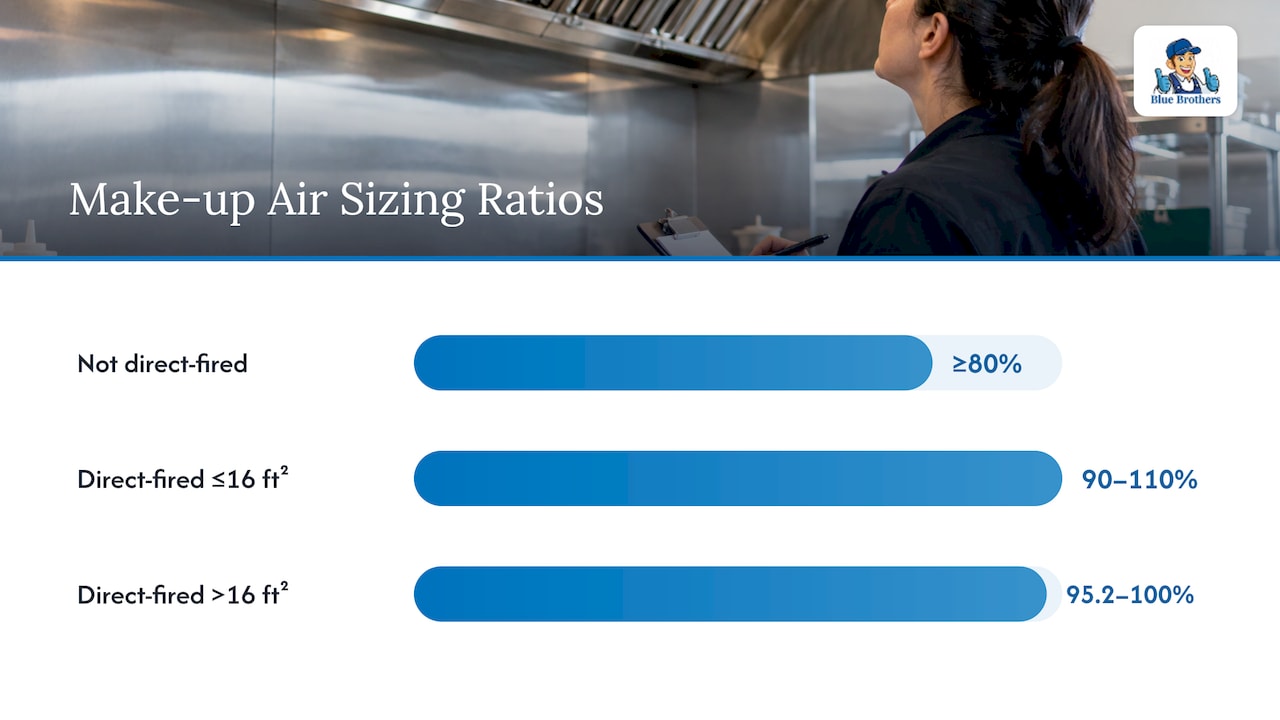
New Westminster’s guidelines set sizing ratios for the make-up air supply fan against the kitchen exhaust fan:
| Make-up air type | Supply as share of exhaust cfm |
|---|---|
| Not direct-fired | At least 80% |
| Direct-fired, openings to public area 16 ft² or less | 90% to 110% |
| Direct-fired, openings over 16 ft² | 95.2% to 100% |
The same document sets exhaust duct velocity between 500 fpm and 1800 fpm, with limited allowances for existing ducts.
Saskatchewan. Saskatoon requires a building and development permit for new cooking equipment and ventilation, or alterations involving a new exhaust hood, a make-up air unit or equipment that does not fit under the existing hood. A mechanical engineer must confirm the design meets NFPA 96, then provide a Letter of Assurance that the installed system conforms, and city inspectors audit it during scheduled site visits.
Building-wide. ASHRAE Standard 62.1-2016 Section 5.9.2 requires total building outdoor air intake to equal or exceed total building exhaust under all load conditions, with stated exceptions.
These steps belong to your municipality, your engineer and your inspector. Check your own city’s current requirements before changing any fan, hood or make-up air unit.
A practical sequence for restoring balance
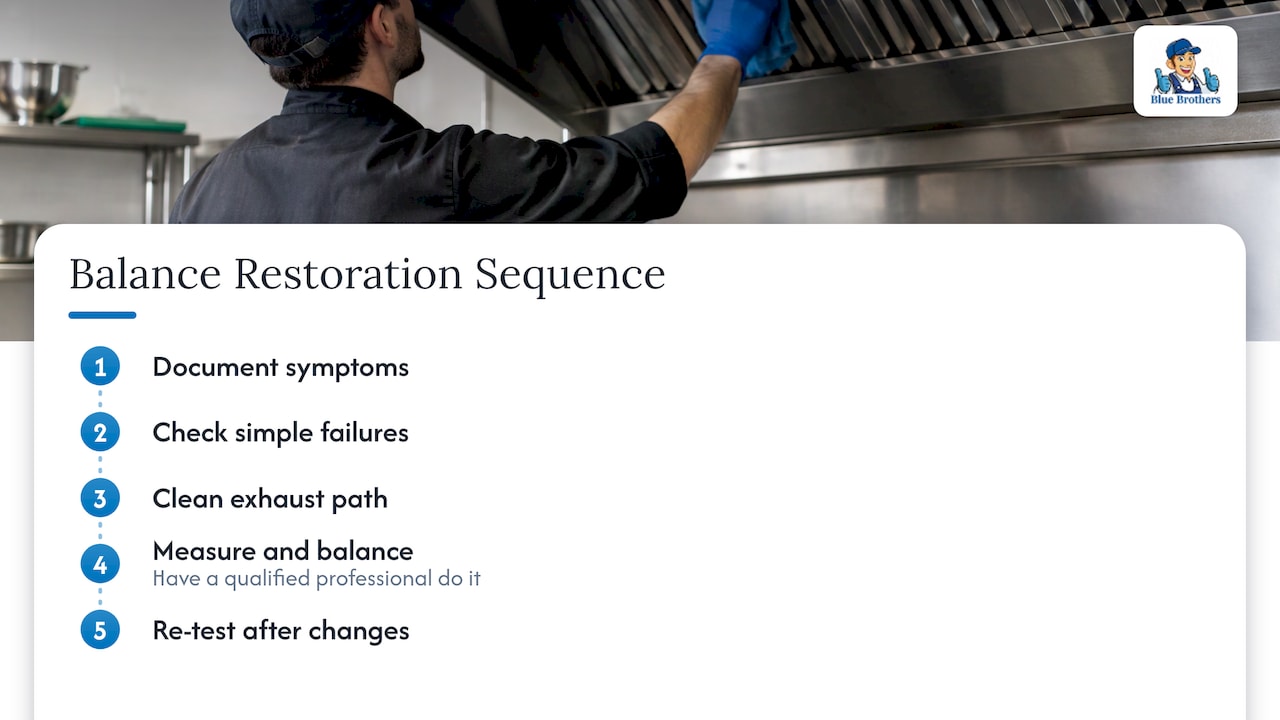
1. Document the symptoms
Note which doors are hard to open, when smoke escapes (which appliances, which hours), and whether it changes with the season. Seasonal change often points at a make-up air unit that is switched off in winter.
2. Check the simple failures first
Is the make-up air unit running whenever the exhaust is? Are belts intact and filters clean? Is the interlock still wired? These are the repeat offenders listed above. Electrical and gas work stays with licensed trades.
3. Clean the exhaust path
Grease on hood filters, in the plenum and in the duct changes how the exhaust side behaves, and it is a fire hazard in its own right. Cleaning to NFPA 96 gives the balancer a clean baseline, so a low reading points to a real airflow problem and not to a loaded system. This is where we come in: our crews clean grease exhaust and hood systems to NFPA 96.
4. Have a qualified professional measure and balance
A TAB specialist or mechanical engineer measures exhaust and supply, compares them with the design, and adjusts. If equipment has changed since the original design, the engineer recalculates required make-up air.
5. Re-test after any change
Every fan, damper or hood change shifts the balance. Re-check pressure, door operation and hood capture after the work, and keep the records for your inspector.
Why a clean hood and duct matter to balance
Balance work assumes the system is in the condition its designer expected. Exhaust components loaded with grease are not. Filters, plenums and duct runs are where the air has to pass, and a plugged filter is an established cause of lost flow on the supply side. We apply the same logic to the exhaust side, which is why our hood and duct service is built around NFPA 96 and not around appearances.
Our view
Kitchen operators often meet airflow trouble as a nuisance: a heavy door, a smoky hood, a cold corner. The better way to see it is as a safety signal. Exhaust that cannot move its rated volume is also exhaust that cannot carry grease vapour away as designed.
We see a clean exhaust system as the foundation for every other fix. Balancing, make-up air upgrades and engineering reviews all work better when the hood, filters and duct are clean and the system is documented. Our certified technicians clean to NFPA 96, we publish clear pricing with no hidden fees, and we offer unlimited hood cleaning packages and round-the-clock support, including emergency service, so cleaning keeps pace with your cooking volume.
If your kitchen is showing the signs in this article, start with a clean exhaust path and then bring in the engineer who will balance it. Both steps matter, and the first one we handle for you.
Jayce
Get the exhaust side ready
Our grease exhaust and hood cleaning service covers commercial kitchen hoods and exhaust systems to NFPA 96 standards, for restaurants, food plants and commercial kitchens in British Columbia, Alberta and Saskatchewan. Published pricing is $400-$800 CAD per one-off job, and we offer unlimited hood cleaning packages for kitchens that need a regular schedule. Support is round the clock, emergency calls included. In BC, see our hood cleaning in British Columbia page.
Book a cleaning before your balancing visit, so the engineer measures a clean system. Start at bluebrothers.ca.
FAQ
Is some negative pressure in a commercial kitchen normal?
Yes. Kitchens are typically kept slightly negative relative to the dining area so odours are contained. The problem is excessive depressurization, which affects door operation, comfort and combustion appliances.
Why are my kitchen doors hard to open?
The most likely reason is that exhaust is removing more air than the building replaces, so the kitchen sits at strong negative pressure. Check whether the make-up air unit is running with the exhaust, then ask a qualified balancer to measure both sides.
Who is allowed to redesign my kitchen’s make-up air?
In Canadian cities such as Nanaimo and Saskatoon, new or upgraded systems need a registered professional or mechanical engineer, and designs must meet NFPA 96. Confirm the current local permit process with your building department before work starts.
Can a dirty hood cause airflow problems?
Grease-loaded filters and ducts add resistance and are a fire risk, so keeping them clean is part of maintaining design performance. We clean hood and exhaust systems to NFPA 96 across BC, Alberta and Saskatchewan.
Sources
- CKV Design Guide 3: Optimizing Make-Up Air
- NBC intent 6.2.3.11.(2), National Research Council of Canada
- Commercial Cooking Equipment Exhaust & Air Systems, City of Nanaimo
- Kitchen Ventilation Guidelines, City of New Westminster
- Commercial Cooking and Ventilation FAQ, City of Saskatoon
- Manual for ventilation assessment in mechanically ventilated commercial buildings, NIST
- ANSI/ASHRAE Standard 62.1-2016 sample
- Make-Up Air and Exhaust Balance
- Exhaust system design for commercial buildings
- When Kitchen Exhaust Drives Customers Away
- Designing Ventilation Systems for Commercial Kitchens