You pass a kitchen hood inspection by showing three things: the hood, filters, ducts and fan are clean of grease, the fire suppression system has been serviced on schedule by a qualified company, and the paperwork proving both is on site. Most failures come from one of those three being out of date, not from anything exotic. This guide covers the schedules set by Canadian authorities, what to fix before the inspector arrives, the records to keep, and what happens if you fail.
TL;DR
- Grease must be removed from the whole exhaust system, not just the visible hood, and cleaned by a trained, certified company acceptable to your local authority.
- Suppression systems are typically serviced and tagged every six months. Cleaning frequency depends on how you cook, from monthly (solid fuel) to annually (low volume) in Saskatchewan.
- Keep your cleaning certificate, the contractor’s kitchen label and the last two years of reports where the inspector can reach them.
- Check clearances, filters, nozzle caps and the manual pull station yourself before inspection day.
- Rules differ by province and city, so confirm the details with your local fire department.
Table of Contents
- What a hood inspection actually covers
- How often the system must be cleaned and serviced
- Who is allowed to do the work
- The pre-inspection checklist
- What your cleaning crew should and should not do
- Records to have ready
- Why hood inspections fail, and the fix
- If you fail: what happens next
- A note from our crew
- Get the cleaning done before the inspector arrives
- FAQ
- Sources
What a hood inspection actually covers
A hood inspection is a fire-safety check. It looks at the hood, grease filters, ductwork and exhaust fan, and at the fire suppression system above your cooking line. The question is whether grease could ignite and spread, and whether the suppression system would work if it did.
That is different from a restaurant health inspection, which is generally concerned with food handling, temperatures, sanitation and pests. The two can overlap: a greasy hood can be flagged by both, and some health inspection checklists ask whether your hood cleaning is on schedule. But they are separate visits with separate standards. In Canada, the fire side usually refers to NFPA 96, which provincial and municipal fire codes adopt. The Government of Saskatchewan, for one, points commercial cooking operations to the fire protection standard, and the City of Weyburn requires installation and maintenance in conformance with NFPA 96.
Your local fire prevention office decides how the code applies to you. A quick call before inspection day is always worth it.
How often the system must be cleaned and serviced
Two clocks run at once: the cleaning clock for the exhaust system, and the service clock for the suppression system.
Cleaning intervals
The interval depends on what you cook. Saskatchewan’s guidance requires a qualified company or individual to inspect all components, ducting and fans monthly for solid-fuel cooking, quarterly for high-volume cooking, semiannually for moderate-volume cooking and annually for low-volume cooking.
In British Columbia, the City of Vancouver says exhaust systems should be cleaned at intervals not greater than 12 months, and not greater than 3 months for deep fat cooking, char broiling or similar operations. The same document says hoods, ducts and filters that collect combustible deposits must be inspected at intervals not greater than 7 days, and cleaned if the buildup creates a fire hazard. That weekly look is your job, not your contractor’s.
| Cooking type | Saskatchewan inspection and cleaning schedule | Vancouver cleaning interval |
|---|---|---|
| Solid-fuel cooking | Monthly | Not stated separately in the source |
| High-volume, deep fat, char broiling | Quarterly | No more than 3 months |
| Moderate volume | Semiannually | No more than 12 months |
| Low volume | Annually | No more than 12 months |
If you fry or grill heavily, plan for quarterly cleaning at minimum, and expect an inspector to look at the actual grease level, not only the date on a sticker.
Suppression system service
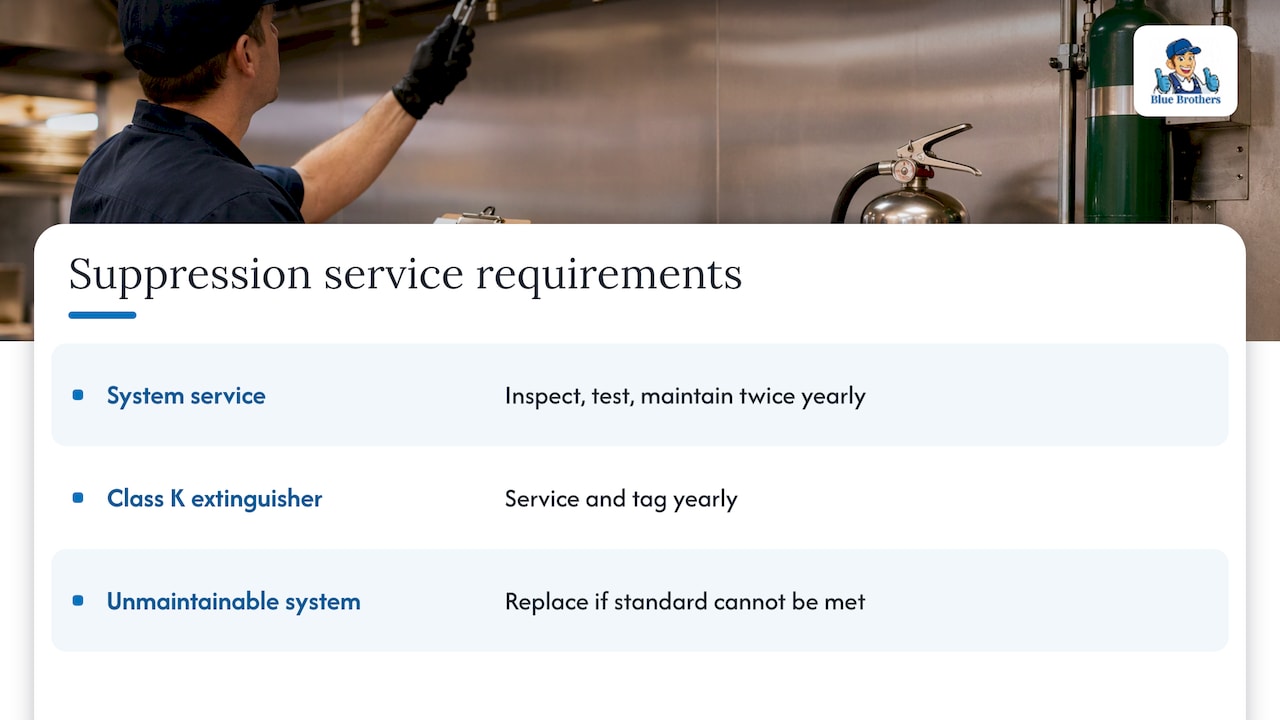
The suppression system runs on a six-month cycle across Canada. Saskatchewan states that fire protection systems in commercial cooking operations need inspection, testing and maintenance at least twice a year. The City of Kitchener’s 2026 form says hoods and extinguishing systems are cleaned, maintained and tested every 6 months, and the City of Calgary says these systems must be maintained, typically every six months.
In Dawson Creek, BC, the fire suppression system must be serviced and tagged at least every 6 months, and a Class K extinguisher serviced and tagged yearly. Saskatchewan adds that if a system cannot be maintained to the manufacturer’s instructions or the standard, it must be replaced.
Who is allowed to do the work
Inspectors do not accept a general handyman’s signature. The qualification rules vary by province:
- British Columbia: the City of Vancouver says only service agencies may test or inspect a commercial kitchen exhaust system, and a service agent means a Registered Fire Protection Technician certified by ASTTBC. To hold the commercial kitchen exhaust endorsement, ASTTBC requires a recognized course or challenge exam plus a supervised log of at least 25 systems.
- Alberta: Municipal Affairs says only persons with an approved manufacturer’s certificate of training may test or maintain special fire suppression systems.
- Saskatchewan: grease buildup calls for the complete system to be cleaned by a properly trained, qualified and certified company or person acceptable to the authority having jurisdiction.
When you hire, ask the company which certifications its technicians hold for your province and confirm they match what your fire department accepts.
The pre-inspection checklist
Walk your kitchen with this list a week before the visit, then again the day before.
Clean to bare metal, all the way up
The City of North Bay states that the entire exhaust hood system is to be cleaned of grease and oil residues to bare metal at the intervals in NFPA 96. That includes the plenum, the duct run and the rooftop fan. A shiny hood with a greasy duct still fails.
Filters should be in place, the right size, with all baffles present and undamaged. Replace bent or missing ones.
Confirm the suppression system is intact
- The service tag is current, within six months.
- Nozzle blow-off caps are intact and undamaged. The City of Weyburn lists this as a check, along with appliances being aligned with the nozzles after cleaning.
- The manual pull station is visible and accessible, with its signage posted.
- If you moved a fryer or range during cleaning, make sure it sits back under its nozzle coverage.
- The Class K extinguisher is within 30 feet of the cooking area, mounted visibly and tagged within the year.
Check the shutdowns
The City of Oshawa states that operating an extinguishing system must automatically shut off fuel and electrical power to the equipment it protects, and that the system must be connected to the building fire alarm where one exists. Inspectors may test this. If a cleaning crew has disturbed gas valves or switches, confirm everything is back in its normal state.
Look at clearances and coverage
Hoods, grease removal devices, fans and ducts need at least 457 mm (18 in.) of clearance from combustible material, with exceptions for listed equipment. The hood also has to cover every appliance so it captures grease vapours properly. If you added a unit under the hood, expect a question.
What your cleaning crew should and should not do
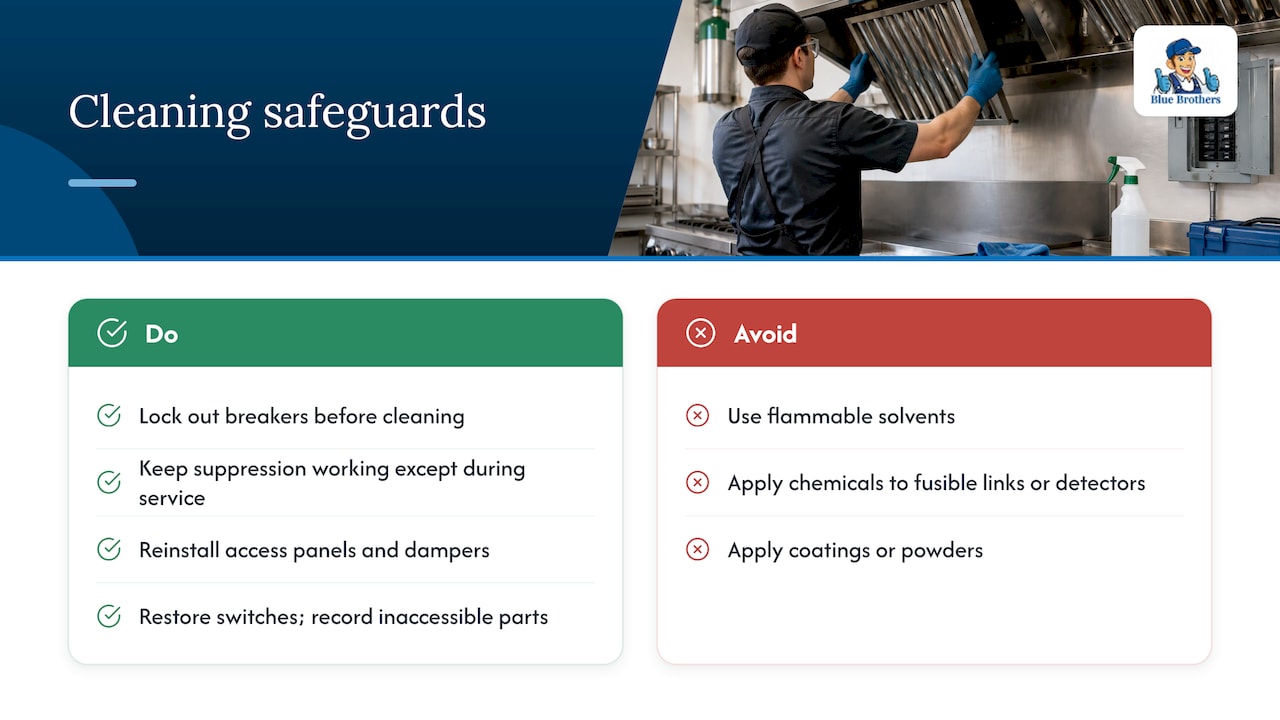
A good cleaning sets you up for the suppression inspection, and a careless one can break it. Saskatchewan’s guidance says that before cleaning, circuit breakers on the main panel should be locked out, and the suppression system should stay in working order during cleaning except when it is being serviced. It also says no flammable solvents, and no chemicals on fusible links or other detection devices. After cleaning, no coatings or powders should be applied, access panels and dampers must be reinstalled, and switches and components returned to normal.
If your contractor cannot reach part of the system, such as a duct with no access panel, that should be recorded, not ignored. Which brings us to paperwork.
Records to have ready
Inspectors read paper before they climb a ladder. Keep a binder or digital folder at the premises with:
- A cleaning certificate. Saskatchewan says the owner or operator must keep a certificate showing the date of inspection or cleaning on the premises.
- The contractor’s kitchen label. The contractor posts a label showing the cleaning date, the company name and any areas that were not cleaned.
- Two years of reports. Weyburn’s requirements describe inspection reports for the previous two years, on site, covering exhaust cleaning and suppression maintenance.
- Drawings and manuals. The same document asks for a drawing of the exhaust installation and the operating instructions for components, including electrical schematics.
- Weekly check records. In Windsor, Ontario, weekly hood checks are part of business licence compliance, and records of checks, tests and inspections must be kept on site.
Some cities want the report sent in. Kitchener’s application form says the owner must attach the inspection report, and Oshawa may ask for certificates of inspection and maintenance to be forwarded to its fire services.
Why hood inspections fail, and the fix
| Common failure | Fix |
|---|---|
| Grease in the hood, filters, ducts or fan | Full-system cleaning by a certified company, with a dated certificate |
| Expired suppression service tag | Book the six-month service before the inspection, not after |
| Missing or damaged filters | Replace with correctly sized filters, all baffles in place |
| Appliances out of line with nozzles | Reposition and have the technician confirm coverage |
| Damaged or missing nozzle caps | Replace during the suppression service |
| Blocked pull station or missing signage | Clear the path and post the sign |
| Combustibles too close to the system | Restore 457 mm clearance or use listed equipment |
| Alterations not reported | Notify the fire department in writing before changing the system |
That last one matters on renovations. Oshawa requires written notice of any alteration, replacement or relocation of an exhaust or extinguishing system, and a call to the fire inspector for the hood rough-in inspection before ducts are wrapped.
If you fail: what happens next
A failed inspection usually means a list of deficiencies and a deadline. In Ontario, Kitchener’s form says deficiencies must be corrected within 25 business days of the inspection, or sooner if the inspector believes they pose a hazard to occupants. Other cities set their own timelines, and a serious grease hazard can mean far less time.
The practical steps:
- Get the written deficiency list and the deadline.
- Book cleaning and suppression service right away, and say you need it done before reinspection.
- Keep the new certificate, label and service tag together with the inspector’s report.
- Contact the inspector to schedule the follow-up rather than waiting.
A note from our crew
Most hood failures we see are not about neglect. They are about timing: the suppression tag lapses while the cleaning is current, or the cleaning is current but one stretch of duct was never reachable. We build our hood and exhaust work around NFPA 96 fire safety compliance, with certified technicians, so the whole system gets attention from the hood to the fan.
We would rather you never face a deficiency list. That is why we offer unlimited hood cleaning packages, so a busy fryer line can be cleaned as often as the schedule calls for without watching the invoice. Our pricing is clear, with no hidden fees, and our support runs round the clock, including emergencies, because a kitchen that cannot pass inspection often cannot open.
Treat the inspector as someone who wants the same thing you do: a kitchen that does not catch fire. Give them a clean system, a current tag and a tidy binder, and the visit tends to be short.
Jayce
Get the cleaning done before the inspector arrives
Our grease exhaust and hood cleaning service is published at $400 to $800 CAD per job. It covers restaurants, food plants and commercial kitchens, delivered by certified technicians to NFPA 96 standards, and you can request a booking for routine or emergency work.
If you operate in Saskatchewan, see our local pages for hood cleaning in Saskatoon, hood cleaning in Regina or our wider Saskatchewan kitchen exhaust service.
FAQ
How far ahead of an inspection should I clean my hood?
Schedule cleaning on your required cycle, and book it early enough that you have the certificate and kitchen label in hand with time to spare. If an inspection is announced and your last cleaning is near its due date, clean first. A dated certificate on site is something inspectors expect to see.
Is the fire inspection the same as the health inspection?
No. The fire inspection checks the hood, exhaust and suppression system for fire safety, while a health inspection focuses on food safety and sanitation. They are separate visits, though a visibly greasy hood can cause problems in either.
Do I need a certified company to clean my hood?
In most places, yes, or at least one your local authority accepts. Saskatchewan calls for a trained, qualified and certified company or person acceptable to the authority, and Vancouver requires a Registered Fire Protection Technician for testing and inspection. Confirm with your fire department which credentials it accepts.
How long do I keep inspection records?
The City of Weyburn’s requirements describe keeping reports for the previous two years on site. Your own municipality or insurer may ask for more, so check with your local fire prevention office.
Sources
- Commercial Cooking Operations, Government of Saskatchewan
- Restaurant Exhaust and Fire Suppression System Requirements, City of Weyburn
- Kitchen ventilation systems, City of Vancouver
- Property Inspection Application Form 2026, City of Kitchener
- Commercial kitchens in businesses or facilities, City of Calgary
- Retail / Commercial Occupancies, City of Dawson Creek
- Fire Protection, ASTTBC
- Qualifications and training for special fire suppression systems, Government of Alberta
- Commercial Cooking Equipment, North Bay Fire and Emergency Services
- Requirements for Commercial Cooking Equipment, City of Oshawa
- Business Licences, Windsor Fire & Rescue Services