For windows, a squeegee is the better main tool and a microfiber cloth is the better finisher. The squeegee pulls most of the dirty water off the glass in one pass. The cloth then picks up the edge drips and any streak the blade left. If you can only own one, choose by the job. A squeegee suits large panes. A cloth suits small panes, mirrors, car glass and quick touch-ups.
This guide compares the two on speed, streaks, cost, safety for coated glass and upkeep. It also covers where microfiber is the clear winner, because the answer changes once you leave the window.
TL;DR
- Use a squeegee for large, flat panes. It is faster and leaves less residue, as long as the blade is clean and undamaged.
- Use a microfiber cloth for small panes, mirrors, car glass, sills and detail work, and to wipe the edges after squeegeeing.
- Pros combine them: soft squeegee first, lint-free cloth second.
- “Microfiber” is a wide category. Cheap, worn or fabric-softener-coated cloths streak.
- Never use scrapers or abrasive pads on tinted or coated glass. Dry the frames and gaskets too.
Table of Contents
- The short answer, by situation
- How a squeegee works, and where it falls short
- How microfiber works, and where it falls short
- The method pros actually use: both, in order
- Coated, tinted and low-e glass
- Squeegee or microfiber for the car?
- Cotton, newspaper and paper towel
- Care: keep your cloths and blades working
- Dust, damp cloths and the air you breathe
- Our perspective
- When the real problem is not on the glass
- What we offer if you would rather not DIY
- Buying guide: what to look for
- Common mistakes
- FAQ
- Sources
The short answer, by situation
| Situation | Better tool | Why |
|---|---|---|
| Large picture window or patio door | Squeegee | One pass clears a wide strip, so there is less wiping and less lint |
| Small panes, French-style grilles | Microfiber cloth | A blade can’t reach into small divisions |
| Bathroom mirror | Microfiber cloth | Fast, low-drip, no bucket needed |
| Heavily soiled exterior glass | Squeegee after washing | The cloth would load up with grit |
| Car windows (inside) | Microfiber cloth | Curved, tilted glass and dashboard clutter get in the way |
| Final polish on any pane | Microfiber cloth | Removes the last streaks and edge drips |
How a squeegee works, and where it falls short
A squeegee is a rubber or silicone blade on a handle. You wet the glass with a soapy solution, then pull the blade across it. The edge shears the water and the dirt dissolved in it off the surface in a single line. Nothing stays on the glass to dry into a spot, which is why professionals rely on it for big windows.

The best-tested squeegees are not the point here. What matters is the blade. Rubber and silicone both work, and users argue over which is better, but a nicked, dried-out or dirty blade will streak whichever you pick. Replace the blade or rotate the edge when it starts leaving lines.
Where it wins
- Speed on large glass. A full-height window takes a few strokes.
- Less residue. Most of the liquid leaves with the blade.
- Less lint. There is no fabric to shed fibres onto the pane.
- Low running cost. A blade is cheap to replace.
Where it struggles
- Technique. A beginner often leaves a wet line at each stroke overlap.
- Edges. Water runs back from the frame, so you still need a cloth.
- Small or divided panes, and curved glass such as car windshields.
- Grit. Dragging a blade over unrinsed sand scratches glass. Wash first.
How microfiber works, and where it falls short
Microfiber is a very fine synthetic fibre, usually a polyester and polyamide blend, woven densely. The fibres lift and hold soil rather than push it around. In lab work, microfiber cloths removed organic soil and microorganisms better than cotton or conventional cloths, often with statistically significant differences. The same body of work notes that performance can drop after repeated high-heat reprocessing, so a cloth that has been through many hot cycles is not the cloth it was.
That last point matters for windows. A tired microfiber cloth leaves streaks and fibres even when your technique is perfect.
Where it wins
- Control. You can reach corners, grilles, tracks and mirrors.
- No chemicals needed for light jobs. A damp cloth lifts fingerprints and dust.
- Forgiving. It is much harder to ruin a pane with a cloth than with a bad blade.
- Reusable and washable, so the cost per job is low.
Where it struggles
- Large panes. You wipe the same area many times and each pass redeposits a little moisture.
- Heavy dirt. The cloth saturates and starts smearing.
- Quality varies. Studies on cleaning cloths stress that performance differs between microfiber makes and models, so the label alone guarantees nothing.
The method pros actually use: both, in order
The real-world answer to “squeegee vs microfiber” is “squeegee, then microfiber”. Professional guidance describes a two-step process: a soft squeegee takes off the bulk of the solution and dirt, and a lint-free microfiber cloth handles the remaining streaks. That order cuts scrubbing and keeps the cloth from loading up with dirt.
- Dust first. Brush or vacuum the frame and sill so loose grit does not turn to mud.
- Wash. Apply warm water with a little dish soap using a washer sleeve or a damp cloth. Work top to bottom.
- Squeegee. Start at a top corner, pull across in one stroke, then wipe the blade with a cloth. Overlap each pass by a couple of centimetres.
- Detail. Wipe the edges, the frame and the sill with a dry, clean microfiber cloth.
- Final buff. Check the glass from an angle, since streaks show best against light, and buff any marks.
- Dry the gaskets. Leaving water sitting at the seals can, over time, degrade sealants, so run the cloth along the rubber and frame.
If you use a homemade solution, our own guide on vinegar versus ammonia for windows covers two ratios and which is safer for glass.
Coated, tinted and low-e glass
Many Canadian homes have sealed units with low-e coatings or tints, and some have factory-applied films. Here the tool choice is also a damage question. Industry guidance warns against scrapers and abrasive materials on any glass, especially glass with coatings or tints, and calls for a soft applicator or squeegee with mild detergent and water. Glass manufacturers say the same thing: exercise special care on coated surfaces and avoid cleaning tinted and coated glass in direct sunlight, where the solution dries too fast and streaks.
Practical rules:
- Skip razor scrapers on coated surfaces. If paint or sticker residue will not move, ask the window manufacturer first.
- Avoid abrasive sponges, steel wool and gritty powders.
- Pick a shaded time of day, or wait for cloud.
- Keep the squeegee blade clean. A speck of grit on the edge can scratch.
Squeegee or microfiber for the car?
Car glass is where microfiber takes over. Windshields are curved and tilted, the inside is surrounded by trim, and a squeegee blade does not reach the base of the glass. For the interior, a clean, dry or very lightly dampened microfiber cloth is the sensible choice, and a second dry cloth finishes the job.
For drying a vehicle’s paint after a wash, the debate is microfiber versus chamois rather than versus a squeegee. Detailers say a chamois spreads water and creates suction on the paint, which can drag any remaining grit across the finish. High-weight microfiber drying towels are built to hold particles in the pile instead. Avoid bath towels too: their stitched edges can be tougher than you would want against clear coat.
One thing that carries across from windows to cars: wash out the cloth between uses, and keep the one you use on glass separate from the one you use on wax or polish residue.
Cotton, newspaper and paper towel
A frequent follow-up question is whether cotton works as well. For general cleaning, microfiber lifts soil better in the lab. Cotton towels and paper towels tend to shed lint, which is exactly what you do not want on glass. Newspaper has its fans for polishing, but it can smudge and leave ink on the frame and sill. If you have no squeegee, a freshly laundered, lint-free microfiber glass cloth is the best substitute.
Care: keep your cloths and blades working
- Wash microfiber alone. Lint from towels and cotton clings to the fibres.
- No fabric softener. It coats the fibres and leaves smears on glass.
- Do not use very hot dryers. Heat degrades the fibres, and the lab evidence on repeated high-heat reprocessing points the same way.
- Replace worn cloths. If a cloth feels stiff or starts leaving lines, retire it to dusting duty.
- Check the squeegee blade. Run a fingernail along it. Any nick or rounded spot means a new blade.
Dust, damp cloths and the air you breathe
There is a health side to cloth choice. Health Canada recommends damp cloths or mops over dry dusting or sweeping, because dry methods can put fine particles back into the air. That is one more reason to wipe sills and frames with a slightly damp microfiber cloth instead of flicking a duster.

It also shows the limit of what a cloth can do. Dust you can wipe is only part of the picture. Dust that settles in the ducts and vents behind the walls gets blown around every time the furnace runs. If your sills collect dust again within days of wiping, look at the system feeding the room. Our guide to how dirty ducts affect your health in winter explains what to look for, and after any construction, the post-renovation duct checks are worth a read.
Our perspective
We clean ducts, dryer vents, furnaces, coils, HRVs and commercial exhaust systems across British Columbia, Alberta and Saskatchewan, and we also offer window cleaning. The lesson is the same in every trade: the right tool is the one that removes the soil from the surface without putting it back or hurting the material. A squeegee does that on glass. A microfiber cloth does it on detail work. Neither does it if it is dirty or worn.
Our technicians work with certified training and safety protocols, and we price jobs plainly with no hidden fees. The same habits apply to your own windows. Start with the cleanest method, fix the source of the mess instead of chasing it, and do not skip the edges and seals where problems hide. If you want the glass done properly without the ladder, see our window cleaning services.
— Jayce
When the real problem is not on the glass
A cloth and a squeegee solve surface dirt. Some household problems that look like cleaning problems are really airflow problems, and wiping will not fix them.
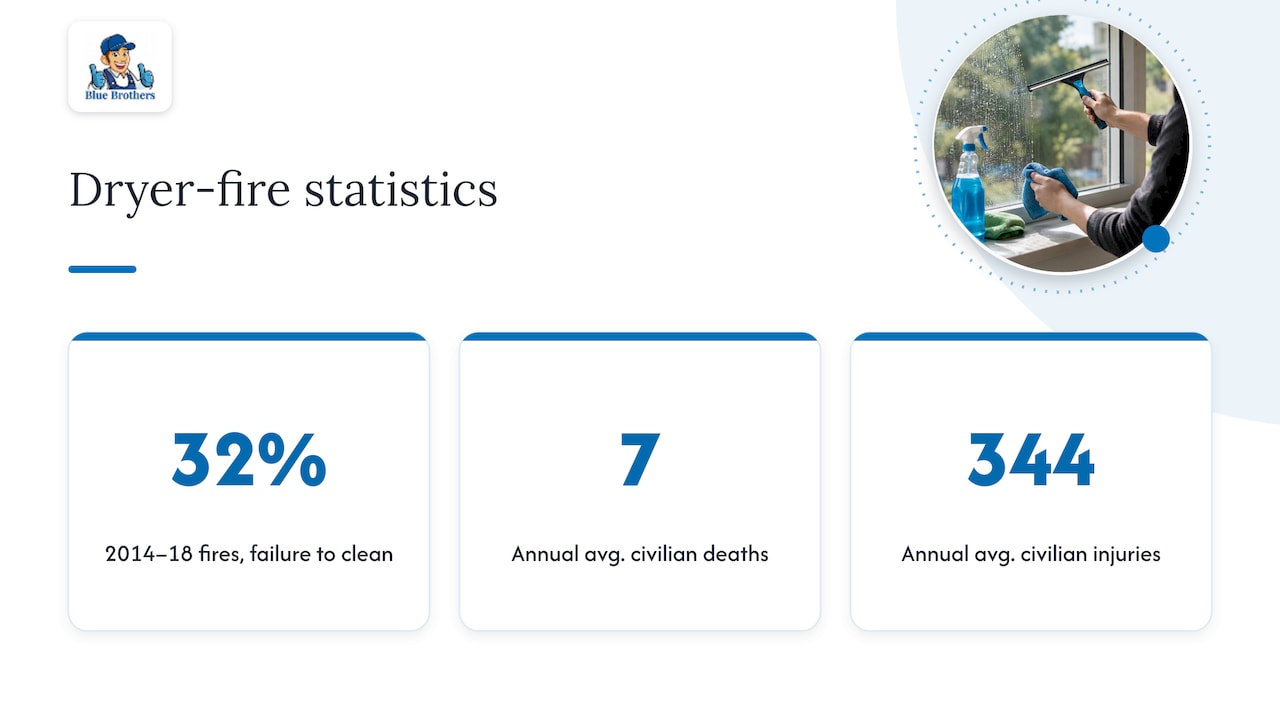
Dryer vents. Many people clean the lint trap and assume the job is done. Fire-safety officials point out that lint also builds up along the vent to the outside, and that clothes taking longer to dry or a dryer that runs very hot are warning signs. The U.S. National Fire Protection Association reports that, in 2014 to 2018, failure to clean was a factor in 32% of home dryer fires, with an annual average of seven civilian deaths and 344 injuries. That is U.S. data, but the physics of lint do not change at the border.
If clothes are taking two cycles, start with our 10-minute checks for a dryer that isn’t drying. If the vent exits on a roof, read about rooftop dryer vent cleaning safety before anyone climbs up.
Foggy windows and dusty rooms. Condensation between panes means a failed seal, and no tool will wipe it away. Persistent dust points to filters, ducts, the furnace or the HRV.
What we offer if you would rather not DIY
If the windows are not your only chore, we can handle the systems that cloths cannot reach. Published one-off price ranges on our site:
| Service | Published price range |
|---|---|
| Dryer vent cleaning | $99 to $225 |
| Air duct cleaning | $400 to $800 |
| Furnace cleaning | $50 to $300 |
| HRV cleaning | $100 to $400 |
| Air conditioning coil cleaning | $100 to $400 |
All prices are in Canadian dollars. Homeowners can start at our residential services page, and property managers can use our commercial duct cleaning service. We also provide grease exhaust and hood cleaning for commercial kitchens. We offer round-the-clock support, including emergencies.
Buying guide: what to look for
Squeegee
- A sturdy handle and a channel that holds the blade firmly.
- A width that suits your windows. Wide blades are quicker on big panes, but narrow ones give more control on small windows.
- Replaceable rubber or silicone blades.
- A washer sleeve or scrubber to go with it, since a clean wet surface is half the result.
Microfiber cloth
- A tight, lint-free weave sold for glass. Waffle-weave towels and plush towels do different jobs.
- Several cloths: one for washing, one for drying and one for buffing.
- Plain colours, so dye does not matter and you can see how dirty the cloth is.
- Clear washing instructions. Remember that quality varies between models.
Common mistakes
- Working in direct sun, so the solution dries before you wipe.
- Using too much soap. Excess leaves film and streaks.
- Skipping the pre-wash on dirty exterior glass.
- Never wiping the blade between strokes.
- Using a cloth that was washed with fabric softener.
- Ignoring the frame and the seals.
FAQ
Is a squeegee better than microfiber for windows?
On large panes, yes. It removes most of the water and dirt in one pass and leaves no lint. Microfiber is better on small panes, mirrors and edges, and most professionals use both.
What can I use instead of a squeegee to clean windows?
A clean, lint-free microfiber glass cloth is the best substitute, ideally one cloth to wash and a second dry one to buff. Avoid paper towels and old cotton rags, which leave lint. Do not use scrapers or abrasive pads on coated or tinted glass.
Is it better to clean with cotton or microfiber?
For most cleaning, microfiber. Lab studies find it removes soil and microorganisms more effectively than cotton cloths, although results vary by cloth and fall with heavy high-heat reprocessing. On glass, cotton also tends to leave lint.
Should I use a microfiber towel or a chamois to dry my car?
Choose a high-weight microfiber drying towel. Detailers warn that a chamois can trap and drag grit across paint, which causes fine scratches. Rinse the car well first and keep the towel clean.
Sources
- Wirecutter: how to clean windows, glass and mirrors
- International Journal of Infection Control: microfiber cloth efficacy
- Hospital Infection Society cloth study (PDF)
- International Window Cleaning Association
- Glass care and cleaning guidance (PDF)
- Ceramic Pro: how to dry your car safely
- Health Canada: improve indoor air quality in your home
- NFPA: home dryer fires (PDF)
- PembinaValleyOnline: dryer vent fire safety reminder