Ducted range hoods win on pollutant removal because they exhaust moisture, heat, and combustion gases outdoors, matching the benchmark Health Canada sets for effective ventilation. A ductless hood is acceptable only for light electric or induction cooking where ducting is physically impossible, since it filters grease and odour but cannot touch combustion byproducts.
TL;DR:
- Aim for capture efficiency of about 80% or higher; measured results range from 17% to 100%, depending on coverage, mounting height, and hood shape.
- Run the fan on high, around 300 CFM, during cooking; Health Canada reports this can reduce pollutant exposure by more than 80% versus slower speeds.
- Start the fan 5 to 10 minutes before high heat cooking and leave it running afterward to improve pollutant capture and clear lingering moisture.
- If ductless is unavoidable, choose a deep, wide hood with recessed filters; its geometry can capture more grease and odor than a shallow, flat profile.
- Route ductwork through a short, straight path to an exterior wall or roof; never terminate it in an attic, where trapped moisture risks mold.
Table of Contents
- How ducted and ductless range hoods work
- Capture efficiency, CFM, and what Canadian research shows
- Installation limits, routing, and what ducting actually takes
- Maintenance, filters, and keeping grease under control
- How to choose: a practical checklist
- When to call a pro for assessment or cleaning
- The hood you’ll actually turn on wins
- Professional hood and grease-exhaust cleaning from Blue Brothers
- FAQ
- Sources
How ducted and ductless range hoods work
A ducted hood pulls air through a filter, then pushes it through ductwork to the outside, carrying grease, odour, steam, and combustion gases away from the kitchen entirely. A ductless (recirculating) hood pulls air through a grease filter and often a charcoal filter, then blows the same air back into the room. That loop is the core limitation: nothing leaves the house.
- Ducted systems remove grease, odour, moisture, heat, and combustion gases such as NO2 and CO.
- Ductless systems capture grease and reduce odour but return moisture and gases to the kitchen.
- Many “convertible” hoods ship ductless-ready but can be converted to ducted if a vent path becomes available later.
The convertible option matters for renovators who are not sure yet whether routing ductwork is feasible. It buys flexibility without locking in the weaker setup permanently.
Capture efficiency, CFM, and what Canadian research shows
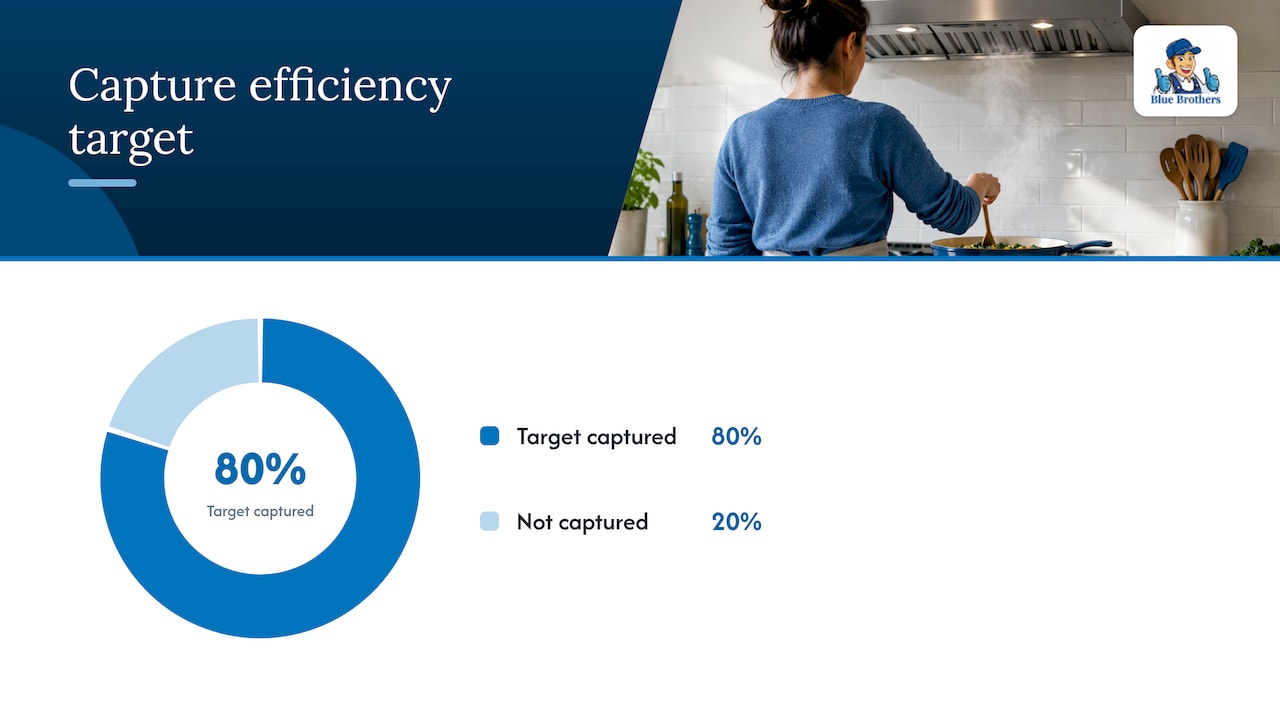
Airflow numbers alone do not tell you how well a hood actually works. Capture efficiency (CE), the share of cooking pollutants a hood actually pulls in rather than lets escape into the room, is the more meaningful measure, and ROCIS guidance recommends aiming for a CE around 80% or higher.
Running exhaust on high, around 300 CFM, can cut exposure to cooking pollutants by more than 80% compared with slower fan speeds, according to Health Canada. That single habit change, speed over convenience, does more for air quality than most hood upgrades.
CE is not fixed by the fan alone. Lab and field work from LBNL research found measured capture efficiency ranging from as low as 17% to as high as 100% depending on:
- Hood overhang and how fully it covers the cooktop and front burners.
- Mounting height, since a hood placed too high loses pollutants to the room before capture.
- Internal volume and geometry, with flat designer hoods and over-the-range microwaves generally performing worse.
Ductless hoods cannot close this gap no matter how good the filter is. They have no mechanism for combustion gases, and grease and charcoal filters lose capacity as they saturate, which drags CE down further over time.
Installation limits, routing, and what ducting actually takes
Ducting has to go somewhere, and where it goes changes both cost and performance. Running the duct through an exterior wall is usually simpler and cheaper than routing it through the roof, and either beats an attic-only termination, which traps moist exhaust air against insulation and framing and invites condensation and mould.
- Prefer a short, straight exterior-wall or roof run over long horizontal routes with multiple turns.
- In cold climates, slope horizontal runs slightly downward and outward so condensation drains away from the fan rather than back into the hood.
- New construction makes ducting far simpler than a retrofit, where routing around joists, cabinetry, and finished ceilings adds real labour.
- External in-line or remote-mounted motors tend to run quieter than a motor housed directly in the hood body.
A kitchen renovation is the easiest point to commit to proper ducting, since the wall and ceiling are already open. Anyone planning a larger remodel around this decision can get a feasibility read from a firm like Y&CO Build, which handles kitchen layout changes and mechanical routing as part of full renovation projects.
Maintenance, filters, and keeping grease under control
Ductless hoods depend entirely on their filters, and those filters wear out. Grease and charcoal filters generally need replacing once or twice a year for average cooking, with heavy frying pushing that toward the more frequent end.
- Ductless charcoal filters lose odour-control capacity gradually and give no obvious warning before they stop working.
- Ducted systems trade filter swaps for duct maintenance, since grease still accumulates inside the ductwork and hood body over years of use.
- Periodic professional duct and hood cleaning keeps capture efficiency high and lowers fire risk from built-up grease.
Pro tip: Start the fan 5 to 10 minutes before high-heat cooking and leave it running after, since early and extended operation measurably improves capture and clears lingering moisture and odour faster.
That timing habit is backed by Canadian survey research on kitchen ventilation use, which found vented hoods were run consistently more often than recirculating ones, and that when the fan runs matters as much as whether it runs at all.
How to choose: a practical checklist
Work through these in order, since each one can rule out an option before you get to the next:
- Fuel type first. Gas burners produce combustion gases a ductless hood cannot remove, so ducting is strongly preferred for gas cooktops; electric or induction cooks have more room to consider ductless.
- Cooking frequency and style. Daily high-heat or frying sessions call for ducted exhaust; occasional light cooking tolerates ductless better.
- Duct path feasibility. Confirm a short, low-turn route to an exterior wall or roof exists before committing to ducted.
- Noise tolerance. If a loud fan means you will not run it, prioritize a quieter motor placement over raw CFM.
- Budget and maintenance willingness. Ducted costs more upfront and needs occasional duct cleaning; ductless needs frequent filter swaps instead.
- Minimum specs. Look for full cooktop coverage, a multi-speed fan with a high setting near 300 CFM for frequent high-heat cooking, and a published capture efficiency or third-party airflow rating when available.
If ductless is the only option, choose a deep, wide hood with recessed filters rather than a shallow, flat profile. That geometry alone can meaningfully improve how much grease and odour actually get captured.
When to call a pro for assessment or cleaning
A professional look makes sense when duct runs are long with multiple turns, when cooking is heavy or frequent, or when you can see grease buildup inside the hood or duct.
- Long or winding duct runs that likely lose airflow between the fan rating and what actually reaches outside.
- Visible grease accumulation in the hood, filters, or visible ductwork.
- Commercial or high-volume kitchens needing exhaust cleaning aligned with NFPA 96 practices.
A proper inspection checks duct length and turns, fan placement, leakage at joints, and grease load, the same factors that determine real-world capture efficiency rather than the number printed on the box. Our grease exhaust and hood cleaning service and air duct cleaning work cover exactly this kind of check.
The hood you’ll actually turn on wins
The best-specified ducted hood only protects your air if you run it. We’d rather see a homeowner choose a slightly smaller, quieter, well-placed hood they use every time than a powerful one left off because it sounds like a jet engine. Coverage, noise, and easy controls decide real-world performance more than any single spec on the label.
— Jayce
Professional hood and grease-exhaust cleaning from Blue Brothers
Once your hood is picked and running, the ducting and grease traps still need upkeep, and that is where we come in. We handle grease exhaust and hood systems cleaning, along with duct assessments that check airflow loss, leakage, and grease buildup along the whole run.

We serve homes and commercial kitchens across British Columbia, Alberta, and Saskatchewan, including local work such as our hood cleaning in Delta and hood cleaning in Dundurn. If your ducted hood has not been inspected in a while or you are planning a retrofit, book a grease exhaust and hood cleaning assessment and get a clear picture of what your system actually needs.
FAQ
What is a ductless range hood?
A ductless, or recirculating, range hood pulls cooking air through a grease filter and usually a charcoal filter, then blows the filtered air back into the kitchen instead of venting it outside. It reduces grease and some odour but leaves moisture and combustion gases in the room.
When is a ductless fume hood the right call?
Ductless setups make the most sense with electric or induction cooktops, light cooking habits, and layouts where running ductwork to the outside is not physically possible. For gas cooking or frequent high-heat meals, a ducted system is strongly preferred because it handles combustion byproducts ductless designs cannot.
Are recirculating cooker hoods worth it?
They are worth it only as a compromise, not as a first choice, since they filter grease and some odour but cannot remove moisture, heat, or combustion gases the way a ducted hood does. Choosing a deep, wide hood with recessed filters and replacing filters on schedule narrows the performance gap but does not close it.
What is the difference between ducted and convertible range hoods?
A ducted hood vents air outside through fixed ductwork from day one, while a convertible hood starts out recirculating air through filters but can be switched to ducted later if a vent path becomes available. Convertible models give renovators flexibility when duct routing is undecided at purchase time.
Sources
- Canada
- Residential cooking and use of kitchen ventilation: The impact on exposure (Journal article)
- ROCIS ducted range recommendations (Dec 2019 update)