Most restaurant hood noise traces back to grease-clogged filters or fan wheels, loose mountings, duct turbulence, or worn motor bearings. If you hear grinding, power the unit off right away. Otherwise, pull the filters and listen for a change: that single step often confirms grease buildup or a loose part before you spend money on repairs.
TL;DR:
- Grinding, sparking, smoke, or a burning smell requires shutting the hood off at the breaker and arranging professional service before restarting it.
- Rattling that changes with fan speed often signals loose hardware or a grease coated wheel, while whistling points to restricted or undersized ductwork.
- Before calling a technician, inspect the filters, clean the fan wheel and housing, tighten visible fasteners, and check flexible ducts for kinks.
- Check filters daily, clean accessible fan parts weekly, and inspect the wheel, belts, and mounting hardware monthly; log amp readings and changing sounds.
- Investigate identifiable workplace sources around 80 to 90 dBA; the eight hour exposure limit is 87 dBA, and persistent vibration warrants professional assessment.
Table of Contents
- Identify the noise: sound signatures and what each usually means
- Quick diagnostics and low-cost fixes you can try today
- Routine maintenance and cleaning schedule that keeps noise down
- Technical and design causes: velocity, static pressure, and vibration
- Safety, compliance, and when to escalate to a professional
- How professional hood and grease-exhaust cleaning removes noise at the source
- Balancing quieter operation with ventilation and fire safety
- How we help restaurants quiet their exhaust systems
- FAQ
- Sources
Identify the noise: sound signatures and what each usually means
The sound your hood makes is the fastest diagnostic tool you have, and matching it to a likely cause saves you from replacing parts that were never the problem.
- Rattle or buzz that shifts with fan speed usually points to loose hardware or an unbalanced fan wheel caked with grease.
- Grinding or screeching signals motor or bearing wear and is a safety concern that warrants shutting the unit down.
- Whistling or whooshing at high speed often means a duct restriction: a crushed flex run, an undersized duct, or a stuck external flapper.
- A low-frequency rumble tends to come from turbulence, a fan running well off its efficient operating range, or vibration transmitted through the structure itself.
A quick way to narrow things down: cycle through fan speeds and note whether the noise scales with speed (mechanical or airflow) or stays constant (structural). Press gently on the canopy or duct housing: if the sound changes, you’re dealing with a loose or resonating panel rather than the fan itself. The Canada Occupational Health and Safety Regulations note that distinguishing airborne, structure-borne, and regenerated noise matters because each needs a different fix, and chasing the wrong one gets expensive fast.
Quick diagnostics and low-cost fixes you can try today
Before calling anyone, run through this sequence. It takes most operators under an hour and resolves a large share of noise complaints on its own.
- Switch the unit off at the breaker if you hear grinding, sparking, or smell anything burning.
- Remove the grease filters and inspect them for saturation; hold one up to a light source and if you can’t see through it, it needs a deep clean or replacement.
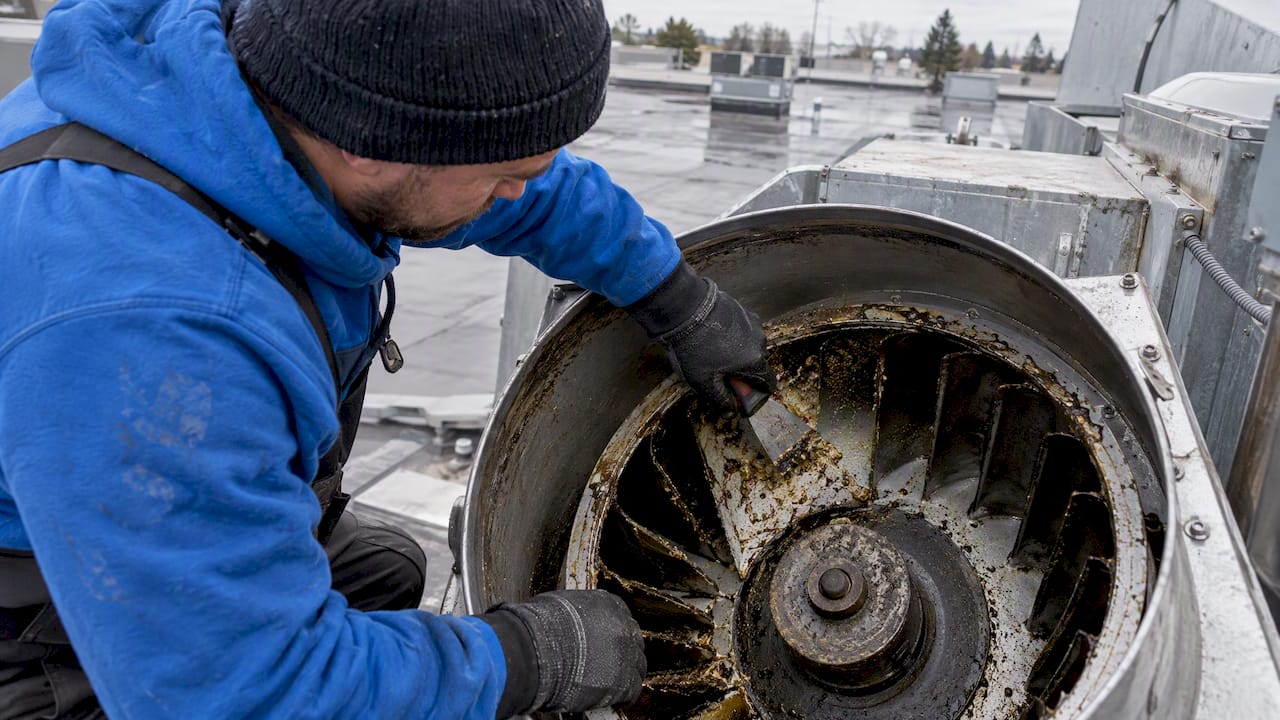
- Degrease the fan wheel and the filter housing; built-up grease is one of the most common causes of imbalance noise.
- Tighten any visible fasteners, mounting bolts, and access panel screws, since loosened hardware vibrates audibly at speed.
- Check flexible duct runs for kinks or crush points, and reseat or swap in rigid duct wherever flex has collapsed.
According to Appliance Journal, most noisy hood calls resolve with cleaning and simple fixes like degreasing fan blades, clearing filters, and tightening fasteners, with motor bearing wear showing up less often and worsening gradually rather than appearing overnight.
If the noise persists after these steps, record a short audio clip at each fan speed before your service call. Note when the noise started, whether it changes under light pressure on the housing, and which speed setting makes it worst. Technicians use this to shortcut the diagnosis rather than starting from scratch.
Pro Tip: Label your audio clips with the fan speed and date, and send them ahead of the appointment so the technician arrives with a working theory.
Routine maintenance and cleaning schedule that keeps noise down
A consistent cleaning cadence prevents the grease buildup and filter choke that cause most of the noise complaints covered above.
- Daily: a quick visual filter check during opening or closing.
- Weekly: degrease accessible fan parts and filter housings.
- Monthly: a deeper inspection of the fan wheel, belts, and mounting hardware.
- Quarterly: access panel inspection and duct interior cleaning as buildup requires.
Technicians performing this work should log fan motor amp draw, visual wheel balance, belt condition, and any noise observations at each visit, since that record makes the next inspection faster and flags gradual wear before it becomes a breakdown. A kitchen that keeps to this schedule, rather than one booking on an as-dust-appears basis, tends to avoid both the noisiest failures and the fire risk that comes with neglected grease exhaust, which NFPA 96 sets standards around for commercial kitchen ventilation and grease removal devices.
Technical and design causes: velocity, static pressure, and vibration
Some noise problems aren’t about dirt or loose bolts. They’re built into how the fan and duct system were sized and installed.
- Operating point matters. A fan running well away from its rated peak efficiency generates more low-frequency noise and turbulence, so selecting or adjusting a fan to run near its rated point reduces acoustic output, per ASHRAE’s chapter on noise and vibration control.
- Duct velocity and sizing affect sound. Many commercial designs target roughly 1,200 to 1,800 fpm to balance grease transport against noise, and pushing well past that range increases turbulence, noise, and vibration fatigue on the ductwork.
- Vibration transmission differs from aerodynamic noise. A hum that travels through the building frame calls for isolation mounts or wheel balancing, while a whistle or roar tied to airflow usually needs duct redesign instead.
- Acoustic silencers are risky in grease-laden exhaust. Fibrous internal silencers foul with grease and become a fire hazard, so outdoor sound curtains or mechanical and flow corrections are the safer route for rooftop or sidewall fans.
Fans with similar aerodynamic performance can still have very different sound output, so comparing manufacturer sound-power data before any replacement or redesign is worth the extra step.
Safety, compliance, and when to escalate to a professional
Noise is also a workplace exposure issue, not just a comfort one. The Canada Occupational Health and Safety Regulations recommend investigating any identifiable source producing roughly 80 to 90 dBA, with an 8-hour exposure limit (L ex,8) set at 87 dBA, and employers are expected to favour engineering fixes over hearing protection alone.
Escalate to a professional immediately if you notice:
- Grinding, sparking, or smoke coming from the motor housing.
- Vibration that persists after cleaning and tightening everything accessible.
- Visible shaft play, oil leakage, or a sudden change in motor amp readings.
Before the appointment, gather amp readings if you have them, your audio clips, the date filters were last changed, and the last professional service date. Having that on hand, alongside guidance from a permitting checklist for ventilation projects if a duct redesign is on the table, speeds up diagnosis considerably.
How professional hood and grease-exhaust cleaning removes noise at the source
A proper grease exhaust and hood cleaning service goes further than a filter swap. It reaches the fan wheel itself, strips grease from duct interiors, and clears grease trap and drain points that trap buildup out of easy reach. Removing that accumulated weight restores wheel balance and airflow at once, which is usually what eliminates the rumble or rattle a kitchen has been living with for months. A thorough visit also leaves an inspection report noting wear worth watching, so the next cleaning cycle starts from a known baseline rather than guesswork.
Balancing quieter operation with ventilation and fire safety
Quiet is never the goal on its own. A hood that’s gone silent because someone throttled the fan or blocked a duct is a bigger risk than one that’s loud but moving air properly. Clean first, check fan and duct function second, and treat acoustic add-ons as a last resort once a professional has confirmed nothing underneath needs attention.
— Jayce
How we help restaurants quiet their exhaust systems
We clean grease exhaust and hood systems to NFPA 96 expectations, with certified technicians who reach the fan wheel and duct interior most routine cleanings skip. 
That depth is usually what restores quiet operation and full airflow at the same time, backed by an inspection report so you know what to watch before the next visit.
| What you get | Detail |
|---|---|
| Service | Grease Exhaust & Hood Systems |
| Price | Current prices are available on our pricing page |
| Support | Emergency response options available |
Request a quote and we’ll get your hood running quiet and compliant again.
FAQ
Should my fan be making noise?
A healthy exhaust fan runs with a steady, low airflow sound and no grinding, rattling, or whistling. Any new or changing noise usually signals grease buildup, a loose part, or a duct or motor issue worth checking right away.
Is 60 dB loud for a range hood?
A range hood running at a relatively low noise level is on the quieter end for commercial equipment and generally isn’t a concern on its own. Canada’s workplace guidance recommends investigating sources in the 80 to 90 dBA range, well above typical hood operating noise.
Is it okay to leave the kitchen exhaust fan on all the time?
Running the exhaust fan continuously during service hours is standard practice and supports consistent grease and heat removal. Outside active cooking, cycling it off when not needed reduces unnecessary wear on the motor and bearings.
How do I reduce exhaust fan noise?
Start by cleaning grease filters and the fan wheel, then tighten any loose mounting hardware, since these two steps resolve most noise complaints. If noise continues, check duct runs for kinks or restrictions, and have a technician evaluate fan operating point or vibration isolation.
Sources
- Levels of sound – Canada Occupational Health and Safety Regulations, Part 7 – IPG-074
- ASHRAE Handbook chapter — Noise and vibration control (chapter 49)
- Restaurant kitchen exhaust fan – Hood noise – eNoiseControl