Yes, most hard water stains come off with a 50:50 white vinegar and distilled water soak, though the toughest ones need stronger chemistry or a professional polish. Start there before reaching for anything abrasive. If the marks stay put after that first vinegar treatment, you’re likely dealing with bonded mineral scale or early etching, and that changes your next move entirely.
TL;DR:
- Cleaning most hard water stains on windows typically begins with a vinegar and water soak, but bonded mineral scale may require stronger chemistry or professional polishing.
- The severity of stains can be assessed with a wet test and a vinegar test, helping determine whether simple removal methods are sufficient or if etching has occurred.
- DIY removal options are ordered by strength, with vinegar soaking for level 1 to 2 stains, baking soda paste for resistant deposits, and professional-grade removers or steel wool as last resorts.
- Avoid jumping straight to abrasive tools or strong chemicals without proper testing, as they can cause permanent damage to etched or coated glass.
- Preventative measures, like squeegeeing after rain or irrigation and applying hydrophobic coatings, save time and reduce the need for repeated deep cleaning.
Table of Contents
- What causes hard water stains on windows?
- How do you test how bad the stains really are?
- What DIY methods actually remove hard water residue?
- When should you stop and call a professional?
- How do you stop hard water stains from coming back?
- Are there eco-friendly ways to deal with hard water residue?
- Why most homeowners tackle hard water stains in the wrong order
- Book a professional window cleaning when the vinegar test says stop
- Sources
- FAQ
What causes hard water stains on windows?
Hard water stains are mineral deposits left behind when water evaporates off glass and leaves calcium and magnesium carbonate stuck to the surface. Canada’s own drinking water guidelines break hardness into bands: soft water sits under 75 mg/L of calcium carbonate, moderately hard runs 75 to 150 mg/L, hard water covers 150 to 300 mg/L, and anything above 300 mg/L counts as very hard, according to Health Canada’s operational water quality guidelines. The harder your local supply, the faster spots build up.
Left alone long enough, those deposits stop sitting on top of the glass and start bonding into microscopic etching, which is a different problem entirely (more on that below). A few sources feed this cycle more than others:
- Lawn sprinklers hitting windows on a regular cycle
- Roof or gutter runoff dripping down exterior panes
- Splashes from an outdoor tap or hose bib
- Condensation on cold glass mixing with dust and minerals
How do you test how bad the stains really are?
Two quick tests tell you almost everything you need to know before you buy a single product. Run them in order, because skipping straight to scrubbing wastes time and risks scratching glass that would have come clean with the right chemistry.
- The wet test. Splash clean water on the stained area and look at it while it’s still wet. If the spot fades or disappears, you’re dealing with a surface deposit that will respond to cleaning. If it looks exactly the same wet or dry, the glass may already be etched rather than just coated.
- The vinegar test. Mix equal parts white vinegar and water, apply it to a small section, and let it sit for five to ten minutes. Watch for fizzing or a visible lightening of the stain.
Use a simple 1 to 4 scale to decide what happens next: level 1 is light haze that lifts with vinegar alone; level 2 is moderate buildup that needs a stronger acid or paste; level 3 is bonded scale that barely responds even after repeated treatment; level 4 is true etching, where the glass itself has been chemically altered.
Pro Tip: Test on a small, low-visibility corner first. Some tinted or coated glass reacts differently to acid than plain float glass, and you want to find that out on a two-inch patch, not the whole pane.
What DIY methods actually remove hard water residue?
Work through these in order of strength. Jumping to the harshest option first is how people end up with swirl marks they can’t undo.
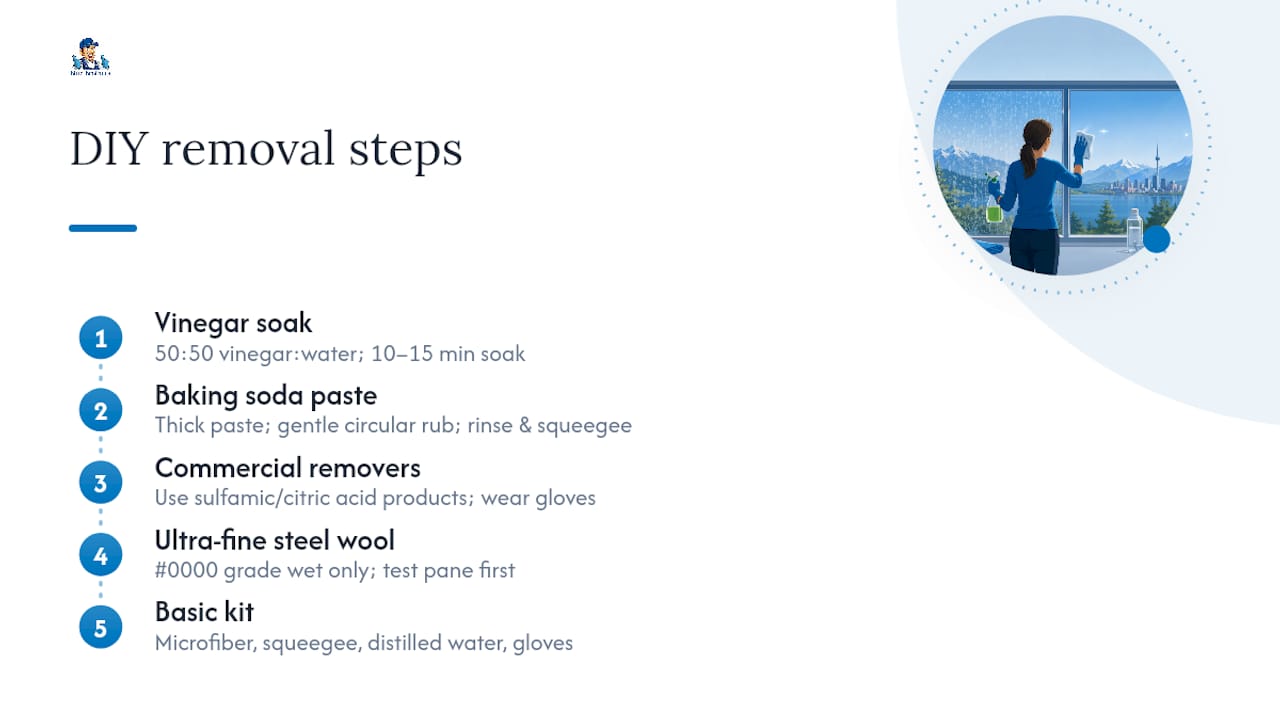
Vinegar soak (level 1 to 2 stains). Mix a 50:50 solution of white vinegar and water in a spray bottle, saturate the stained glass, and let it sit for 10 to 15 minutes so the acid has time to dissolve the mineral film, a method backed by longstanding DIY cleaning protocols. Wipe with a microfiber cloth, then rinse thoroughly with distilled water and squeegee dry immediately. Skipping the distilled rinse is the single most common mistake here: tap water just re-deposits the same minerals you spent ten minutes removing.
Baking soda paste (level 2 stains that resist vinegar alone). Mix baking soda with a small amount of water until it forms a thick paste, not a runny one. Apply with a soft cloth in gentle circular motions, let sit briefly, then rinse and dry the same way. A paste that’s too wet just slides off the glass without doing any work.
Commercial hard water removers (level 2 to 3 stains). Look for products with sulfamic acid or citric acid on the label, since these dissolve mineral scale without the strong fumes of harsher acids. Wear rubber gloves and eye protection, check the label against your window frame material, since some removers attack aluminum or vinyl seals, and never let the product pool at the frame’s edge.
Ultra-fine steel wool (level 3 only, and only after testing). This is the last resort, not a starting point. Trade suppliers are clear that only #0000 grade steel wool, used wet with a lubricant like soapy water, is safe on glass, and even then only after you’ve confirmed the pane isn’t tinted or fitted with a vulnerable coating, per trade guidance on abrasive use. Anything coarser risks permanent scratches.
Keep a simple kit on hand: microfiber cloths, a squeegee, distilled water, rubber gloves, a plastic bucket, and a soft non-scratch scrub pad. That covers every method above without a specialty purchase.
When should you stop and call a professional?
Some signs mean it’s time to hand the job off rather than keep experimenting. Call a professional when:
- The vinegar test produces no change at all after two attempts
- The glass feels smooth to the touch but still looks cloudy or hazy
- You’re dealing with second storey windows, skylights, or anything requiring a ladder you’re not comfortable on
- The window is tinted, laminated, or has a specialty coating that might react badly to acid or abrasives
Professionals differ from DIY in two important ways. First, they finish every job with a deionized or pure water rinse, which eliminates the minerals in tap water that would otherwise redeposit and cause the same haze to return within weeks. Second, they can judge the difference between removable deposits and true etching, and when polishing is warranted, they use controlled compounds like cerium oxide rather than household abrasives. Costs vary by window count, height, and stain severity, but professional restoration is almost always cheaper than replacing an etched pane.
How do you stop hard water stains from coming back?
Prevention costs less time than repeated deep cleaning, and most of it comes down to habit rather than product. Adjust sprinkler heads so they don’t spray directly onto glass, and squeegee windows after any heavy rain or irrigation cycle rather than letting water evaporate on its own.
A rough maintenance rhythm works for most homes: check windows every two to six weeks depending on how exposed they are to sprinklers, splashback, or condensation. Homes with very hard water or heavy irrigation exposure sit at the shorter end of that range.
- Squeegee glass immediately after any wet event instead of letting it air dry
- Apply a hydrophobic glass repellent or professional coating to make future water bead and run off rather than sit and evaporate
- Consider treating the water source itself with a softener or filtration system if scale is a recurring issue across your whole property, not just your windows, an option worth exploring through a residential water treatment provider like Pure Wave Water
- Always finish any cleaning session with a distilled or deionized water rinse, then dry immediately, since air-drying tap water is what causes new spots in the first place
Pro Tip: A cheap squeegee used weekly does more to prevent hard water stains than any cleaner does to remove them. Prevention is the easier half of this job.
Are there eco-friendly ways to deal with hard water residue?
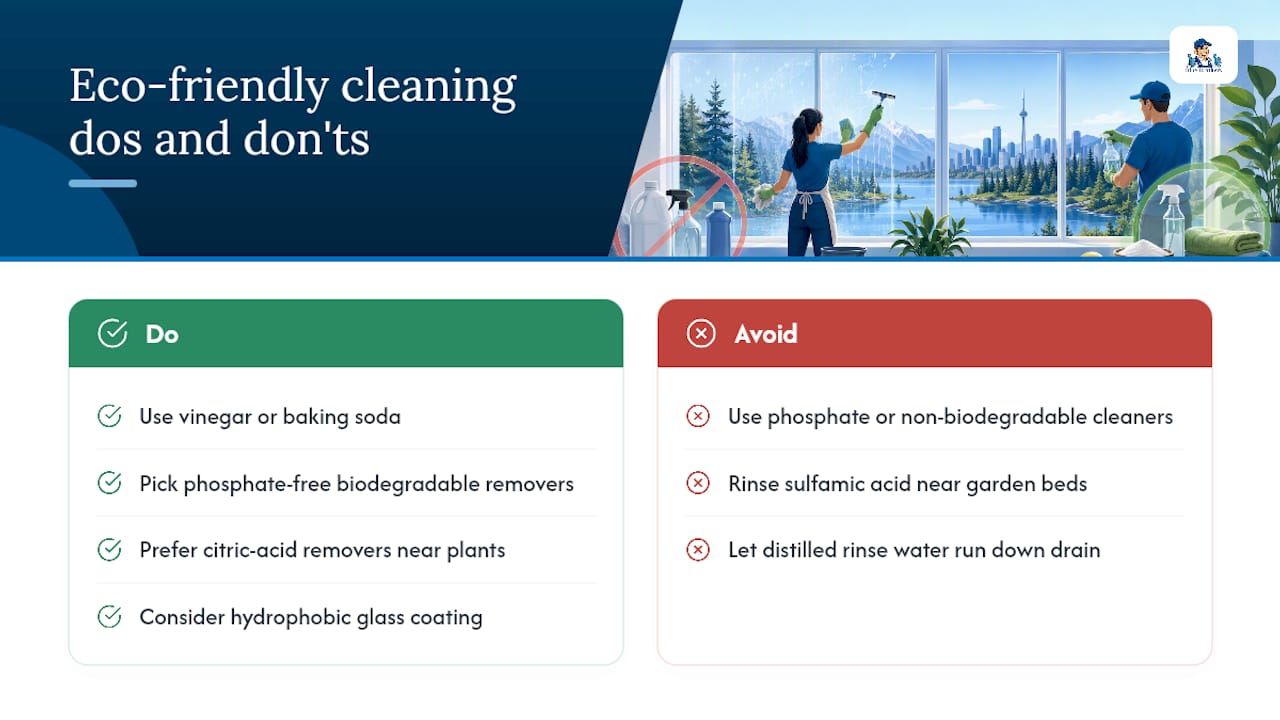
Vinegar and baking soda are already about as environmentally low-impact as window cleaning gets. Both break down completely, carry no toxic runoff concerns, and don’t require any special disposal, which makes them a sensible default before reaching for a commercial product.
When a stronger commercial remover is genuinely necessary, look for ones labelled phosphate-free and biodegradable, since standard household drains eventually connect to municipal treatment systems or septic fields that handle simple acids far better than synthetic surfactants. Citric acid based removers tend to be gentler on surrounding plants and soil than sulfamic acid versions if you’re rinsing runoff near a garden bed.
The bigger environmental win, though, is on the water side rather than the cleaner side. Every time you avoid a fresh mineral deposit, you avoid the vinegar, paper towel, or scrubbing session it would have taken to remove. A hydrophobic glass coating that keeps water beading and running off, rather than sitting and evaporating, cuts down on both cleaning frequency and product use over the life of the coating. Treating hardness at the source with a softener has a similar effect across a whole property, since it reduces scale buildup in appliances and fixtures at the same time it reduces window spotting, an angle worth considering if you’re already frustrated by how often you’re outside with a spray bottle.
Distilled water for rinsing is reusable if you catch it in a bucket rather than letting it run down the drain, and it’s a small habit that stretches a jug further than most people expect.
Why most homeowners tackle hard water stains in the wrong order
The biggest mistake we see isn’t choosing the wrong product. It’s skipping the test phase entirely and going straight to the strongest thing in the cupboard, usually because a spot looks stubborn and patience runs thin. That instinct is understandable and almost always counterproductive.
Etched glass and coated-with-mineral-deposit glass look nearly identical to an untrained eye, but they demand opposite responses. Scrubbing an etched pane with steel wool doesn’t fix anything, since etching is chemical, not superficial, and mechanical force just adds scratches on top of damage that’s already permanent. Meanwhile, plenty of people give up on a removable deposit after one weak wipe with a dry paper towel, convinced their windows are “just like that now.” Professionals handling exterior glass across multiple provinces see both mistakes constantly, and the fix for each is the same: test before you escalate, and know the difference between a stain you can dissolve and one you can only polish out.
— Jayce
Book a professional window cleaning when the vinegar test says stop
If your windows tested at level 3 or higher, sit two storeys up, or you’d rather not spend a Saturday on a ladder with vinegar and a squeegee, Blue Brothers handles exactly that job. Our window cleaning services across British Columbia, Alberta, and Saskatchewan cover everything from routine seasonal cleans to stubborn deposit removal on high or hard to reach glass, using deionized rinses and trained technicians rather than trial and error.
Booking starts with a free estimate: a technician looks at the actual severity of your stains, tells you honestly whether it’s a cleaning job or a restoration job, and quotes accordingly before any work begins. Since window buildup often shows up alongside other maintenance needs, like clogged gutters or a furnace overdue for a check, it’s worth browsing our home maintenance services at the same time and bundling the visit. Request your free window cleaning estimate today and skip the guesswork on whether your glass can still be saved.
Sources
- How to remove water spots from windows and mirrors (Hillyard)
- Steel wool product and trade guidance (Window Magic Supply)
- How to clean hard water spots off windows (WikiHow)
FAQ
How do you get hard water stains off windows?
Soak the glass with a 50:50 mix of white vinegar and water for 10 to 15 minutes, wipe with a microfiber cloth, then rinse with distilled water and dry immediately to stop new spots from forming. If that doesn’t fully clear it, move up to a baking soda paste or a commercial sulfamic acid remover before considering any abrasive.
Are hard water stains permanent?
Not usually. Most are removable mineral deposits, but if a stain shows no change during a wet test or vinegar test, the glass may be etched, which means the surface itself has been chemically altered and typically needs professional polishing rather than cleaning.
Does Dawn dish soap and vinegar remove hard water stains?
Dish soap alone won’t dissolve mineral scale since it’s not acidic, but vinegar is what does the actual work. A small amount of dish soap mixed into a vinegar solution can help cut through grease or dust sitting on top of the mineral layer, making the vinegar’s job easier.
How do you get years of buildup off glass?
Years of accumulated hard water residue usually means level 3 or 4 severity, where household vinegar alone won’t cut it. Try a commercial sulfamic acid remover first, and if that fails, book a professional who can assess whether the glass needs restoration polishing through Blue Brothers’ window cleaning services rather than risk scratching it with abrasives.